TiLDA
EMF 2012 radio-enabled badge
The first EMF electronic badge, designed around wireless communication, Arduino-style hacking, and camp game mechanics.
Tag dossier
Badge records tagged with Arduino, across Australia, Belgium, Brazil, Dominican Republic, France, Japan, Kenya, Mexico, Puerto Rico, Singapore, Thailand, United Kingdom, United States.
EMF 2012 radio-enabled badge
The first EMF electronic badge, designed around wireless communication, Arduino-style hacking, and camp game mechanics.
Assemble-and-hack Black Badge challenge
A limited collector badge and hardware-hacking challenge from Nuit du Hack 2014, with public challenge rules, writeups, and a Virtualabs repository.
Arduino-clone badge with FTDI header, blinky expansion board, and hidden challenges
The SAINTCON 2014 badge was an Arduino-compatible conference badge designed for attendee soldering and badge hacking, with FTDI programming, LED blinky behavior, a companion blinky expansion board, and hidden Hacker Challenge secrets documented in first-hand and Hackaday coverage.
Japanese ATmega328P LED attendee badge
AVTOKYO's official 2015 badge page says the conference made an electrical badge for attendees, with an AT-MEGA328P-PU, eight 5mm LEDs, two push buttons, 16 MHz crystal, resistors, capacitors, IC socket, coin-cell holder and battery, public KiCad PCB design, and public Arduino program.
Home-made Arduino badge with conference schedule display
BSides Canberra 2016 is represented by official event context and a contemporary Register report saying delegates received a home-made Arduino badge that displayed the conference running order.

Arduino-compatible AVR camp badge with IR play
A custom Fri3d Camp badge derived from Arduino Micro-era hardware, designed for roughly 300 attendees as both a beginner-friendly badge and a reusable Arduino development board.
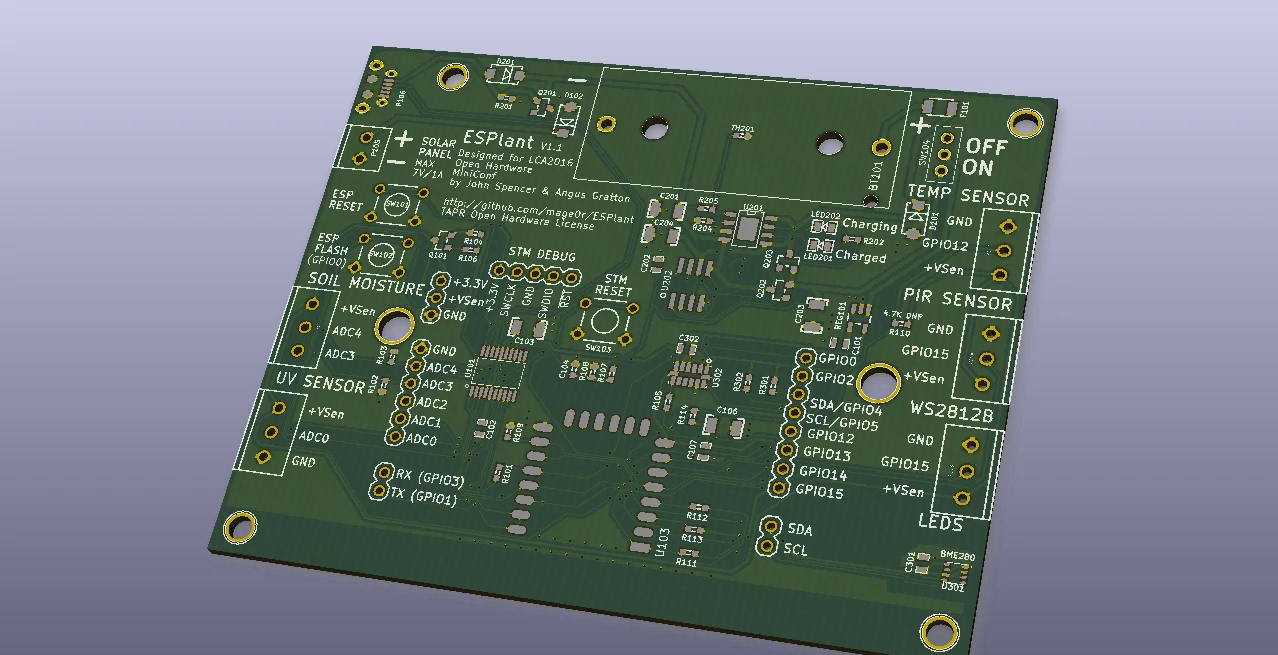
ESP8266 environmental-sensor board for the linux.conf.au Open Hardware Miniconf
linux.conf.au 2016's Open Hardware / Arduino Miniconf produced ESPlant, an ESP8266 WiFi environmental-sensor board with solar-friendly power, onboard sensors, optional external sensors, Arduino firmware, and public hardware files.
Kenyan ESP8266 OLED MQTT conference badge
A limited-run AfricaHackOn 2017 electronic conference badge built around an ESP8266-01, 0.96-inch 128x64 I2C OLED display, LEDs, resistors, hand-built mounting-board construction, Arduino firmware, WiFi scanning, and MQTT schedule updates.
ATTiny85 USB HID injector badge
A small H2HC 2017 badge built around an ATTiny85 USB-stick module for USB HID keyboard-injector experiments, Micronucleus bootloader flashing, and Arduino IDE workshop-style payload development.
Bottle-shaped ESP32 BLE and OLED badge
A small-batch H2HC 2018 bottle-shaped PCB badge with an ESP32 WROOM, I2C OLED display, six controllable LEDs, BLE behavior, AAA or USB power, and Arduino IDE source-code notes.
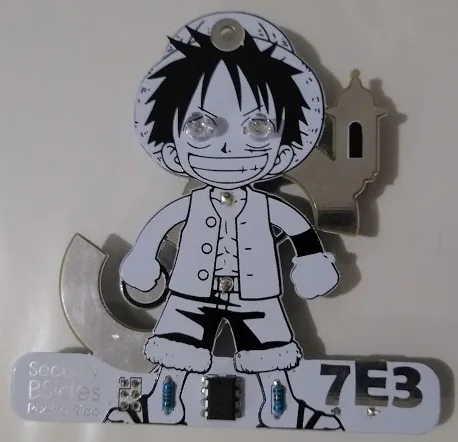
ATtiny13A solder-and-program participant badge
BSides Puerto Rico 2019's badge is preserved as a DIY participant kit: an easy-through-hole electronic badge built around an ATtiny13A, two red/blue LEDs, two 680 ohm resistors, a slide switch, CR2032 power, public Gerbers, KiCad files, Arduino sample code, and real assembled-badge photos.
Arduino-compatible badge with games, base-station laser tag, and C interpreter
HackRVA's RVAsec 8 badge post documents the 2019 conference badge as a custom Arduino-compatible layout with games, Badge Monsters, Maze, base-station Laser Tag, a scoreboard plan, and a public Dustin Firebaugh C-interpreter repository.
DePaul IRL ESP32 badge with capacitive pads, LEDs, speaker, and microphone
The THOTCON 0xA / Infinity badge was a Chicago electronic conference badge produced with DePaul's Idea Realization Lab for the May 3-4, 2019 event. DePaul Newsline reported a six-month, 1,700-unit custom circuit-board badge build; the public Poplicola repository documents a SparkFun ESP32 Thing Dev base, five capacitive touch pads, six LEDs, speaker output, microphone input, stock-firmware restore commands, and Arduino examples.
Resistance-themed ESP32-S3 and RP2040 official badge
BugCON 2023's Electronic Cats repository documents the official resistance-themed BugCON 2023 badge with an ESP32S3 or RP2040 platform statement, UART, Bluetooth and Wi-Fi on ESP32S3, AA battery support, public Arduino firmware, GPL-3.0 software licensing, CERN-OHL v1.2 hardware licensing, and KiCad hardware source.
ESP32-C3 BLE rock-paper-scissors conference badge
Somerset Recon's post-event source archive says 400 badges were distributed at BSides San Diego 2024. It documents a custom ESP32-C3 conference board with a Bluetooth LE rock-paper-scissors game, high-level Wargames-themed UART and SAO CTF context, and KiCad, Gerber, BOM, and Arduino-style source material. The README also distinguishes the conference units' earlier firmware from later archived source behavior.
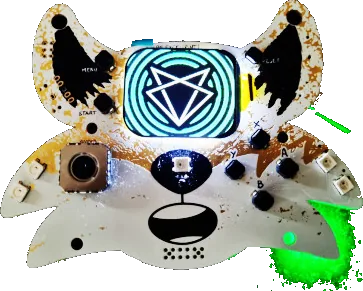
ESP32-S3 badge with blaster and communicator add-ons
A Fri3d ESP32-S3 badge with LCD, joystick/buttons, SD card, USB-C, LiPo power, MicroPython/Arduino docs, and blaster/communicator add-ons.
Raspberry Pi Pico fault-injection village device
A conservative Badge Village artifact record for HITBSecConf2024 Bangkok, where the official village page documented a specialized Raspberry Pi Pico-based device for controlled fault-injection experiments against embedded systems.
First official Dominican Republic badgelife badge
HackConRD 2024's first official badge was an ATTiny85-based electronic conference badge documented by a public repository and workshop writeup, with lanyard wear, challenge/hidden-feature firmware, serial reprogramming, aRGB LED expansion, buzzer output, and KiCad manufacturing-file evidence.
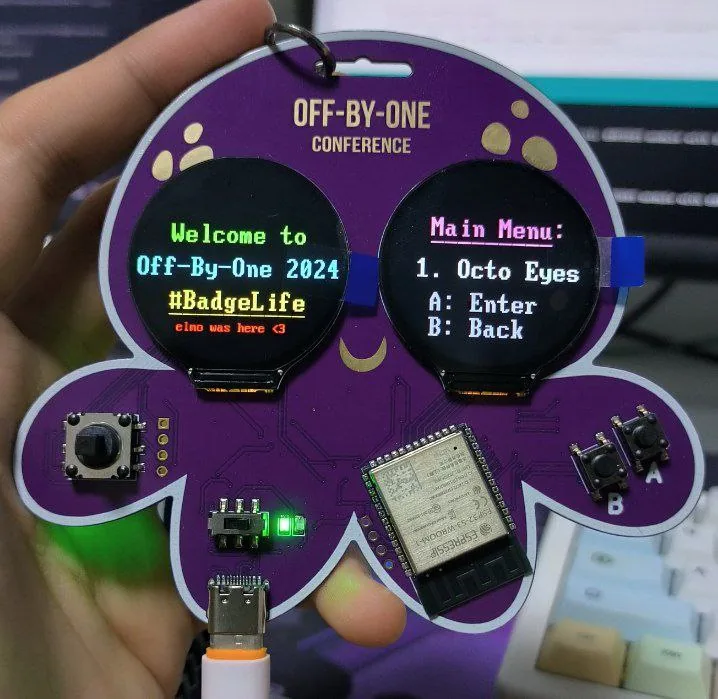
Singapore dual-screen Octopus badge
Off-By-One Conference 2024 used an Octopus-themed hardware badge with ESP32-S3 and ATmega328P controllers, dual 128x128 GC9A01 round LCDs, IR, WS2812 LEDs, buttons, a user-flashable MicroPython challenge surface, and six published challenge flags.
Maker-published one-off ESP32 badge-challenge device
A source-bounded independent BSides Peoria 2025 challenge-badge dossier. Technet8394's event-period public HackTheBadge README calls the work "My ESP32 code for the BSides Peoria Badge Challenge 2025." Its later source release documents an ESP32, a 240×320 ILI9341 TFT panel, two batteries, and wiring. BSides Peoria's official 2025 announcement establishes the October 25 Bradley University event, and its 2026 organizer retrospective says the prior edition drew nearly 350 people and had electronic badges. No reviewed organizer source links this specific maker project to a main attendee badge, official issuance, or completed handoff, so the catalogue keeps it as an independent event-associated challenge device.
Attendee-assembled ESP32 DevKit / 1.8-inch TFT challenge badge
The public BSides Perth 2025 badge archive and its assembly documentation identify a physical, attendee-assembled custom-PCB artifact built around an ESP32 DOIT DevKit v1, 1.8-inch LCD TFT, four tactile buttons, headers, and Micro-USB power. The archive also documents a virtual companion and challenge context, but it was published in September-October 2025 and does not prove that every event attendee received the same physical configuration.
Independent ESP32-S3 Wi-Fi monitoring and foxhunt badge sold for DEF CON 33
HackMy*'s maker storefront labels GigaGeiger a Wi-Fi badge for DEF CON 33 and shows a USD 120 price with a sold-out-since-August 6, 2025 state. The same listing describes a retro Geiger-counter-inspired device with a single rotary dial for 2.4 GHz channel monitoring, MAC-address foxhunting, and browser-based firmware flashing; it says the product shipped with a lanyard and batteries. Its linked public Penzz-HM repository publishes an MIT-licensed Arduino/C++ implementation for an ESP32-S3-WROOM, GC9A01 display, rotary input, Wi-Fi scanning, promiscuous-mode packet counting, RSSI tracking, and a local web updater, plus firmware binaries, Gerbers, and enclosure STL files. A separately published GigaGeiger PCB project on PCBWay is dated June 25, 2025, names Matt Wagner, provides Gerbers, and is marked CC BY-SA. These sources establish a real independent 2025 BadgeLife artifact and a public design trail, not official DEF CON issuance, admission, a completed event handoff, a complete electrical specification, universal radio/OTA safety, or a rights-cleared hero image.
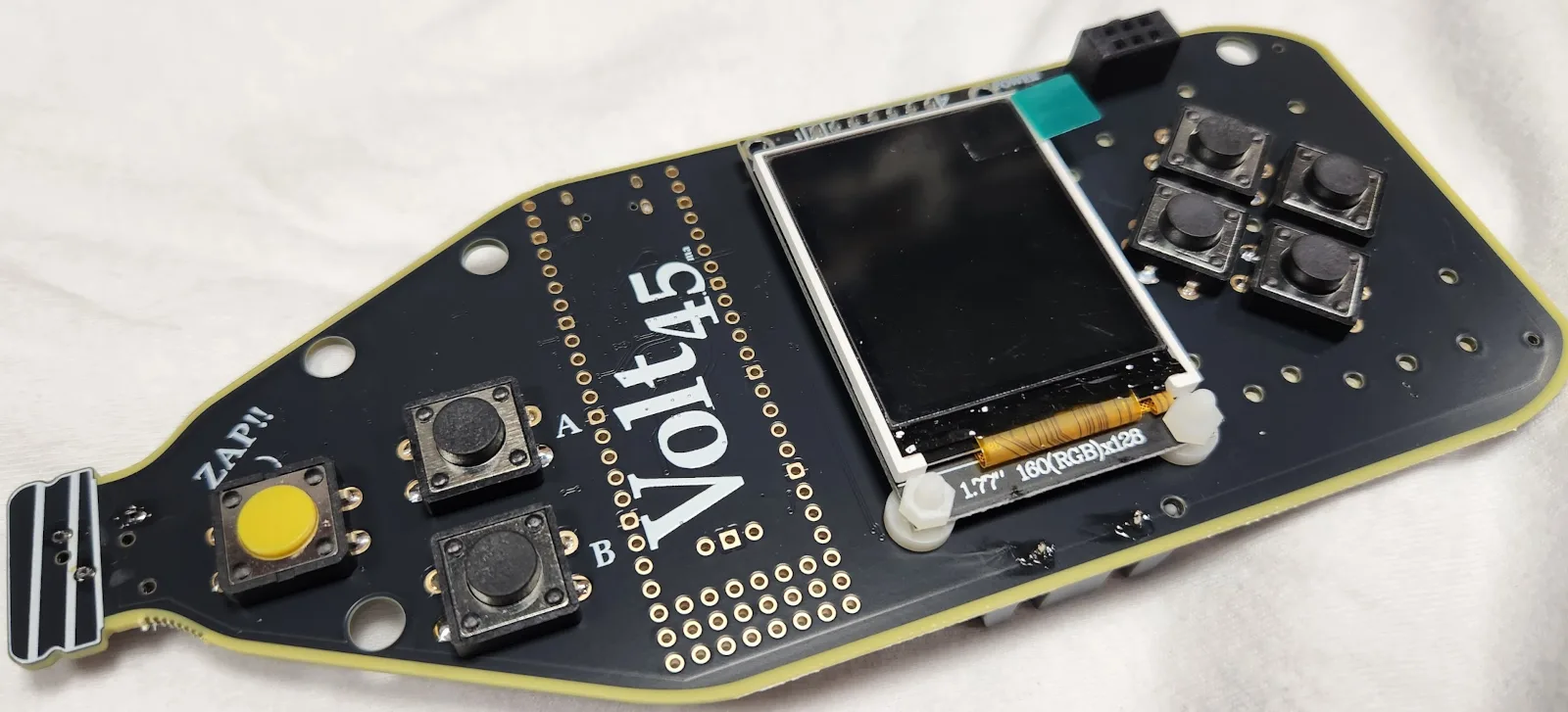
RP2040 galvanic-vestibular badgelife badge
The Tipsy Badge was an independent DEF CON 33 electronic badge by seeess, sold at the Hacker Warehouse vendor booth, with public CC BY-NC 4.0 repository documentation, firmware, a badge photo, 2xAAA power, RP2040 control, TFT display, buttons, LEDs, SAO port, custom photo storage, and galvanic vestibular stimulation modes.
Independent brass Coin M0 text-adventure and CircuitPython eChallengeCoin planned for DEF CON 34
AoSC's 2026 eChallengeCoin page describes a planned limited run of 40 brass electronic coins, framed as gifts for participants in its Choose Your Own Charity initiative rather than items for sale. It describes a Sara and the Missing Artifacts terminal text adventure, three groups of NeoPixels, a small speaker, one large touch pad for CircuitPython, no battery, 46-gram brass construction, and a Micro-USB serial connection; its form says a $100-or-greater youth-STEM-charity donation may receive a 2026 coin by U.S. mail or DEF CON pickup. The same page links the official CircuitPython Bradán Lane STUDIO Coin M0 profile as the build specifically for the eChallengeCoin. That profile identifies an ATSAMD21G1A, 4 MB flash, three RGB-NeoPixel groups, three capacitive touch pads, a speaker, and native USB-C. The linked primary sources therefore document a real planned independent DEF CON 34 electronic artifact while also disagreeing about USB connector type and touch-pad count; this record preserves the conflict rather than resolving it. They do not establish final manufactured-unit parity, confirmed donations or delivery, charity/tax treatment, official DEF CON issuance or admission, game-source licensing, or reusable-image rights.
Independent RP2040-Zero firmware project; physical build and event handoff unverified
MadmanTimmy3241's public repository describes itself as DEF CON 34 'Agency' SAO badge firmware for a Waveshare RP2040-Zero, and its commit-pinned source header calls the sketch DEF CON 34 "Agency" badge - V2. The public Arduino/C++ tree contains current display, scrolling, button, switch, buzzer, and infrared source paths, while dated first-person commit messages report staged local hardware smoke, display, input, and buzzer testing. The source header simultaneously says handshake, infrared, and logging logic is not wired up yet. This is sufficient to retain a distinct, independent pre-event event-labelled firmware-project record, not proof of a completed board, an event badge run, a compatible SAO, a delivered unit, DEF CON authorization, admission use, or a reusable image.
Pre-event BTV fundraiser for a DC32-origin ESP32 camera badge
Blue Team Village at DEF CON's Eventbrite offer schedules the BTV Camera Badge as a DEF CON 34 fundraiser for August 7-9, 2026 at the Las Vegas Convention Center West Hall, with in-person village pickup only. It offers an assembled badge and lanyard for $120 or an intermediate-to-advanced soldering kit for $60. The listing says the badge does not take photos; instead, in an appropriate mode, its camera-lens display shows when deauthentication packets are being sent or Flipper Zeros are nearby, and says its brain is an ESP32 board capable of custom software. BTV's public MIT `btv_dc32_badge` archive explicitly describes the artifact as a DEF CON 32 indie badge and preserves its Arduino source, KiCad project, Gerbers, CAD/fabrication files, parts list, and assembly guide. This is a current source-backed fundraiser for a documented DC32-origin design, not evidence of a newly engineered DEF CON 34 hardware revision, completed pickup, final 2026 firmware, radio-detection performance, electrical safety, conference admission, or reusable-image rights.
Independent planned ESP32-S3 battle-game badge project for DEF CON 34
Cyber Professionals Enthusiast Club's public `DC34-Mech-Badge` repository calls the work the DC 34 MechBattle Badge, describes it as the second iteration of menu and game logic for a CPEC DC34 badge offering, and says it is not final; its GitHub description explicitly calls it a DEFCON 34 Mech Badge by CPEC. A second CPEC repository publishes an in-progress PlatformIO/Arduino game codebase targeted at an Adafruit Feather ESP32-S3 no-PSRAM board, with source-level display, Bluetooth Low Energy, QR, and sound surfaces. A third CPEC repository says it contains design files for SAO plug-in modules for the CPEC DC 34 badge; its commit-pinned source tree includes native KiCad project, PCB, and schematic paths with fist, gatling, laser, missile, panel, and sword filenames, an Arduino source file, and BOM/placement artifacts. The linked game-mechanics document is also a draft. These primary sources establish a real independent planned badge and companion-add-on design trail, not final physical hardware, manufactured units, electrical compatibility, availability, event authorization, DEF CON organizer affiliation, admission, deployed radio behavior, or reusable-image rights.
Public KiCad/Arduino DEF CON 34 project; production and distribution unverified
eggsactly's public `DC-34-Countdown-To-Singularity` repository explicitly calls itself KiCad 6 design files for a DEF CON badge that lets users display an estimate for when the AI singularity will occur. Its README names eight seven-segment displays, a real-time clock, front buttons for changing the estimate, a KiCad board tree, an Arduino firmware tree, and a BOM that includes an ATmega328P-PU, PCF8523T, seven 2×3 SAO connectors, three buttons, 9 V input/battery parts, and display/power components. This is a real, independently documented pre-event source project, not proof of an assembled run, a specific final unit, DEF CON authorization, allocation, sale, delivery, credential function, or a rights-cleared image.
Documented independent pre-event ESP32 RFID-kit badge; distribution unverified
The public `slash128v6/DC34_Cnet_Badge` repository documents a DC34-named electronic kit titled “DC34 CompuNet Badge - Malware Scan Tool 3000.” Its README has a banner reading “Join CompuNet & Critical Start at Defcon!” and lists a PCB, ESP32 Dev Module, round LCD, RFID reader, microSD reader/card, RGB LED, six-pin female SAO header, four-AAA battery holder, 3D-printed stand and slides, RFID sticker tags, plus a separate RGB-LED SAO. The public project tree includes hardware, software, SD-card assets, and a root MIT license. It is therefore a real, independently documented pre-event DEF CON 34-associated kit record, not evidence that DEF CON, CompuNet, or Critical Start authorized, made, issued, sold, or distributed it.
Pre-event FirstBuild / GE Appliances 100-free-badge washer/dryer motion giveaway project
FirstBuild's official DefCon34-Badge repository describes an Arduino-compatible FirstBuild / GE Appliances washer/dryer badge for DEF CON 34. Its README names a current production target of an STM32G031F8P6 with an MXC6655XA three-axis accelerometer and eight SK6805 side-emitting RGB LEDs, driving an infinity-mirror water effect that follows gravity. The repository publishes firmware, a schematic PDF, an MIT license for software and associated documentation, and a distribution guide that says the project is intended to be distributed as firmware installed on physical badges. A first-person r/Defcon post reviewed on 2026-08-05 says its public-account author is returning with the GE Appliances booth in IoT Village, has another 100 free badges to give away, and plans an unspecified number per day; it calls the item a cartoon UltraFast Washer/Dryer Combo with a motion-responsive infinity mirror. In a comment, the author says the artwork, PCB design, and software were done in-house at FirstBuild. That account statement does not independently establish the author's employment, formal FirstBuild or GE Appliances authority, official booth authorization, final stock, or completed handoff. GitHub still shows no release or tag, and the record remains a separate event-associated pre-event project, not the official DEF CON attendee credential or an image-reuse grant.
Pre-event independent ESP32-C3 touchscreen badge project for DEF CON 34
Aask42's public MidWestCoastBadge repository identifies an independent MidWestCoast Badge project, labels its firmware as DEF CON 34 badge firmware, and frames it around a MidWestCoast Party / IoT-hacking context. Its commit-pinned firmware README names an ESP32-C3 driving a 240×320 ST7789 IPS panel plus a capacitive touch controller at I2C address 0x15, with swipe-and-tap controls and no buttons. A project MVP note identifies the Arduino/C++ tree as the current implementation. DEF CON's own registration page independently establishes the August 6-9, 2026 Las Vegas conference context. These sources support a real pre-event independent electronic-badge project associated by its publisher with DEF CON 34, not proof of final physical units, party or event authorization, DEF CON issuance or endorsement, allocation, price, delivery, attendance, admission, deployed firmware, or reusable-image rights.
Source-published 15-pixel touch SAO firmware project; physical artifact and handoff unverified
Punk Security's public repository calls its Arduino sketch "the firmware for the OWASP DefCon 34 SAO." Its final public source snapshot provides an actual `main.ino` rather than an event-labelled name alone: it defines 15 addressable RGB pixel positions, three PTC capacitive-touch nodes, and a README that says the SAO header exposes UPDI for reprogramming. This clears the catalogue threshold for a named, source-published pre-event electronic add-on project. It does not establish a final PCB, microcontroller, power path, exact SAO specification, fabricated unit, approved OWASP or DEF CON relationship, price, allocation, pickup, delivered handoff, credential function, or reusable image rights.
Open ESP32-S3 Chicago builder-festival hardware badge
Onion DAO's official 2026 Chicago festival page says every accepted attendee gets a hardware badge at registration, with most components already on the board and a final soldering step. The same official site links to OnionDAO's public oniondao-badge repository, which documents a hacker-conference-style ESP32-S3 design, optional RF/audio modules, a display socket, secure element, expansion ports, and source trees for hardware and software. The public record supports a real organizer-published artifact and design, while exact recipient allocation, completed assembly, and final attendee population remain unverified.
Maker-documented ATtiny1604 soldering-challenge Simple Add-On
NerdFlare's public repository describes a 2026 iFixit Shitty Add On (SAO), while its repository description labels the project an iFixit DEFCON 2026 SAO. The commit-pinned README documents a physical PCB art badge with multiple LED animations, an interactive surface-mount soldering challenge, user-programmable firmware, an ATtiny1604-SS target, PlatformIO/Arduino code, and KiCad design files. A dated July 18 source commit says "Version 0.1 - FINAL: art, code, and PCB. 1000 made for DEFCON34." Those are direct project-publisher statements sufficient to retain a distinct pre-event DEF CON 34 artifact, but not proof of organizer issuance, iFixit corporate publication, event authorization, attendee allocation, actual handoff, admission function, a final unit-by-unit configuration, or reusable-image rights.