soynerdito
GitHub publisher of the public BSidesPR_2019_Badge repository used for the badge source, documentation, sample code, and image provenance.
SourceBSides Puerto Rico 2019 · Puerto Rico · 2019
ATtiny13A solder-and-program participant badge
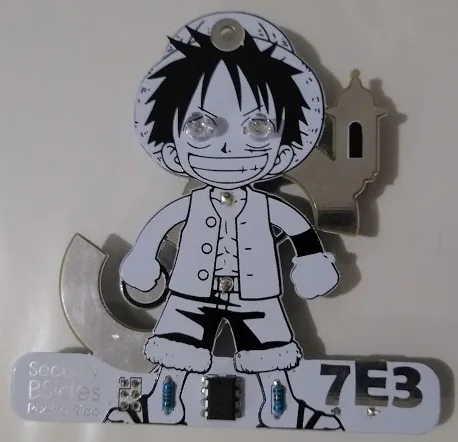
BSides Puerto Rico 2019's badge is preserved as a DIY participant kit: an easy-through-hole electronic badge built around an ATtiny13A, two red/blue LEDs, two 680 ohm resistors, a slide switch, CR2032 power, public Gerbers, KiCad files, Arduino sample code, and real assembled-badge photos.
People
GitHub publisher of the public BSidesPR_2019_Badge repository used for the badge source, documentation, sample code, and image provenance.
SourceThe Security BSides wiki page says BSides Puerto Rico was organized by Obsidis Consortia, a community-run not-for-profit organization.
SourceIt adds a Caribbean hacker-conference badge lineage to the worldwide compendium and captures a modest but important community badge pattern: every participant received a solderable artifact that taught basic assembly, bootloader/programming setup, and simple LED firmware.
The badge uses an ATtiny13A microcontroller with two bicolor LEDs, two 680 ohm resistors, one slide switch, and a CR2032 battery and holder, per the badge documentation. The GitHub repository preserves Gerber files, KiCad project files, drill files, source images, and front/back assembled-badge photos under Apache-2.0.
Programming used the Arduino IDE after configuring ATtiny support and burning the ATtiny bootloader. The public documentation links sample Arduino code for police-light and fade behavior, and the repository keeps the ArduinoSamples tree with those examples.
The official BSides wiki describes BSidesPR as the only hacker conference in the Caribbean for the 2019 edition, while the badge README says the badge was not a sale product: it existed to share and learn through hands-on soldering at the conference.
Lifecycle
The documentation frames the badge as a DIY kit distributed to participants, with easy-to-mount DIP components and step-by-step resistor, LED, switch, and battery-holder assembly.
SourceThe public sample-code tree preserves simple police-light and fade examples for the red/blue LED badge hardware.
SourceProgramming instructions use the Arduino IDE, ATtiny support configuration, bootloader/fuse burning, and sample badge sketches.
SourceOperational history
This satisfies the original-photo requirement without introducing generated, synthetic, or placeholder imagery.
The badge taught more than soldering, but the software path depended on a working microcontroller-programming toolchain.
The record keeps its claims to documented kit distribution, assembly, and sample-code behavior rather than inventing on-site gameplay or contest lore.
