2016 linux.conf.au Open Hardware Team
The repository credits the 2016 linux.conf.au Open Hardware Team with designing ESPlant.
Sourcelinux.conf.au 2016 Open Hardware Miniconf · Australia · 2016
ESP8266 environmental-sensor board for the linux.conf.au Open Hardware Miniconf
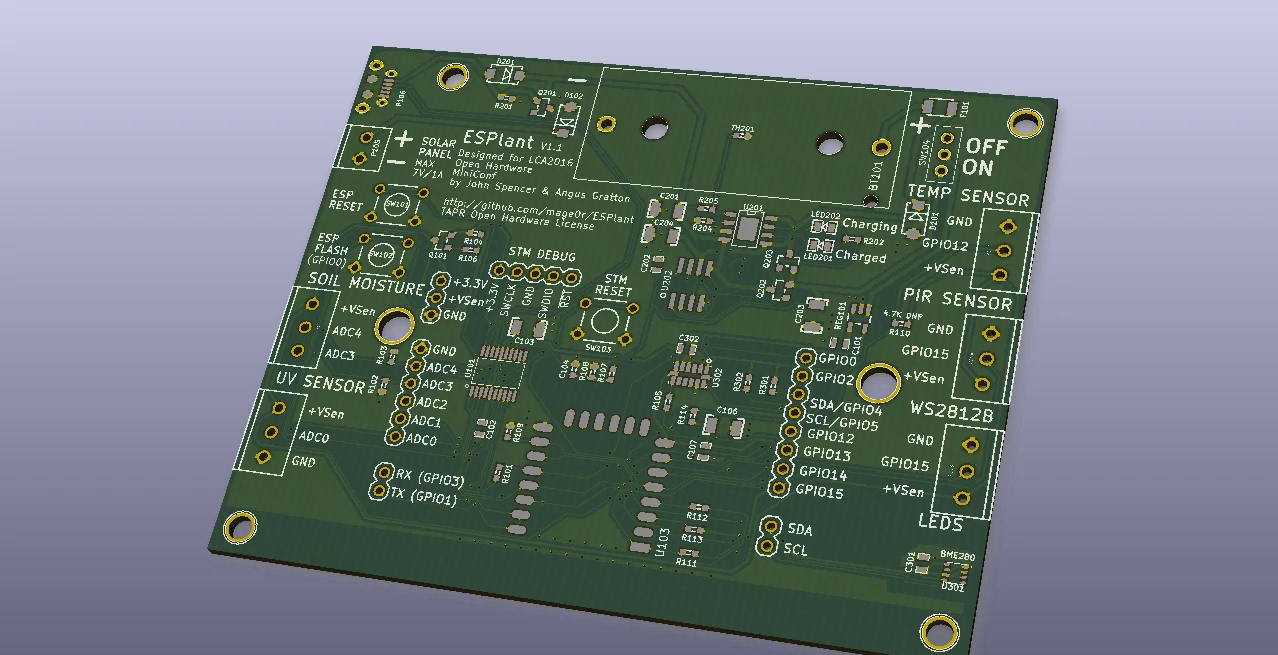
linux.conf.au 2016's Open Hardware / Arduino Miniconf produced ESPlant, an ESP8266 WiFi environmental-sensor board with solar-friendly power, onboard sensors, optional external sensors, Arduino firmware, and public hardware files.
People
The repository credits the 2016 linux.conf.au Open Hardware Team with designing ESPlant.
SourceNamed in the ESPlant README credits and copyright statement.
SourceNamed in the ESPlant README credits and copyright statement.
SourceNamed in the current CCHS Melbourne ESPlant README credits.
SourceNamed in the ESPlant README credits; Simon Lyall's notes identify Angus Gratton as the ESP8266 session presenter discussing ESPlant context.
SourceNamed in the ESPlant README credits; Marc Merlin's writeup documents Jon opening the miniconf and presenting the assembly machine that placed ESPlant components.
SourcePublished the first-hand ESPlant Arduino Miniconf writeup and linked the public blinky-code fork.
SourcePublisher of the primary ESPlant hardware, firmware, library, STM firmware, photo, wiki, credit, and license repository.
SourceESPlant is an important Oceania bridge between earlier Arduino Miniconf hardware and later LCA badgelife: it put WiFi, solar sensor telemetry, open hardware files, attendee assembly, and post-event MQTT hacking into one conference artifact.
An ESP8266 WiFi microcontroller, STM32F042 secondary microcontroller for USB/serial and I2C ADC behavior, 16340 lithium-cell holder, solar-input-friendly lithium charger, automatic switching between solar, battery, and USB power, BME280 temperature/humidity/barometric pressure sensor, ADXL345 accelerometer, screw-terminal optional external sensors, DS18B20 support, PIR sensor support, WS2812B LED strip support, switchable 3.3 V sensor rail, and KiCad/source material are documented in the public repository.
Arduino IDE ESP8266 setup, NodeMCU v1.0 compatibility, ESPlant serial-sensor firmware, production-test firmware, MQTT sensor firmware with WiFi provisioning, git-submodule libraries, and ESP_Kwai bridging to STM32/I2C ADC peripherals are documented in the repository. Attendee writeups also show post-event MQTT graphing and custom LED-strip code.
Marc Merlin described the LCA open-hardware team bringing ESPlant as a new ESP8266 board for plant monitoring, with Jon Oxer showing the assembly machine that built the boards. The repository credits the 2016 linux.conf.au Open Hardware Team and HackMelbourne/CCHS community.
Lifecycle
The repository documents ESPlant as an ESP8266 WiFi kit for transmitting environmental data, with Arduino IDE, Espressif SDK, and esp-open-rtos programming paths.
SourceRepository sketches include production-test, serial-sensor, and MQTT sensor firmware; Marc Merlin's writeup adds a participant LED-strip blinky reuse trail.
SourceESPlant included a 16340 lithium-cell holder, solar-input-friendly charger interface, and automatic switching between solar input, battery, and USB power.
SourceThe board exposed BME280 and ADXL345 I2C sensors, screw-terminal ADC inputs for soil moisture, DS18B20, PIR, WS2812B LED strip support, and a switchable VSens rail.
SourceAn onboard STM32F042 acted as USB/serial interface and I2C ADC bridge, with ESP_Kwai library support and STM firmware material in the repository.
SourceOperational history
The public badge page, image archive, and API now point at a real upstream ESPlant render with source URL, license, attribution, and processing notes preserved.
The entry is modeled as a conference hardware kit in the linux.conf.au badgelife lineage rather than an attendee identity badge.
The dossier records verified features and source locations while avoiding unsupported production-run or image-provenance claims.
