Hacker Warehouse
The README says the badge was sold at the Hacker Warehouse Vendor Booth during DEF CON 33.
Sourceseeess at DEF CON 33 · United States · 2025
RP2040 galvanic-vestibular badgelife badge
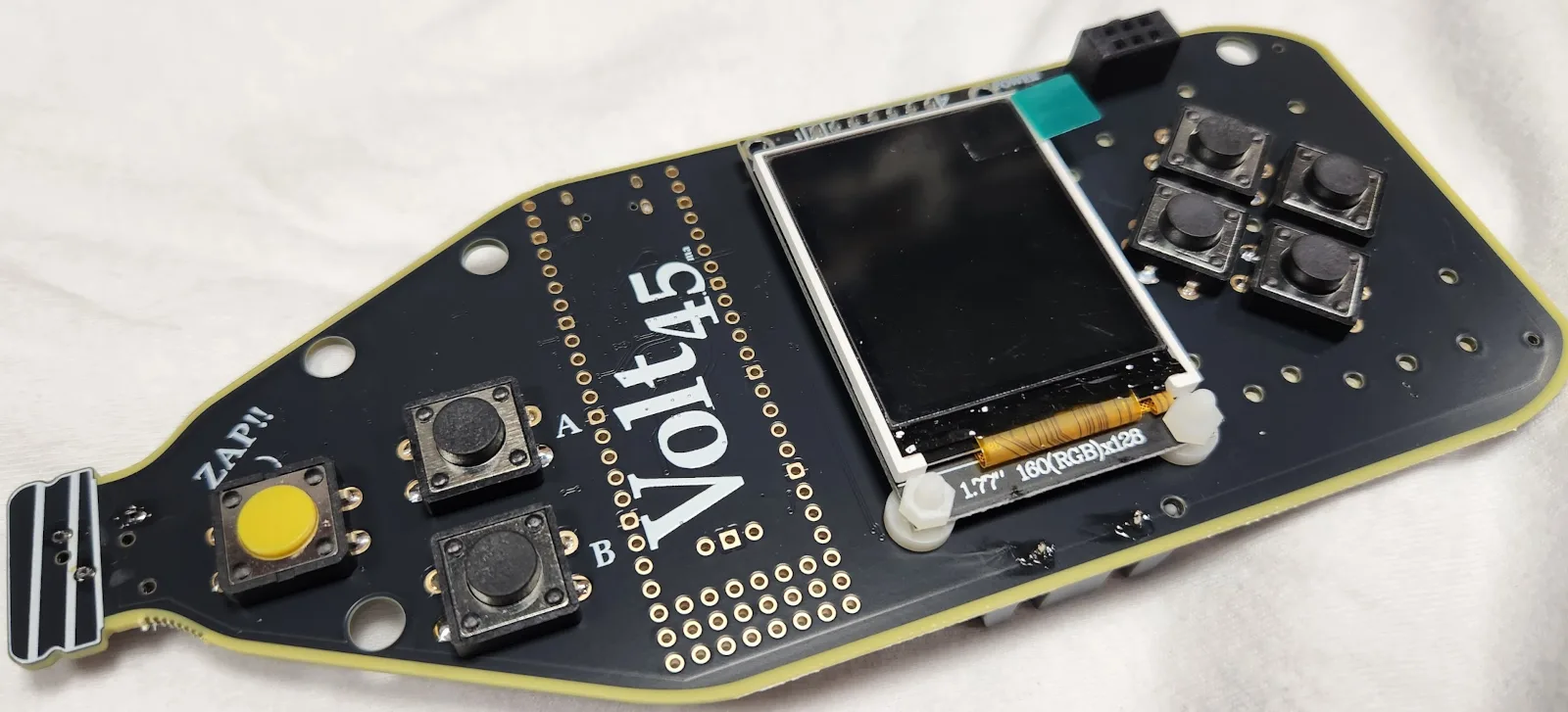
The Tipsy Badge was an independent DEF CON 33 electronic badge by seeess, sold at the Hacker Warehouse vendor booth, with public CC BY-NC 4.0 repository documentation, firmware, a badge photo, 2xAAA power, RP2040 control, TFT display, buttons, LEDs, SAO port, custom photo storage, and galvanic vestibular stimulation modes.
People
The README says the badge was sold at the Hacker Warehouse Vendor Booth during DEF CON 33.
SourceThe repository and forum announcement identify seeess with the Tipsy Badge, and the repository license provides the CC BY-NC 4.0 basis for the selected badge image.
SourceThe tipsy.ino source header lists G-19fffaf5943a20b2baddfb5a106d881f0058128a and seeess as authors.
SourceIt adds a source-backed DEF CON 33 hallway badge that is not just another LED/game board: the artifact documents an unusual vestibular-stimulation experiment, careful public safety warnings, firmware source, mass-storage photo workflows, and an explicit nonprofit donation story around Tor.
The badge uses a Raspberry Pi Pico / RP2040-class controller with 2 MB flash split between code and file storage, two AAA batteries, USB-C, 1.77 inch 160x128 RGB565 TFT display, one 1.69bis SAO port, six menu/game buttons, charlieplexed orange LEDs, red and green status LEDs, DAC-controlled pad drive, current and voltage monitoring, 3.5 mm electrode lead, conductive pads, elastic head band, lube, custom dye-sub lanyard, spare batteries, and battery clip, per the README. The firmware header maps pins for screen SPI, H-bridge/GVS power, buttons, DAC bits, current sensing, pad voltage, VBUS detection, and battery/VSYS monitoring.
The public Arduino firmware is CC BY-NC 4.0 and built for Earle Philhower's RP2040 core with Adafruit GFX and ST7735/ST7789 libraries. The badge supports calibration, steering, wobble, Stroop-effect color-game, bling/photo, and custom name-scroll style behavior, per the README, and exposes a USB mass-storage partition for TGA photo assets copied into `blingpic/` after flashing.
The repository announcement says the badge was sold at the Hacker Warehouse booth during DEF CON 33 and that half of profits went to Tor. A public 2026 DEF CON 34 Badgelife self-submission names Tipsy Badge, says it will be sold at the Hacker Warehouse booth, and links to this historical DC33 repository plus the same current product page. That seller page uses SKU SS-TB and shows an in-stock USD 75 sale price from USD 100, but neither source identifies a separate 2026 board or revision; the catalogue therefore records the current sale as continuity of this DC33 artifact rather than a duplicate DC34 badge. The public documentation repeatedly warns that the device is experimental, not a medical device, not for children, should be used while seated and away from hazards, should not be used in zap modes while USB is connected, and should be controlled by the person wearing the electrodes.
Lifecycle
The hardware list includes one 1.69bis SAO port plus conductive pads, 3.5 mm lead, elastic band, lube, custom lanyard, spare batteries, and battery clip.
SourceThe README describes a Stroop-effect color game where positive or negative shock reinforcement can be configured before play.
SourceThe README says the badge was sold at the Hacker Warehouse vendor booth during DEF CON 33 and that half of profits went to the Tor project.
SourceThe repository guide documents Earle Philhower RP2040 board-manager setup, required Adafruit libraries, 2 MB sketch/filesystem partitioning, upload, and copying data files after first boot.
SourceThe README and firmware document a Raspberry Pi Pico / RP2040-class badge with two AAA batteries, TFT display, buttons, LEDs, DAC drive, current/voltage monitoring, and electrode output hardware.
SourceThe badge splits flash into code and filesystem partitions and exposes a USB mass-storage volume where users copy 128x160 TGA images into `blingpic/` for display on the badge.
SourceThe badge manual documents calibration plus steering and wobble modes that affect perceived left/right balance through conductive electrode pads.
SourceOperational history
The catalogue treats the Tipsy Badge as an independent DEF CON 33 badgelife release while keeping the official DEF CON 33 badge record separate.
The record has a real source image, attribution, license basis, retained local source original, and optimized WebP delivery file rather than generated, placeholder, social-media, or screenshot imagery.
The catalogue can publish the selected image as a credited noncommercial reference asset, but downstream reuse should preserve the noncommercial restriction and attribution.
The catalogue records the device as an event artifact and badgelife experiment, not as a safe consumer medical or therapeutic device.
User-facing wording preserves the practical safety boundary around operating surviving badges or reproductions.
