GHP1989 Identity Pass
Dutch hacker-camp origin artifact
A conservative identity-pass record for the Galactic Hacker Party, the 1989 Amsterdam event that WHY2025 history identifies as the start of the Dutch hacker camp lineage.
Country dossier
Worldwide badge coverage for Netherlands, grouped into seeded badges, event editions, add-ons, operational issues, resources, and evidence sources.
Seeded artifacts
Dutch hacker-camp origin artifact
A conservative identity-pass record for the Galactic Hacker Party, the 1989 Amsterdam event that WHY2025 history identifies as the start of the Dutch hacker camp lineage.
Hitchhiker-era Dutch camp artifact
A historical identity-badge record for Hacking at the End of the Universe, the 1993 Dutch camp remembered as a formative outdoor hacker gathering.
Dutch camp on-site printed photo ID badge
A personalized black-and-white photo badge produced on site at Hacking in Progress 1997 using then-rare digital photography and field printing.
Early Dutch camp identity artifact
A conservative historical record for the simple identity-badge era around Hackers At Large 2001, where public badge histories do not describe a hackable electronic PCB badge.
Simple pre-electronic Dutch camp badge
A record for What The Hack 2005's simple camp identity-badge era, before the Dutch camp badge became an expected open-hardware device.
Bridge-era Dutch camp badge record
A bridge-era Dutch camp badge record for Hacking at Random 2009, kept separate from later open-hardware badge entries until primary badge details are recovered.
Dutch camp non-PCB identity artifact
A non-electronic identity-artifact entry for OHM2013, modeled as the camp's patch/hat style rather than as a programmable PCB badge.
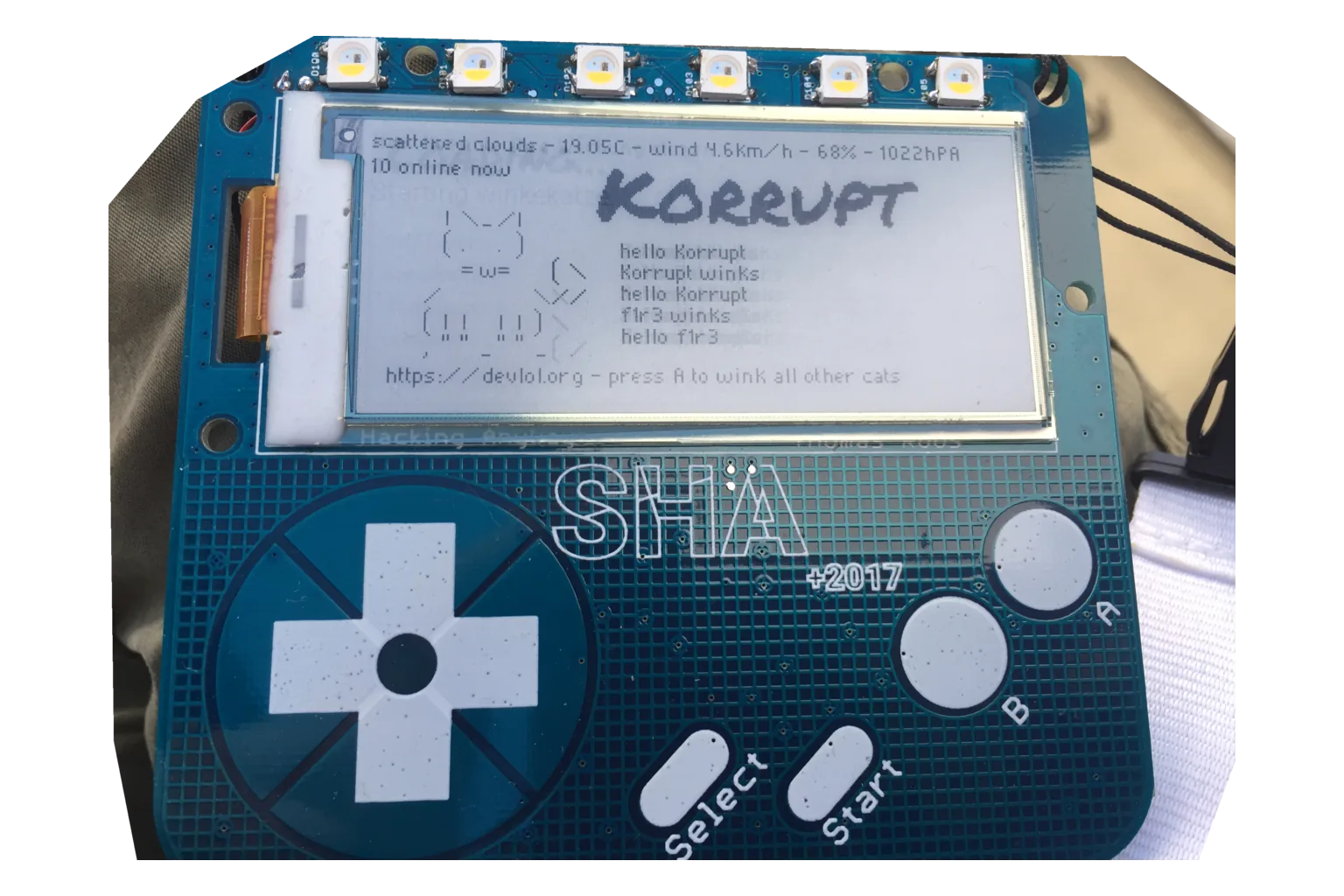
Dutch camp Badge.Team milestone
A Badge.Team-supported Dutch camp badge with ESP32, e-paper, WiFi, Hatchery apps, WebUSB install paths, production lore, and a lasting role in European badge culture.
Qihoo360 Unicorn Team electronic badge with Badge Village games
An official HITB Amsterdam electronic badge record for registered conference attendees, with public CommSec Village evidence for Qihoo360 Unicorn Team design, Badge Village hacking support, packet-decoding play, mini-games, hidden challenges, and hardware specs.
Badge.Team Hatchery and RGB matrix badge
A Badge.Team firmware badge with a documented app-development workflow, Hatchery submission path, hardware-mod instructions, OTA setup, and post-event behavior notes.
DIY circuit-building badge
A small DIY protoboard badge intended for attendees to build their own circuits.
SHA2017-derived Badge.Team badge
A HackerHotel badge made mostly from leftover SHA2017 parts, adding PSRAM, IR, stereo audio, Grove I2C, and SAO expansion.
10th-anniversary special-edition electronic badge
A conservative official-archive record for HITB's 10th-anniversary Amsterdam electronic badge, documented on the 2019 event page as a special-edition badge with HITB Badge Village reprogramming, secret features, and challenges.
Badge.Team Python API badge
A CampZone badge documented primarily through its Badge.Team Python API surface: keypad, display, audio, WiFi, HID, MIDI, touchpads, speech, app config, MQTT, and mixer modules.
Mixed-reality escape-room challenge badge
A story-first challenge badge where the badge, hotel, terminal session, puzzles, and lore formed a mixed-reality escape room.
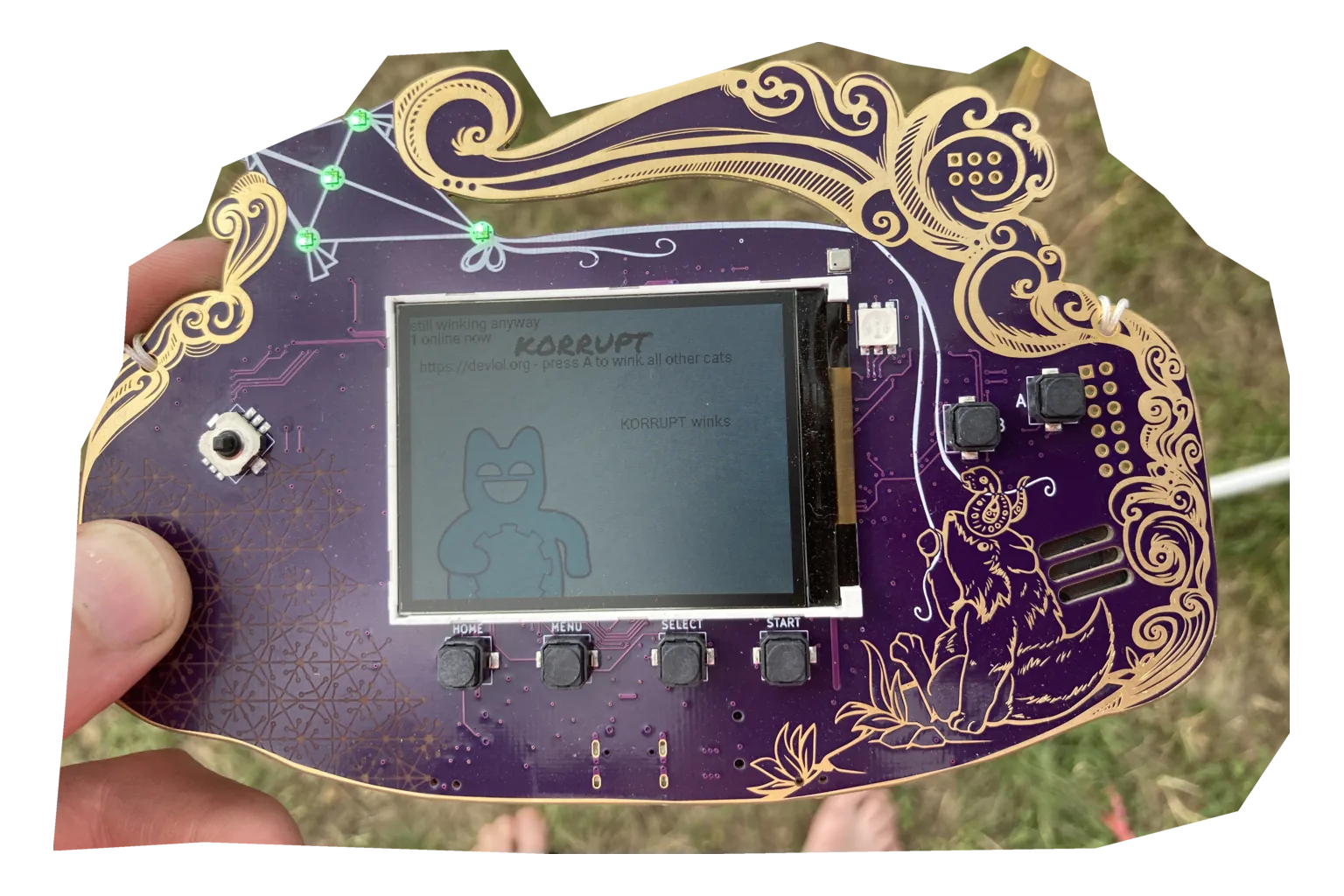
ESP32, RP2040, FPGA game-console badge
A game-console-shaped badge with ESP32, RP2040 board management, iCE40 FPGA graphics, Bosch sensors, BadgePython, Hatchery apps, SAO/Qwiic/PMOD expansion, and WebUSB FPGA workflows.
Badge.Team challenge and artwork badge
A Badge.Team-documented HackerHotel badge whose public record currently centers on team roles, challenge ownership, and artwork.
Reused retail e-paper price-tag badge
A Hardwear.io Netherlands badge built from reused e-paper price tags, with attendee-facing firmware behavior documented after the conference.
ESP32-C6 e-paper telegraph puzzle badge
An interactive Victorian-telegraph-themed puzzle badge inspired by the Cooke and Wheatstone telegraph.
Badge-team workflow and challenge badge record
A HackerHotel 2025 badge record anchored by the public badge talk, preserving badge-team workflow, challenge integration, production handoff, and lessons learned rather than unsupported component-level details.
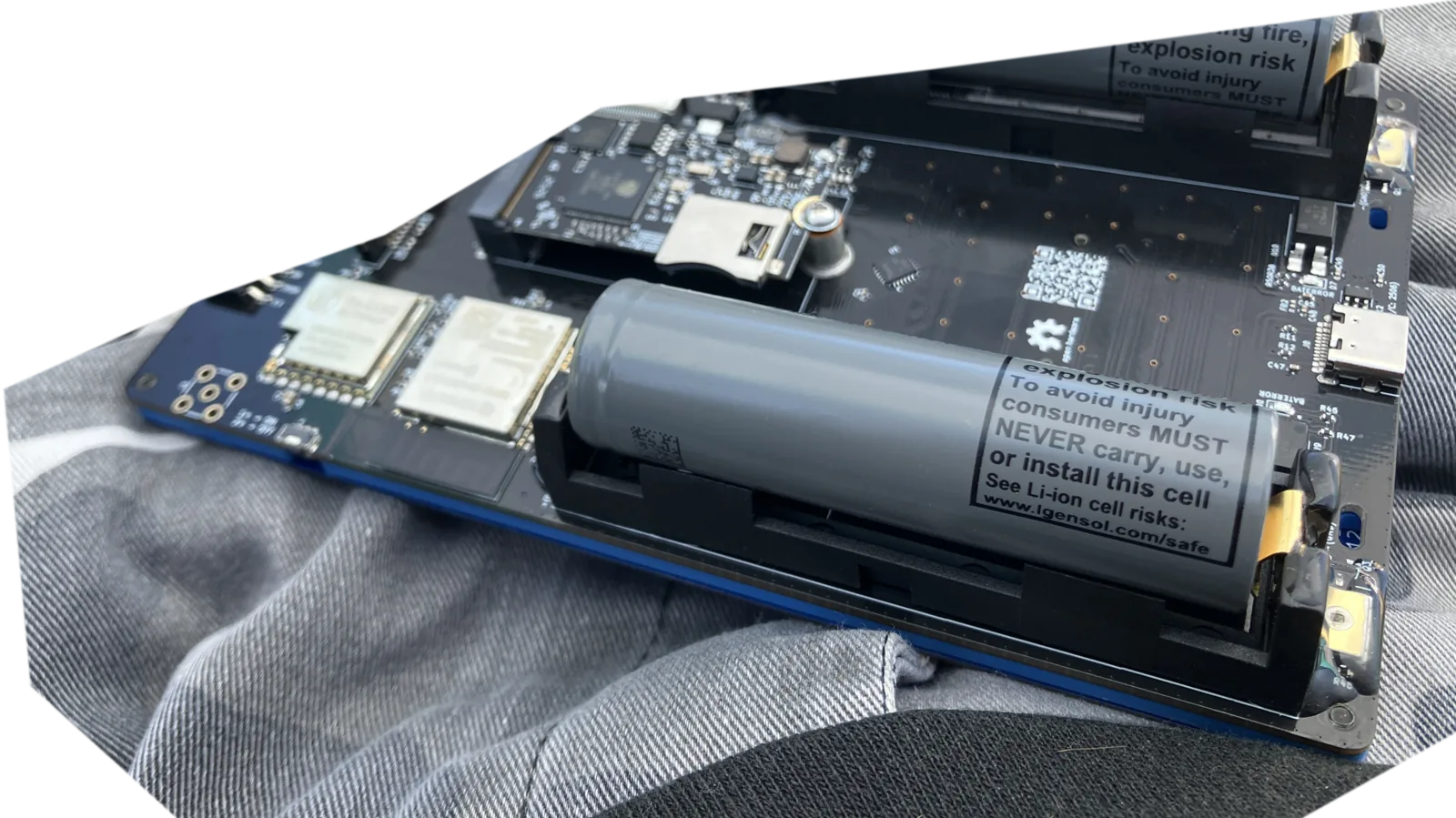
Capable hardware, difficult camp history
The Dutch 2025 camp badge mixed ambitious hardware with late distribution, LoRa caveats, battery-safety controversy, and a documented pre-event team conflict.
Badge.Team-compatible handheld platform
An ongoing Badge.Team-compatible handheld badge platform, commercially related to Tanmatsu, with public hardware specs, SoftwareHub app installation, LoRa tooling, and expansion-board documentation.
Planned Badge.Team badge: ESP32-P4 ambition versus CH643 starfish board in layout
A pre-event record for the February 19-21, 2027 HackerHotel badge. Badge.Team's homepage still advertises LoRa, a keyboard, a big screen, and an ESP32-P4-class processor, while the official badgeteam/hackerhotel2027-hardware repository, under active layout work by Renze Nicolai and Julian Scheffers since September 2026, holds a CERN-OHL-P-2.0 KiCad design for a starfish-shaped CH643 LED-matrix board with infrared and LiPo charging, with a prototype-1 Gerber and assembly package committed on October 22, 2026. Which direction ships is not yet stated.
Events
The origin point of the Dutch hacker camp lineage, documented as the beginning of the sequence that leads to WHY2025.
The 1993 Dutch outdoor hacker camp whose Hitchhiker's Guide naming tradition echoes through later Dutch camps.
A Dutch camp predecessor remembered for on-site personalized photo badge production under 1997 field conditions.
A Dutch outdoor hacker camp in the post-HIP lineage, before electronic badges became a defining expectation.
The 2005 Dutch camp whose public badge-history record treats badges as simple or absent compared with later electronic devices.
The Dutch 2009 camp sits in the bridge period between early identity artifacts and the later Badge.Team-era electronic tradition.
The 2013 Dutch camp is remembered more for camp identity artifacts such as hats and patches than for a modern electronic PCB badge.
A milestone Badge.Team badge and predecessor to the modern Dutch camp badge ecosystem.
The April 9-13, 2018 Amsterdam HITB edition whose official CommSec Village page documented a Qihoo360 Unicorn Team electronic badge for registered conference attendees, with Badge Village support, mini-games, hidden challenges, and a published hardware-spec list.
A Badge.Team firmware badge with app development docs, Hatchery workflow, hardware-mod notes, OTA setup, and community firmware behavior.
A small DIY protoboard badge documented by Badge.Team as a simple, fun badge for building circuits.
A hotel-format Dutch hacker event badge built from SHA2017 leftovers with new audio, IR, Grove, and SAO features.
The May 6-10, 2019 tenth annual HITB Security Conference in the Netherlands, whose official archive documented a 10th-anniversary special-edition electronic badge and HITB Badge Village reprogramming and challenge path.
A CampZone Badge.Team firmware badge documented through its Python API module surface and team notes.
A challenge badge framed as a mixed-reality hotel escape room with story, puzzles, SAO, and field errata.
A Dutch camp badge shaped like a game console, with ESP32, RP2040, FPGA, and Hatchery apps.
A documented Badge.Team event badge with public team credits and challenge/artwork context.
A hardware-security conference year whose attendee badge used reused e-paper price tags and OpenEPaperLink-style infrastructure.
The Telegraph badge, an ESP32-C6 e-paper puzzle badge with telegraph-inspired switches, LED matrix input, Qwiic, SAO, and case files.
A Dutch HackerHotel edition whose public badge talk documents badge-team workflow, production handoff, challenge integration, and lessons learned.
A badge remembered both for capable hardware and for serious delivery, safety, process, and camp-impact issues.
An ongoing Badge.Team-compatible handheld platform, also known commercially as Tanmatsu, with hardware, software, app-store, LoRa, and expansion-board documentation.
The planned February 19-21, 2027 HackerHotel edition. The official site, checked October 17, 2026, gives these dates and Hotel Zuiderduin in Egmond aan Zee as the venue, with room tickets on sale; Badge.Team's homepage still describes the event at hotel de Werelt on the Veluwe. The pre-event badge record follows two Badge.Team sources that disagree: the homepage ambition of LoRa, a keyboard, a big screen, and an ESP32-P4, and the badgeteam/hackerhotel2027-hardware repository, in active layout work since September 2026, for a CH643 starfish-shaped LED-matrix board whose prototype-1 Gerber and assembly package was committed on October 22, 2026.
Lifecycle
The FPGA Peripheral demo exposes the FPGA as an ESP32 peripheral with timer and random-number behavior, documenting the badge as a hardware experimentation platform.
The iCE40 firmware repository preserves FPGA examples and source that let the badge act as a learning platform for video, IO, and custom logic.
The PMOD connector exposed FPGA-oriented IO for advanced hardware experiments beyond the application chooser and BadgePython surface.
The FPGA docs preserve a browser/WebUSB loading workflow for experimenting with the iCE40 fabric without treating FPGA development as ordinary app publishing.
Henri Manson's app loads Doom on the ESP32 while using the FPGA for video and sound, turning MCH2022 into a handheld game-and-FPGA demonstration.
The Zero board is documented as an educational RFID, iButton, and sub-GHz hardware expansion with project links and maturity notes.
SHA2017 used the Badge.Team Hatchery path for discoverable badge applications, and the current Hatchery index still exposes SHA2017-compatible project records.
The MCH2022 Hatchery catalogue made app discovery and installation part of the camp badge workflow rather than a post-hoc source dump.
HITB invited attendees to learn how to hack the badge, expand its functionality, get started reprogramming, and unlock secret features, challenges, and more.
The Badge Village promised secret feature unlocks, mini-games, hidden challenges, and help getting started with reprogramming the badge.
HITB lists an IR and 433 MHz packet-decoding game as a badge activity, tying the RF/IR hardware to explicit on-site play.
Hackaday describes a Battleships game played with another badge over the ESP32-C6's 802.15.4 mesh networking.
The expansion adds two protected 18650 cells, an on/off switch, USB-C charging from the Konsool/Tanmatsu, and mounting holes.
The dedicated RP2040 firmware repository documents the badge's board-management co-processor as a separate maintained software component.
The SHA2017 docs and Hack42 WebUSB installer preserve the browser-based badge installation path used by the Badge.Team platform.
Nicolai Electronics presents Tanmatsu as a preassembled, out-of-the-box handheld derived from the Konsool open-design community hardware project.
The official archive says there would be a special-edition electronic badge for the 10th year anniversary of HITB in the Netherlands.
The public team record credits challenge work, making puzzle content part of the badge's event role even though technical details remain sparse.
The talk and schedule context preserve the badge as a HackerHotel challenge surface, even though component-level firmware and app-store records remain open.
Badge.Team's ESP32 platform firmware repository anchors SHA2017 in the reusable firmware lineage later Badge.Team records build on.
The badge post directs attendees toward OpenEPaperLink access-point tooling so the reused e-paper tags can be updated after the conference.
The challenge used a 3.3 V USB-serial adapter on the SAO connector at 115200 8n1, with OS-specific Badge.Team guides for Linux, macOS, and Windows.
Tilde Industries produced a CYBER SCARAB add-on for the HackerHotel 2020 challenge badge.
LoRa use depended on attaching the connector and a suitable, matched antenna; the wiki records VNA/SWR antenna checks and warns that transmitting without a proper antenna could permanently damage RF hardware.
Konsool documents expansion boards and multiple expansion buses, making external hardware part of the platform rather than a one-off mod.
The official CommSec Village page lists an STM32F103 MCU, W25Q32 flash, 1.3-inch OLED, 433 MHz RF receiver, IR receiver, six direction/action buttons, and six RGB LEDs.
Badge.Team documents supported OV5647-based camera modules and calls out unsupported IMX519-based Raspberry Pi camera modules.
HackerHotel 2019 added Grove I2C and SAO connectors on top of the SHA2017-derived base hardware.
Qwiic gave badge hackers a documented I2C expansion path for sensor and breakout-board experiments.
The hardware docs record a 6-pin SAO connector and IR receive/transmit hardware, giving SHA2017 both badge-add-on and badge-to-badge interaction surfaces.
The extension-header docs preserve the badge's SAO surface, tying MCH2022 into the wider badgelife add-on ecosystem.
The badge itself is a protoboard, so attendee-added circuitry is the primary expansion model.
The page documents diffuser installation, slide-switch direction changes, and an optional MPU6050 module, making hardware modification part of the badge record.
The Telegraph badge documentation links SAO designs, Qwiic expansion, ESP32-C6 firmware, CH32V003 co-processor firmware, hardware files, and a 3D printable case.
The badge's FPGA and RP2040/ESP32 split enabled deeper hardware experiments beyond ordinary app loading.
The Tanmatsu manual documents internal personality modules as hot-swappable boards that can be exchanged to change device behavior while preserving the same handheld base.
The wiki tracks 3D-printed cases, spacers, covers, and repair guidance, reflecting the post-event mechanical support ecosystem.
The field report calls out an onboard relay whose practical purpose was tactile clicking, reinforcing the telegraph feel of the five-switch interface.
Badge.Team publicly names LoRa, a keyboard, a big screen, and ESP32-P4 as the ambition for HackerHotel 2027.
The March 2025 update tracks firmware, app, documentation, module redesign, and production work, showing the platform evolving like a badge ecosystem rather than a static product page.
Sprite_tm documented adapting a Gameboy emulator to the SHA2017 badge's e-paper display, preserving a concrete example of post-camp app hacking under unusual display constraints.
Hardwear.io documents leaving the badge's presentation mode around the 6:30 mark and uploading pictures afterward, turning the attendee object into a reusable e-paper display target.
Badge.Team published a post-event guide for completing the mixed-reality challenge without the original hotel props, magnetic maze, and badge-to-badge team formation.
The public HackerHotel Badge talk captures the badge-team process, challenge integration, and lessons learned as part of the badge's post-event record.
The project is publicly shown in staged progress from idea collection through prototyping, electronic design, firmware, and delivery, with budget fit called out as the next challenge.
The 144 MHz Morse app uses GPIO and FPGA behavior for a ham-radio-style badge experiment, broadening MCH2022 beyond ordinary MicroPython apps.
The LoRa docs expose regional frequency settings and configuration paths, which matter for legal and practical radio use.
The badge workflow depended on taking attendee photos at the entrance, transferring them, laying out the badge, and printing personalized IDs in the field.
BadgePython exposed an `mch22` module for badge-specific behavior such as display, LEDs, buttons, sensors, power, and peripherals.
CampZone 2020 exposed a broad set of Badge.Team Python modules for input, display, audio, WiFi, HID, MIDI, MQTT, touchpads, and app configuration.
SHA2017 sits in the early Badge.Team lineage where apps, contributed code, documentation, and post-event platform work became central.
The CampZone 2019 docs explain app packaging, metadata, icons, state persistence, Hatchery submission, and post-install behavior.
MCH2022 used Hatchery for app loading and publishing, making post-distribution applications part of the badge experience.
SoftwareHub is documented as the app source for browsing and installing Konsool software.
The event wiki links appfs as the way applications were stored and loaded on the badge, making installable apps part of the platform instead of just firmware demos.
Konsool documents browser-based firmware flashing plus OTA and USB update workflows.
Operational history
The warning shaped distribution, battery handling, user confidence, and the badge's public reputation.
The badge's technical potential was hard to realize while the camp was happening.
Badge-dependent embedded work became timing-constrained for at least one participant; this aligns with public feedback about late handout.
Many attendees could not use the badge as a nametag or as a normal camp hacking object.
SHA2017 is remembered as successful, but its production story still shows the logistics risk behind ambitious camp badges.
Users were told to remove batteries when storing the badge and to handle the exposed front carefully.
Volunteers spent substantial camp time applying epoxy; users had handling and curing concerns.
The conflict forms part of the badge's production history and likely contributed to a hurried replacement effort, but individual claims should not be overstated beyond public evidence.
CampZone 2020 should be represented as a reusable Badge.Team firmware badge with a different input API surface, not as a drop-in match for every BadgePython app.
LoRa was not a simple out-of-box feature: users needed soldering, antenna choice or tuning, and caution with auto-transmitting firmware such as Meshtastic to avoid RF damage.
Users needed post-event reflashing and troubleshooting before the badge became a stable hacking platform.
The first-use path depended on event infrastructure, while post-event users needed to follow a separate reflashing workflow.
Users wanting add-ons or full LED intensity needed rework guidance and sometimes volunteer help.
Attendees needed a hardware fix for proper audio behavior.
The badge's visual polish came with substantial volunteer assembly effort that belongs in the compendium's production history.
The record captures both a failure mode and the on-site support workflow that kept the challenge playable.
MCH2022 was accessible as a Python app badge, but its FPGA surface required a higher hardware-tooling skill level.
The record links the standalone Tanmatsu/Konsool platform to the same Dutch camp badge-history branch as WHY2025 without treating it as the shipped WHY2025 attendee badge.
The compendium should revisit the platform periodically rather than treating this page as a frozen historical badge entry.
The final badge may differ from the early public ambition, so hardware claims should be revisited when production docs are published.
The record lists both descriptions with attribution and makes no claim about which hardware attendees will receive.
Credits should be updated only if primary sources or firsthand records identify the people behind the badge workflow.
The record distinguishes registered-attendee distribution from the free CommSec Village visitor purchase path.
The record avoids implying universal attendee distribution or a known production run.
The page should keep multiple source links instead of pretending there is one complete canonical source.
The compendium treats MCH2022 as a platform record with multiple source trails rather than a single static badge page.
This is useful lore for app-store records: the badge could run surprising software, but display technology shaped what was practical.
The badge exposed rich expansion hardware, but safe use depended on reading the correct connector documentation.
The badge game depended on accessories that some attendees needed to borrow from the badge hacking area.
The dossier can use the report for mesh gameplay and relay-interface lore while keeping low-level hardware claims anchored to primary sources.
The dossier records the verified anniversary-badge context while avoiding unsupported component-level claims.
Users running LED-heavy apps needed to understand power limits and hardware context.
The compendium includes HAL2001 as a lineage and identity-artifact entry while leaving electronics, credits, and images marked for primary-source recovery.
The page keeps WTH2005 visible in the Dutch lineage without falsely presenting it as a firmware or app-store badge.
The compendium includes HEU1993 as lineage context and avoids claiming electronics until a primary artifact source appears.
The compendium models OHM2013 as a non-PCB identity artifact and leaves any electronic-badge claim open pending primary evidence.
The page keeps the origin point visible while marking the badge itself as an identity/pass record pending primary material recovery.
Keeping this distinction prevents early Dutch camp history from being erased while avoiding false claims about hackable electronics.
The record is intentionally conservative until primary photos, registration notes, or production files identify a specific badge artifact.
The badge facts and visual provenance are now aligned: the image record preserves source URL, CC BY-SA 4.0 license, attribution, and cutout-processing notes.
The badge facts and visual provenance are now aligned: the image record preserves source URL, CC BY-SA 4.0 license, attribution, and cutout-processing notes.
The Dutch record remains source-backed and image-free rather than copying Badge.Team page media, documentation screenshots, event photos, placeholders, or generated approximations.
The record remains source-backed and image-free rather than copying Badge.Team page media, documentation screenshots, event photos, placeholders, or generated approximations.
The Netherlands record remains source-backed and image-free rather than copying source-page media, documentation screenshots, event photos, social media, placeholders, or generated approximations.
The Netherlands record remains source-backed and image-free rather than copying source-page media, documentation screenshots, event photos, social media, placeholders, or generated approximations.
The record remains source-backed and image-free rather than copying Badge.Team page media, documentation screenshots, event photos, placeholders, or generated approximations.
The record remains source-backed and image-free rather than copying Badge.Team page media, documentation screenshots, event photos, placeholders, or generated approximations.
The record remains source-backed and image-free rather than copying Badge.Team page media, documentation screenshots, event photos, placeholders, or generated approximations.
The image archive should stay empty for this badge until an original licensed photo can be attributed and processed.
The entry remains source-backed and image-free rather than copying event imagery, screenshots, social-media photos, or generated placeholder art.
The Dutch record remains source-backed and image-free rather than copying Badge.Team page media, documentation screenshots, event photos, placeholders, or generated approximations.
The Netherlands record remains source-backed and image-free rather than copying source-page media, documentation screenshots, event photos, social media, placeholders, or generated approximations.
The entry remains source-backed and image-free rather than copying event imagery, screenshots, social-media photos, or generated placeholder art.
The Netherlands record remains source-backed and image-free rather than copying source-page media, documentation screenshots, event photos, social media, placeholders, or generated approximations.
The Netherlands record remains source-backed and image-free rather than copying source-page media, documentation screenshots, event photos, social media, placeholders, or generated approximations.
The Netherlands record remains source-backed and image-free rather than copying source-page media, documentation screenshots, event photos, social media, placeholders, or generated approximations.
The Netherlands record remains source-backed and image-free rather than copying source-page media, documentation screenshots, event photos, social media, placeholders, or generated approximations.
The image replacement queue can point contributors at the right source page without importing an all-rights-reserved-looking photo into the public archive.
The platform record remains source-backed and image-free rather than copying product-page media, manual screenshots, article photos, logos, placeholders, or generated approximations.
The Netherlands record remains source-backed and image-free rather than copying source-page media, documentation screenshots, event photos, social media, placeholders, or generated approximations.
The planned record remains source-backed and image-free rather than copying Badge.Team page media, event-site media, placeholders, or generated approximations.
The architecture enabled unusual experiments but makes firmware provenance and troubleshooting more complex than a single-MCU badge.
badge.gallery models it separately from event editions so add-ons, apps, and firmware can continue evolving without rewriting a historical event page.
badge.gallery should track the planned badge without overstating it as a delivered artifact.
The platform needs region-aware documentation and defaults for legal and reliable LoRa use.
This is useful operational context for an open badge-derived platform becoming a purchasable handheld.
The dossier records the public hardware-spec and challenge surface while avoiding unsupported firmware, schematic, or implementation claims beyond the official page.
The compendium treats it as a badge-hacking object and post-event firmware target while avoiding unsupported claims about custom hardware design.
The dossier preserves the public badge talk while avoiding unsupported component-level claims.
Future work should add chip-level tag models, packet captures, firmware forks, and attendee writeups if they are published.
The edition uses the official event site's venue; the Badge.Team text is kept only as attributed context.
The install workflow was accessible for many users, but the compendium records it as an ecosystem dependency rather than firmware alone.