Henri Manson
Listed as the owner of the Doom with sound Hatchery entry.
SourceMay Contain Hackers 2022 · Netherlands · 2022
ESP32, RP2040, FPGA game-console badge
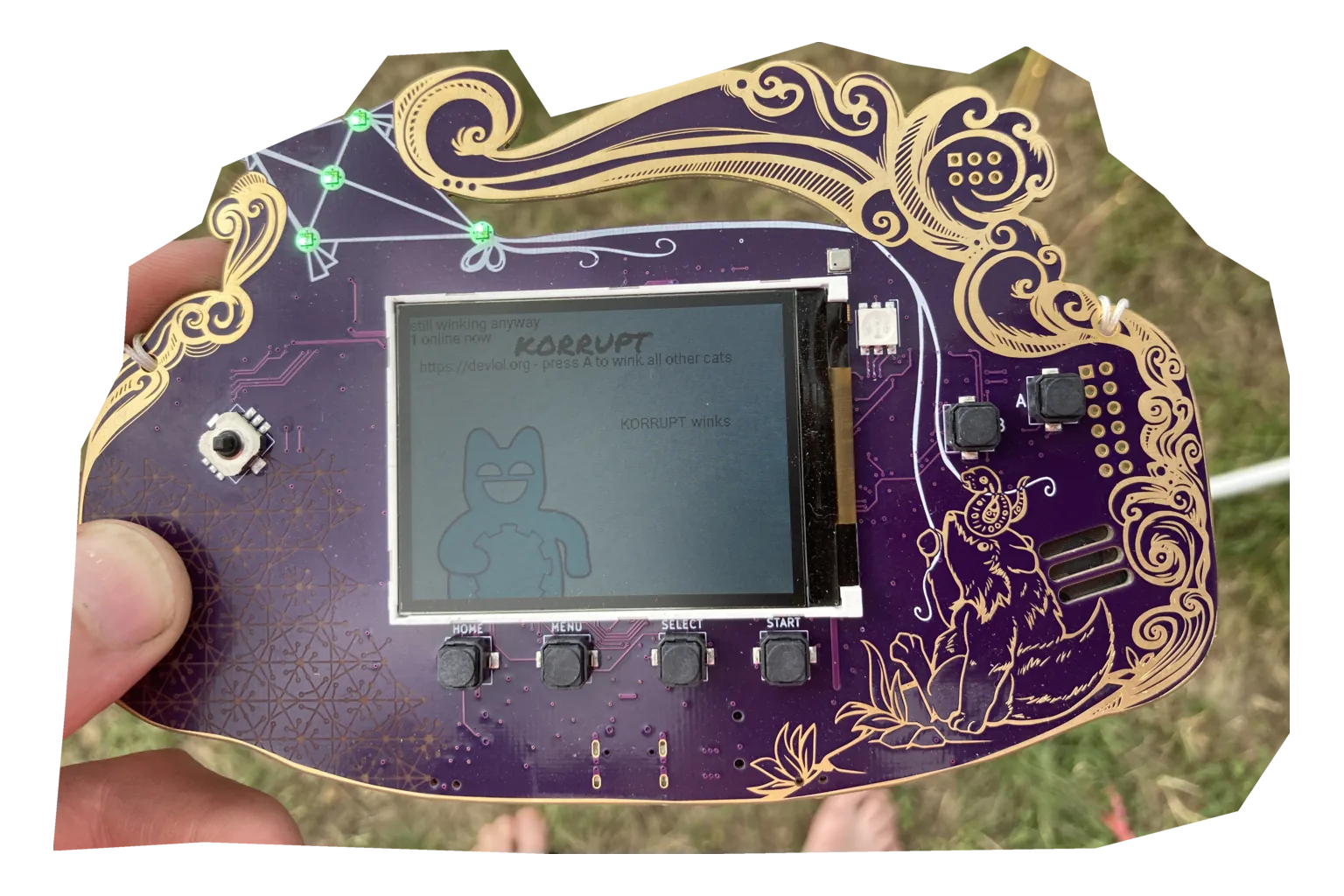
A game-console-shaped badge with ESP32, RP2040 board management, iCE40 FPGA graphics, Bosch sensors, BadgePython, Hatchery apps, SAO/Qwiic/PMOD expansion, and WebUSB FPGA workflows.
People
Listed as the owner of the Doom with sound Hatchery entry.
SourceListed as a project owner on the FPGA Morse 144MHz Hatchery entry.
SourceListed as a project owner on the FPGA Morse 144MHz Hatchery entry.
SourceListed as the owner of the FPGA Peripheral demo Hatchery entry.
SourceListed in the MCH2022 FPGA examples and tools credits.
SourceListed in the MCH2022 FPGA examples and tools credits.
SourceListed in the MCH2022 FPGA and documentation credits.
SourceListed by Badge.Team as an MCH2022 badge sponsor.
SourceListed by Badge.Team as an MCH2022 badge sponsor.
SourceListed by Badge.Team as an MCH2022 badge sponsor.
SourceListed by Badge.Team as an MCH2022 badge sponsor.
SourceListed in the MCH2022 RP2040 co-processor firmware credits.
SourceListed in the MCH2022 documentation credits.
SourceListed in the MCH2022 documentation credits.
SourceListed in the MCH2022 documentation credits.
SourceListed as helping the MCH2022 hardware effort.
SourceListed as helping the MCH2022 hardware effort.
SourceListed as helping the MCH2022 hardware effort.
SourceListed as helping the MCH2022 hardware effort.
SourceListed as helping the MCH2022 hardware effort.
SourceListed as helping the MCH2022 hardware effort.
SourceListed as helping the MCH2022 hardware effort.
SourceListed as helping the MCH2022 hardware effort.
SourceListed as helping the MCH2022 hardware effort.
SourceListed in the MCH2022 hardware credits.
SourceListed in the MCH2022 hardware credits.
SourceListed in the MCH2022 launcher firmware credits.
SourceListed in the MCH2022 launcher firmware and BadgePython credits.
SourceListed in the MCH2022 launcher firmware and BadgePython credits.
SourceListed in the MCH2022 firmware and FPGA credits.
SourceListed across several MCH2022 team sections.
SourceListed in the MCH2022 team section.
SourceMCH2022 combined serious hardware with an accessible camp hacking workflow: nametag, games, BadgePython, app loading, sensor play, hardware expansion, and FPGA experiments.
MCH2022 uses ESP32 Wrover-E with 16 MB flash and 8 MB PSRAM, Raspberry Pi RP2040, Lattice iCE40UP5K FPGA, display, BNO055 orientation sensor, BME680 environmental sensor, SAO, Qwiic, PMOD, MicroSD, audio, IR, debug pads, and prototyping areas, per Badge.Team docs.
Boots into an application chooser with nametag, BadgePython, sensor playground, Hatchery app loading/publishing, `mch22` hardware APIs, WebUSB FPGA loading, and ESP32/RP2040/FPGA firmware source trails.
The badge became a reference point for later discussions about what a camp badge should enable during the event itself: it was a Python app platform, game handheld, FPGA lab, sensor board, expansion host, and camp identity object at once.
Lifecycle
The FPGA Peripheral demo exposes the FPGA as an ESP32 peripheral with timer and random-number behavior, documenting the badge as a hardware experimentation platform.
SourceThe iCE40 firmware repository preserves FPGA examples and source that let the badge act as a learning platform for video, IO, and custom logic.
SourceThe PMOD connector exposed FPGA-oriented IO for advanced hardware experiments beyond the application chooser and BadgePython surface.
SourceThe FPGA docs preserve a browser/WebUSB loading workflow for experimenting with the iCE40 fabric without treating FPGA development as ordinary app publishing.
SourceHenri Manson's app loads Doom on the ESP32 while using the FPGA for video and sound, turning MCH2022 into a handheld game-and-FPGA demonstration.
SourceThe MCH2022 Hatchery catalogue made app discovery and installation part of the camp badge workflow rather than a post-hoc source dump.
SourceThe dedicated RP2040 firmware repository documents the badge's board-management co-processor as a separate maintained software component.
SourceQwiic gave badge hackers a documented I2C expansion path for sensor and breakout-board experiments.
SourceThe extension-header docs preserve the badge's SAO surface, tying MCH2022 into the wider badgelife add-on ecosystem.
SourceThe badge's FPGA and RP2040/ESP32 split enabled deeper hardware experiments beyond ordinary app loading.
SourceThe 144 MHz Morse app uses GPIO and FPGA behavior for a ham-radio-style badge experiment, broadening MCH2022 beyond ordinary MicroPython apps.
SourceBadgePython exposed an `mch22` module for badge-specific behavior such as display, LEDs, buttons, sensors, power, and peripherals.
SourceMCH2022 used Hatchery for app loading and publishing, making post-distribution applications part of the badge experience.
SourceOperational history
MCH2022 was accessible as a Python app badge, but its FPGA surface required a higher hardware-tooling skill level.
The compendium treats MCH2022 as a platform record with multiple source trails rather than a single static badge page.
The badge exposed rich expansion hardware, but safe use depended on reading the correct connector documentation.
The badge facts and visual provenance are now aligned: the image record preserves source URL, CC BY-SA 4.0 license, attribution, and cutout-processing notes.
The architecture enabled unusual experiments but makes firmware provenance and troubleshooting more complex than a single-MCU badge.