TiLDA
EMF 2012 radio-enabled badge
The first EMF electronic badge, designed around wireless communication, Arduino-style hacking, and camp game mechanics.
Country dossier
Worldwide badge coverage for United Kingdom, grouped into seeded badges, event editions, add-ons, operational issues, resources, and evidence sources.
Seeded artifacts
EMF 2012 radio-enabled badge
The first EMF electronic badge, designed around wireless communication, Arduino-style hacking, and camp game mechanics.
EMW2013 LED and IR badge
A small Electromagnetic Wave badge with ATTiny44A, 20 location LEDs, IR receiver/transmitter, unique-ID beacon behavior, coin-cell power, and a ship-wide treasure hunt.
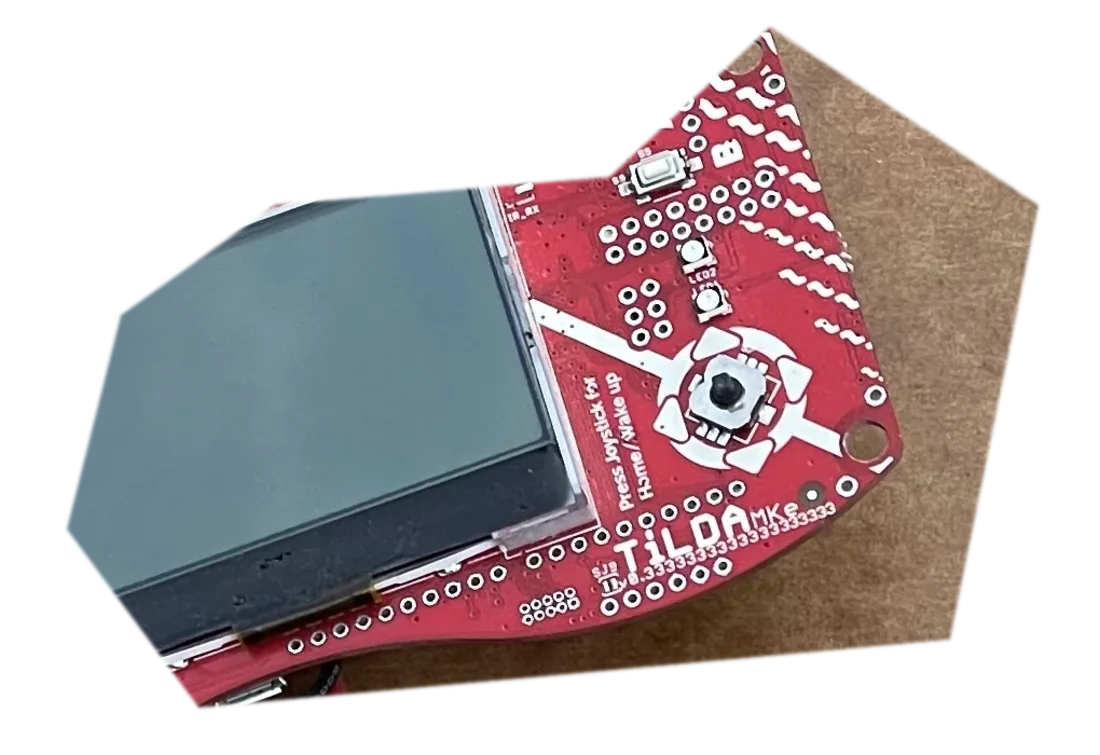
EMF 2014 schedule and radio badge
An EMF badge built around camp schedules, radio base-station updates, online registration, alerts, torch mode, and practical utilities.
Unreleased USB HID prototype board
The 44CON 2016 badge was the unreleased HIDIOT 0.7 board, a USB Human Interface Device Input/Output Toolkit prototype that attendees could build, program through the Arduino IDE as a Digispark-compatible device, and use for HID payload experiments.
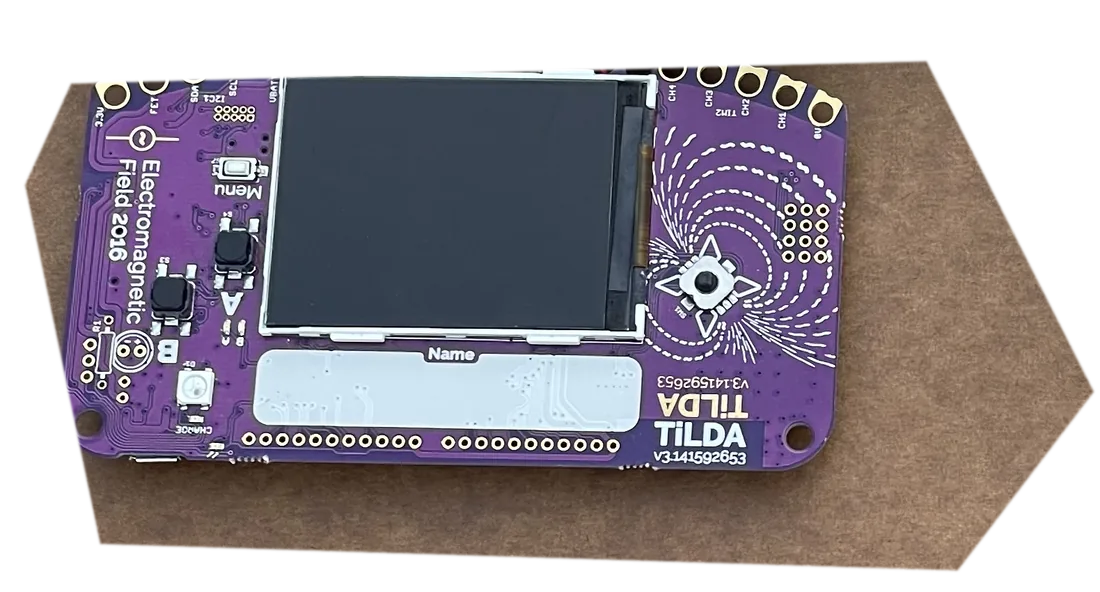
EMF 2016 MicroPython badge
An EMF badge with color LCD, WiFi, sensors, MicroPython, app library, and USB hacking workflow.
Raw Hex USB HID hardware badge
The 44CON 2017 brochure documents the conference badge as a Raw Hex HIDIOT 1.0 44CON edition, a build-it-yourself USB HID board programmed through the Arduino IDE and supported by HIDIOT documentation, assembly help, and a Hackster project competition.
Retro-gaming attendee object badge
A non-electronic SteelCon attendee badge where floppy disks were used as the badge object for a year with a retro gaming area and orange shirts.
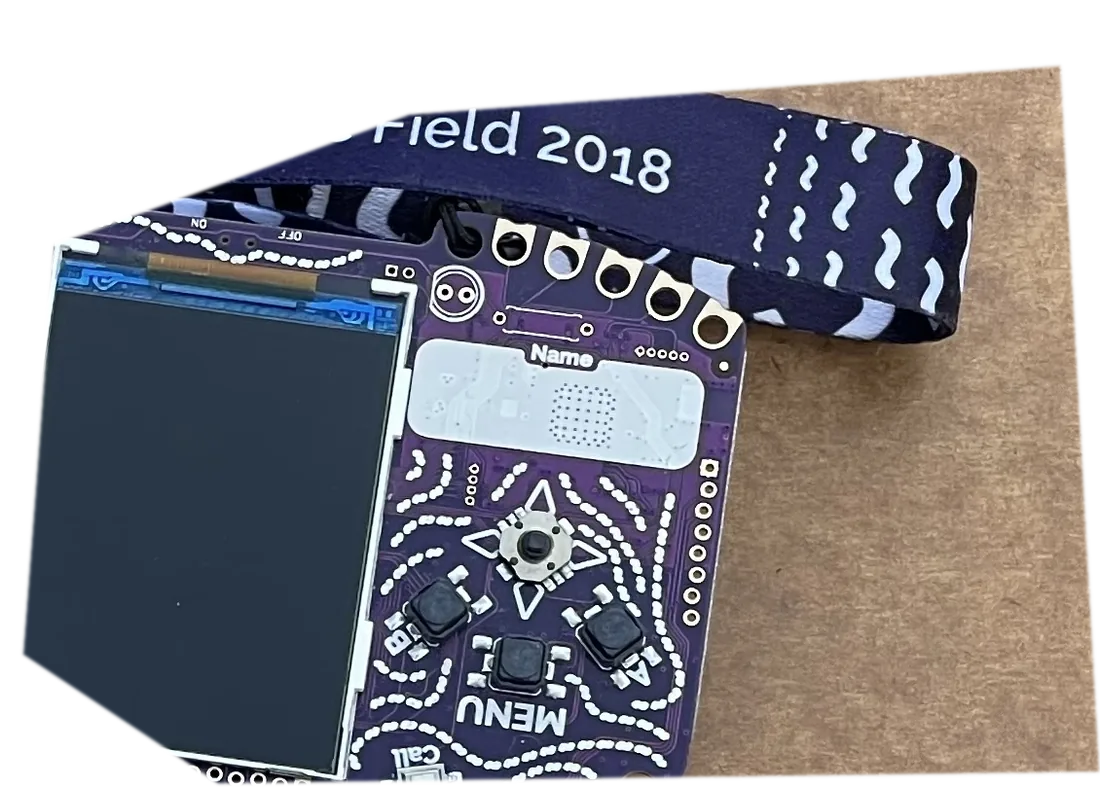
EMF 2018 phone-like MicroPython badge
An EMF badge with MicroPython, WiFi, GSM/SMS/calling, screen, sensors, keypad, Grove connectors, and a badge store.
EMF 2022 badge
The EMF 2022 badge, renamed TiDAL, with MicroPython app development and a software repository for badge apps and API proxy services.
ATtiny402 DeLorean PCB-art conference badge
An electronic PCB-art conference badge documented by its maker and badge sponsor, Punk Security, for BSides Cheltenham 2023. Punk Security's own dated event listing identifies its June 3 Cheltenham appearance as that year's badge-sponsor engagement, names a talk on building the BSides Delorean badges, and describes them as functional conference badges. The public `bsides-cheltenham-2023-badge` repository calls the artifact the Delorean badge, reports that parts sold for badge completion on the day raised more than £300 for Mind, and preserves EAGLE, Gerber, library, and Arduino firmware material. Its parts list names an ATtiny402, button, CR2032 clip, NeoPixel, and 3528 blue LED. The reviewed sources do not establish organizer-side 2023 confirmation, venue, production quantity, attendee allocation, individual handoff, final unit-by-unit configuration, completed assembly count, safety validation, or reusable image provenance.
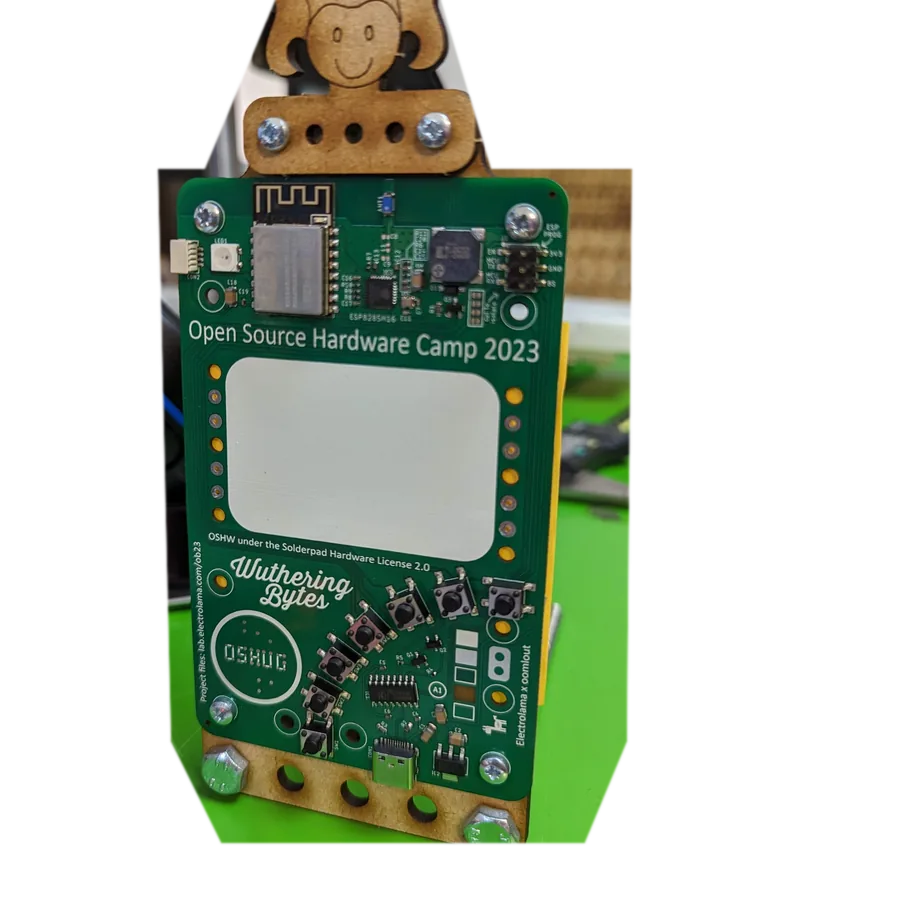
WiFi room-sensor name badge
A WiFi badge for Open Source Hardware Camp 2023, designed as a name badge, solder-paste workshop board, USB-UART adapter, qwiic/STEMMA QT sensor host, and post-event Tasmota room sensor.
ATtiny402 UFO PCB badge with source-described activity material
An electronic PCB badge identified by Punk Security's public source archive as the UFO badge for BSides Cheltenham 2024. Its repository preserves EAGLE, Gerber, Arduino firmware, vector-art, 3D-case, and activity-booklet material, and names an ATtiny402, button, CR2032 clip, and 5050 NeoPixel. The archive says the activity booklet was given out on the day. Punk Security's historical event timeline separately says it was the badge sponsor and had UFO badges, but currently renders that entry with an inconsistent early-2023 timestamp; the record therefore uses the repository's explicit 2024 badge identity without inventing an exact date or venue. The reviewed sources do not establish organizer-side 2024 confirmation, production quantity, attendee allocation, individual handoff, final unit-by-unit configuration, activity participation or outcome, safety validation, or reusable image provenance.
Little Shop of Horrors ATtiny402 soil-sensor PCB badge
An electronic PCB badge documented by its maker and badge sponsor, Punk Security, for BSides Newcastle 2024. Punk Security's own dated event listing identifies its October 5 Newcastle appearance as that year's badge-sponsor engagement and says Simon Gurney presented the making of the conference badge. The public `bsides-newcastle-2024-badge` archive calls the artifact the Little Shop of Horrors Plant Badge, says it was given out at BSides Newcastle, and describes it as a working soil sensor. It preserves EAGLE, EasyEDA, Gerber, firmware, board-image, and schematic material, and names an ATtiny402, button, CR2032 clip, 5050 NeoPixel, and 6.8 kΩ resistor. The reviewed sources do not establish organizer-side 2024 confirmation, venue, production quantity, attendee allocation, individual handoff, final unit-by-unit configuration, measurement performance, safety validation, or reusable image provenance.
Secure Impact nine-challenge AVR badge
CyberThreat 2024 featured brand-new hackable badges from Secure Impact with nine challenges, documented by the official CyberThreat site and final-challenge walkthrough PDFs by badge challenge author Nathan Taylor.
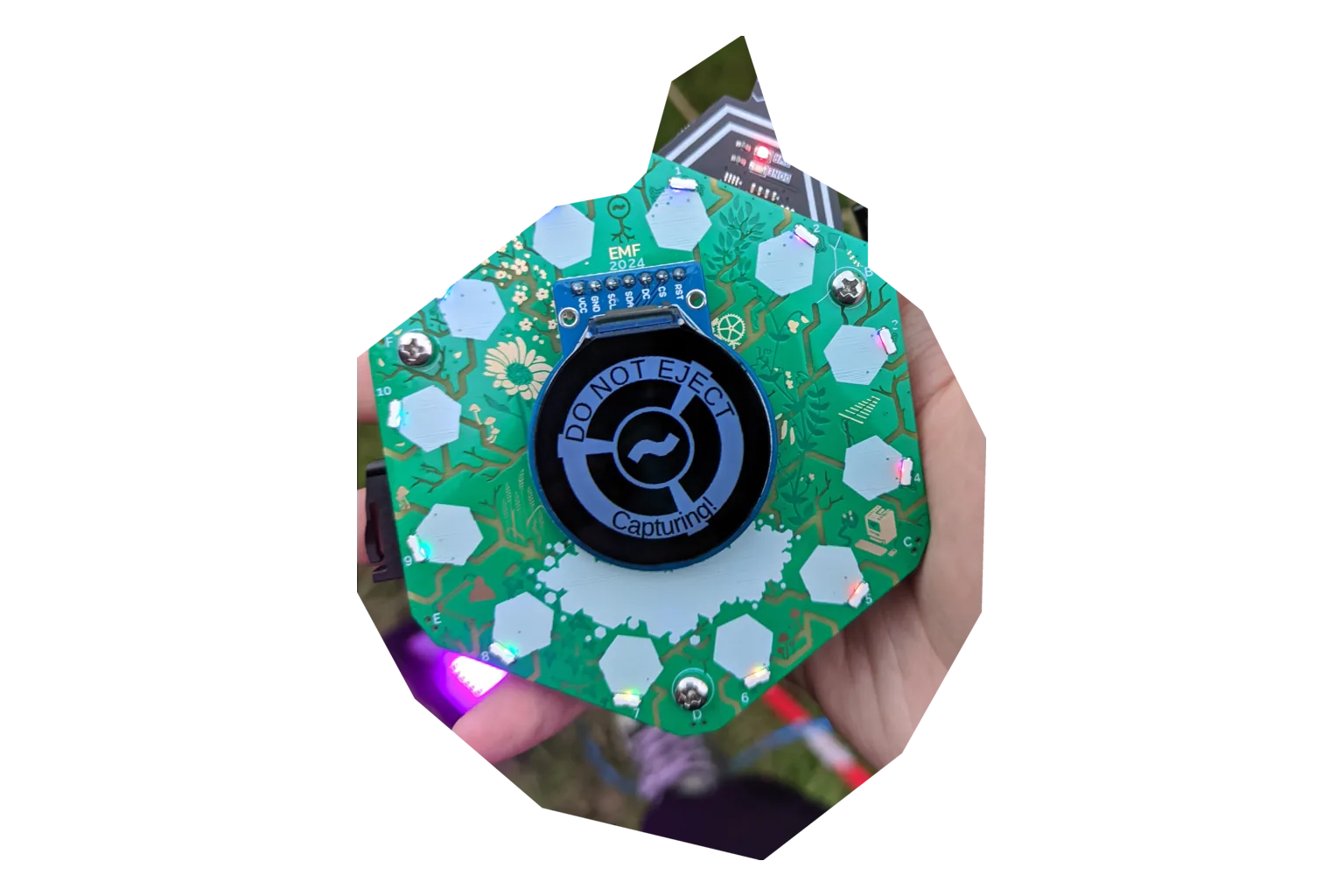
EMF 2024+ reusable hexpansion platform
A reusable hexagonal badge platform with six expansion slots, MicroPython apps, and community hexpansions.
Electronic Cats OLED and RF-detector badge
The 44CON 2025 badge is a public Electronic Cats hardware and firmware project that can run with a CH32-style shield for an OLED mini-game or with an ESP32 Wemos D1 module plus optional buzzer, MT3608 boost converter, AD8317 RF detector, and add-on board.
ATtiny402 skull PCB badge
A completed BSides Bournemouth 2025 electronic PCB badge created by the event's badge sponsor, Punk Security. BSides Bournemouth's official 2025 page establishes its Bournemouth 2600-led community cybersecurity conference and reports 200+ attendees; the Security BSides schedule records the August 16 date. Punk Security's own event page identifies it as badge sponsor and calls the artifact a Punk BSides skull badge, while its post-event repository identifies the Skull Badge and preserves EAGLE, Gerber, Arduino firmware, vector, and printed-art material. The archive names an ATtiny402, button, two CR2032 clips, and 5050 NeoPixel. The sources do not establish a production quantity, attendee allocation, individual handoff, final unit-by-unit configuration, safety validation, or reusable image provenance.
ATtiny402 pirate-ship badge with venue treasure-chest interaction
A completed BSides Exeter 2025 electronic PCB badge created by the event's badge sponsor, Punk Security. Organizer ticketing and Security BSides sources establish the April 26 conference at The Forum, University of Exeter; Punk Security's own event listing identifies it as badge sponsor. Its post-event public repository identifies the pirate-ship badge, says it was given out at BSides Exeter, preserves EAGLE, EasyEDA, Gerber, badge/chest firmware, and chest-model material, and describes a venue treasure-chest interaction for unlocking additional LED modes. The archive names an ATtiny402, button, CR2032 clip, and 5050 NeoPixel for the badge. The sources do not establish a production quantity, attendee allocation, individual handoff, final unit-by-unit configuration, chest count or deployment, safety validation, player outcome, or reusable image provenance.
ATtiny412, NeoPixel, and Morse-code game PCB badge
A completed BSides Newcastle 2025 electronic PCB badge created by the event's badge sponsor, Punk Security. Punk Security's public repository identifies it as the Space Badge, preserves board, schematic, EasyEDA, Gerber, artwork, firmware, and venue-sign material, and describes a Morse-code game using signs placed around the venue. Its README names an ATtiny412, one button, CR2032 holder, and 5050 NeoPixel. The sources do not establish a production quantity, attendee allocation, individual handoff, final unit-by-unit configuration, safety validation, or reusable image provenance.
ATtiny1614 infrared-capable electronic crab badge
A completed CSIDES 2025 electronic PCB badge created by the event's badge sponsor, Punk Security. The organizer's sources and Eventbrite listing establish the October 3 Grand Pier community cybersecurity conference in Weston-super-Mare; Punk Security's own event page calls it the custom badge sponsor and identifies an infrared-capable badge. Its post-event public repository identifies the crab badge, preserves board, schematic, Gerber, firmware, and artwork material, and names an ATtiny1614, buttons, two CR2032 clips, 5050 NeoPixel, trimmer, capacitor, transistor, and 940 nm infrared LEDs. The sources do not establish a production quantity, attendee allocation, individual handoff, final unit-by-unit configuration, electrical-safety result, device-interaction outcome, or reusable image provenance.
ATtiny412 and LIS2MDLTR electronic compass badge
A completed CyberNorth CyberFest 2025 electronic PCB badge documented by its maker, Punk Security, as a compass badge distributed at the Community Conference. CyberNorth's official 2025 materials place that conference on October 7 at Newcastle Civic Centre within its month-long northeast England cybersecurity festival. The public maker archive names an ATtiny412, button, CR2032 clip, 5050 NeoPixel, and LIS2MDLTR three-axis magnetometer, and preserves EAGLE, EasyEDA, Gerber, firmware, and board-art material. The sources do not establish a production count, recipient ledger, final unit-by-unit configuration, calibrated field performance, electrical-safety result, or reusable image provenance.
Planned student-pass conference identity artifact
Black Hat Europe's official 2026 registration and pass-comparison pages say Student Pass badge pickup is Thursday, December 10 only. The official event site places the cybersecurity conference at ExCeL London on December 7-10, but the public sources do not identify the badge's material, artwork, barcode/QR/RFID/NFC/electronic form, technical function, broader pass eligibility, or completed pickup/delivery.
Early Bird ticket-tier conference token
A conservative United Kingdom BSides Cheltenham 2026 conference-token record from the organizer's Early Bird ticket package, which promises an exclusive Limited Edition BSides Cheltenham 2026 Challenge Coin alongside entry, afterparty access, a t-shirt, and a swag bag. The Early Bird tier sold out before the October 3 event, which the organizer has since wrapped up as its biggest edition, without any public note on the coin itself.
UK ATtiny814 LED owl with EEPROM-gated game unlocks
An official UK BSides Leeds 2026 badge documented by the punk-security repository as an ATtiny814 Artie the Owl board with eighteen SK6812 addressable RGB side-emitting LEDs, six capacitive touch pads, two CR2032 coin cells, and three single-player games whose one-byte EEPROM unlock gates hidden bonus LED animations, for the June 13, 2026 seventh edition at Cloth Hall Court in Leeds.
Planned interactive hackable-badge competition for London
CyberThreat's official 2026 site and SANS registration page advertise an interactive hackable-badge challenge and a Hackable Badge Competition for the November London event, and the official site's benefits copy now labels the artifact a Digital Event Badge that delegates wear and hack to explore, attack, and solve challenges throughout the event. They establish a planned 2026 badge activity with an official form label, not a released platform specification, attendee-wide issue, or completed handoff.
Released Tildagon frontboard revision with reusable base and new input surface
Spaceagon is the released 2026 update to EMF's reusable Tildagon badge platform. The official completed-event, order, assembly, and API pages document a complete kit or a 2024 upgrade path, the new Spaceagon frontboard, and a distinct input surface while retaining the Tildagon base and hexpansion ecosystem.
Completed write-in Scottish conference identity badge
A conservative completed Scottish attendee-identity artifact. Hack Glasgow's official statistics page, updated August 16, reports continuing 2026 ticket and check-in reporting after the August 15 conference; its FAQ says attendees could write any handle or name on their badge on the day. The sources do not establish the badge's material, ticket inclusion, allocation, electronics, access role, or individual delivery.
Events
The first EMF badge year, introducing TiLDA as a radio-enabled Arduino-style camp badge.
The EMF spin-off event that used the SiNE badge for LED effects, IR-based games, locator beacons, and a scurvy-themed scavenger hunt.
The TiLDA MKe year, focused on schedules, radio base stations, and practical camp utilities.
The September 14-16, 2016 London 44CON edition whose official badge-onboarding post documents the HIDIOT 0.7 USB HID prototype board.
The TiLDA MK3 year, where MicroPython became central to the EMF badge experience.
The September 13-15, 2017 London 44CON edition whose official brochure documents the 44CON edition HIDIOT 1.0 badge from Raw Hex.
The TiLDA MK4 badge combined MicroPython, sensors, WiFi, GSM, and a badge store.
A UK security-conference year whose official badge timeline documents floppy disks as attendee badges, tied to a retro gaming area and orange shirts.
The TiDAL badge year, bridging EMF's Python badge lineage toward the reusable Tildagon platform.
The June 3, 2023 Security BSides conference in Cheltenham as documented by its badge sponsor, Punk Security. Punk Security's own dated event archive says it was badge sponsor, names a talk about building the BSides Delorean badges, and calls them functional conference badges; its contemporaneous public repository preserves the electronic badge's design and firmware material. No organizer-side 2023 recap, venue confirmation, production count, recipient list, final unit configuration, safety validation, or reusable image rights were recovered in this pass.
A UK open-source hardware camp whose WiFi badge doubled as a solder-paste workshop device, name badge, USB-UART adapter, and post-event sensor platform.
A 2024 BSides Cheltenham edition evidenced by Punk Security's public UFO Badge repository. The repository explicitly identifies the artifact as the UFO badge for BSides Cheltenham 2024 and says its companion instructional flyer was given out on the day; Punk Security's historical timeline separately identifies it as badge sponsor with UFO badges but currently renders that entry with an inconsistent early-2023 timestamp. The record therefore does not infer an exact date, venue, organizer-side confirmation, production count, recipient list, final unit configuration, safety validation, or reusable image rights.
The October 5, 2024 Security BSides conference in Newcastle as documented by its badge sponsor, Punk Security. Punk Security's own dated event archive says it was badge sponsor and presented the making of that year's conference badge; its later public project archive says the Little Shop of Horrors Plant Badge was given out at BSides Newcastle. No organizer-side 2024 recap, venue confirmation, production count, recipient list, final unit configuration, safety validation, or reusable image rights were recovered in this pass.
The London CyberThreat 2024 edition whose official event site documents brand-new Secure Impact hackable badges with nine challenges and published official walkthroughs for the final two badge challenges.
The first Tildagon year, intended as a reusable badge platform with hexpansions.
The September 18-19, 2025 44CON edition at Novotel London West whose public Electronic Cats repository documents the 44CON 2025 RF-detector badge hardware and firmware.
The completed August 16, 2025 Security BSides community cybersecurity conference in Bournemouth. The official 2025 event page describes a Bournemouth 2600-organized conference with 200+ attendees, the Security BSides schedule records its August 16 date, and Punk Security's own event listing identifies it as badge sponsor with Skull Badges. Punk Security's post-event source archive documents the electronic Skull Badge. The sources do not establish a production count, recipient list, individual handoff, final unit configuration, safety validation, or reusable image rights.
The completed April 26, 2025 Security BSides conference at The Forum, University of Exeter. The organizer's ticketing page and Security BSides listing establish the passed date and venue; Punk Security's own event listing identifies it as badge sponsor, and its post-event source archive says the Pirate Ship Badge was given out at the event with a venue treasure-chest interaction. The sources do not establish a production count, recipient list, individual handoff, final unit configuration, chest count or deployment, safety validation, player outcome, or reusable image rights.
The completed September 27, 2025 Security BSides conference in Newcastle. The official event site reports 200 checked-in participants, Punk Security's own event page identifies it as badge sponsor, and Punk Security's post-event public source archive documents the Space Badge. The sources do not establish how many were produced or distributed, ticket eligibility, recipient identity, final unit configuration, safety validation, or reusable image rights.
The completed October 3, 2025 community cybersecurity conference at Grand Pier in Weston-super-Mare. CSIDES' own sponsor page identifies its completed 2025 event, the organizer's Eventbrite listing records the passed date and venue, and Punk Security's event page identifies it as badge sponsor with a custom infrared-capable badge. Punk Security's post-event Crab Badge source archive documents the event-associated electronic artifact. The sources do not establish a production count, recipient list, individual handoff, final unit configuration, safety validation, device-interaction outcome, or reusable image rights.
The October 7, 2025 flagship CyberFest Community Conference at Newcastle Civic Centre, part of CyberNorth's month-long northeast England cybersecurity festival. CyberNorth's own 2025 material establishes the date, venue, and cybersecurity-community-conference context; Punk Security's post-event source archive calls its Compass Badge the CyberNorth CyberFest 2025 badge and says it was given out to conference attendees. The sources do not establish a production count, recipient list, individual handoff, final unit configuration, safety validation, or reusable image rights.
The planned December 7-10, 2026 Black Hat Europe cybersecurity conference at ExCeL London. Official registration and pass-comparison pages state that Student Pass badge pickup is Thursday, December 10 only; they do not identify the badge's material, technology, artwork, technical function, broader pass eligibility, or completed collection/delivery.
The completed October 3, 2026 United Kingdom Security BSides conference at Cheltenham Town Hall. The official site, regenerated October 4, thanks attendees for making 2026 the biggest BSides Cheltenham ever and reports 1303 pounds raised for St Mark's Hospital. Its Early Bird ticket package promised an exclusive limited-edition challenge coin, but public material does not describe the coin's final physical specification, completed allocation, or delivery.
The June 13, 2026 seventh BSides Leeds edition whose punk-security repository documents an ATtiny814 Artie the Owl LED badge with three single-player games and a one-byte EEPROM unlock that gates hidden bonus animations.
The planned November 16-17, 2026 CyberThreat conference at the Roundhouse in London. CyberThreat and SANS official pages advertise a hackable-badge challenge or competition in the 2026 programme, and the official site's benefits copy now labels the artifact a Digital Event Badge that delegates wear and hack throughout the event; the platform behind that label, participant allocation, technical implementation, and delivery remain unpublished.
The completed July 16-19, 2026 Electromagnetic Field camp at Eastnor whose official badge sources document the Spaceagon: a new Tildagon frontboard and optional keyboard hexpansion offered as complete and upgrade kits with on-site-only pickup.
The completed August 15, 2026 Scottish community-led information-security conference. The organizer's post-event statistics page reports continuing 2026 ticket and check-in reporting, while its official FAQ says attendees could write any handle or name on their badge. These sources establish event completion and a write-in identity credential, not its material, allocation, electronics, or delivery.
Lifecycle
Yale32's Social Battery renders configurable social energy as a fuel gauge and adds BLE remote support, another example of post-event badge apps using the platform's radio and display surface.
The Machine Shop's GPS Hexpansion and its published files document a location-sensing hardware path for Tildagon owners.
Giles Greenway's Euclidean Tides uses the badge GPIO header and TRS sockets to produce Euclidean rhythms; without external wiring it still works as a blinkenlicht.
The qwiic/STEMMA QT compatible port gives the badge a plug-in sensor ecosystem for post-event use and experiments.
John Thurmond's LED Filament hexpansion appears in the official showcase as a rainbow LED-filament add-on, extending Tildagon's visual display culture beyond the onboard LEDs.
Chris's neopixel_rave drives WS2812/NeoPixels from TiDAL, with Hatchery notes about torch-LED data wiring, level-shifting constraints, and external 5V/power-bank needs.
Matt Emerick-Law's EEH Logo app controls NeoPixels on the East Essex Hackspace LED Logo Hexpansion and advertises that the hexpansion is expected to be available at EMF 2026.
Matt Emerick-Law's Pacman LED app controls LEDs on the Pacman hexpansion created by The Untitled Goose, capturing another app-store entry tied to a named physical add-on.
dratini0's legacy adapter connects Tildagon to SAO, TiDAL, and QW/ST-style expansion traditions, showing that add-ons also serve compatibility and reuse.
The MK4 wiki documents installing apps directly on badge through the Badge Store app: choose Install, pick a category/app, save it, then restart back to the launcher.
The EMF 2022 Hatchery API still lists TiDAL categories across event, game, graphics, hardware, utility, data, silly, unusable, and adult apps, preserving the badge as an app ecosystem rather than a one-off PCB.
The live app directory makes Tildagon a post-event software platform, with badge, background, game, media, music, pattern, hexpansion utility, schedule, WiFi, and sensor apps published by community authors.
Apps were submitted by adding a folder with main.py metadata headers to the Mk4-Apps GitHub repository, validating with tilda_tools, and opening a pull request; official rules banned malicious apps and code/image hot-loading without good reason.
Lix's Microphone hexpansion prototype stores visualisation code on EEPROM and samples audio on the badge, a concrete example of self-describing add-on behavior.
The named TGSTL sound-to-light module records the performative side of Tildagon expansion culture: audio-reactive light hardware built for the badge edge.
The repository includes a separate KiCad add-on project, and the README notes the add-on location on the badge front side.
A one-byte EEPROM state byte at address 0 gates three hidden bonus LED animations, each unlocked by winning one of three single-player games (Stop The Light, Follow The Sequence, Find The Sequence), with matching two-player variants.
The official CyberThreat page says CyberThreat 2024 used brand-new hackable badges from Secure Impact with nine challenges.
The repository says signs with player codes were placed around the venue and preserves the signs plus Morse-code guide material. It establishes the source-described game context, not an event-wide participation result, challenge completion record, prize outcome, or current playable service.
The firmware includes a nine-minute countdown timer mode usable as a practical con timer, alongside Knight Rider, breath, spin, and looping-eye animation modes.
JonTheNiceGuy's EMFight lets EMF Camp badge holders challenge each other, keeping inter-attendee play in the app-store layer rather than only in built-in firmware.
naomi's Breadboard Tester is scoped to breadboard hexpansions and toggles eGPIO and GPIO pins, making hardware bring-up and pin probing part of the app-store lifecycle.
The wiki describes hidden beacons around EMWave/Stubnitz: reaching a clue location and holding the badge near the matching letter lit the corresponding location LED, with progress preserved in EEPROM.
The README documents default CH32 OLED control and a cut-and-bridge jumper path for switching the display bus to ESP32 control.
Electronic Cats recommends soldering the ESP32 Wemos D1 module for the best badge experience, with OLED-routing jumpers available when moving display control from CH32 to ESP32.
Punk Security's own historical event listing identifies it as BSides Newcastle's 2024 badge sponsor and says it would present the making of that year's badge; its public repository identifies the Little Shop of Horrors Plant Badge and says it was given out at BSides Newcastle. This establishes a maker-side event association without claiming organizer confirmation or that every attendee received a unit.
Punk Security's own historical event listing identifies it as BSides Cheltenham's 2023 badge sponsor, says it would talk about building the BSides Delorean badges, and calls them functional conference badges; its public repository identifies the Delorean Badge. This establishes a maker-side event association without claiming organizer confirmation or that every attendee received or completed a unit.
Skyler Mansfield's Goosespansion is a named PCB hexpansion with published files, showing how the Tildagon gallery tracks both creator attribution and reusable fabrication data.
Tiff's Ducks hexpansion records the purely expressive side of the ecosystem: camp-lore ornamentation using the same connector format as active electronics.
lornajane's Petals use multiple decorative hexpansions around a badge, illustrating how the connector can turn the badge silhouette into a larger wearable object.
JonTheNiceGuy's WiFi Scanner app scans nearby access points and includes a connection doctor that decodes STAT_* failures, a practical post-event network-debugging upgrade.
webboggles' Tildagon WiFi Radar turns a single badge into a directional WiFi radar: rotate the badge to sweep and nearby APs appear as blips on a polar display.
The BOM documents eighteen SK6812 addressable RGB side-emitting LEDs arranged nine per eye and six capacitive touch pads on the ATtiny814 board.
dratini0's HUB75 hexpansion ties the badge platform to large LED-matrix display experiments through published hardware files.
kliment's Flipspansion is an adapter for mounting a hexpansion upside down, with caveats around USB-port-adjacent slots preserved in its project notes.
The repository says a companion activity flyer was given out on the day. This preserves high-level printed-material context without publishing its contents, codes, procedure, participant count, completion data, prize outcome, or a current playable or supported activity.
The maker archive says attendees could use venue treasure chests to unlock additional LED modes and preserves companion source/model material. It establishes the source-described event interaction, not a chest count, deployment record, device configuration, challenge value, participant result, prize outcome, or current playable service.
Tom Dalby's HAB Flash app used Tildagon as a HABVille navigation and tracking tool, sending location to a physical receipt printer during EMF 2024.
Punk Security's repository says the Compass Badge was given out at the CyberFest conference to all attendees. CyberNorth's official sources establish the conference context, but reviewed sources do not give a count, ticket tiers, recipient list, or individual pickup/handoff record.
James Harrison's Barstats is an event-related Hatchery app, documenting that TiDAL apps included live camp-service integrations as well as graphics and games.
Punk Security's own event listing says it was BSides Newcastle's 2025 badge sponsor, and its public repository calls the artifact the Space Badge for BSides Newcastle 2025. This establishes a maker/sponsor event association without claiming the event organizer owned the archive or that every attendee received a unit.
Punk Security's own event listing says it was BSides Exeter's 2025 badge sponsor, and its public repository identifies the Pirate Ship Badge for the event. This establishes a maker/sponsor event association without claiming the event organizer owned the archive or that every attendee received a unit.
Punk Security's own event listing says it was BSides Bournemouth's 2025 badge sponsor and identifies Punk BSides skull badges, while its public repository identifies the Skull Badge for the event. This establishes a maker/sponsor event association without claiming the event organizer owned the archive or that every attendee received a unit.
Punk Security's own event listing identifies it as CSIDES 2025 badge sponsor, and its public repository identifies the Crab Badge for the event. This establishes a maker/sponsor event association without claiming the event organizer owned the archive or that every attendee received a unit.
The repository says parts to complete the badges were sold on the day and raised more than £300 for Mind. This preserves the narrow maker-reported fundraiser account without claiming an organizer-run campaign, exact purchaser count, exact parts-to-unit mapping, individual donation outcome, completed assembly total, or final badge allocation.
The recommended build includes a buzzer, and the RF-detector behavior can use audible alerts when signal detection warrants it.
The A Nice Edit walkthrough describes firmware validation, red-screen failure after an edited flash, CRC16/XMODEM analysis, corrective bytes, and restoring a valid challenge-completion firmware image.
The WebUSB flasher gives owners an official browser-based recovery and update path, with caveats around USB serial access and supported browsers.
Base firmware updates used tilda-tools over USB/DFU rather than the Badge Store; the update page says they fixed stability, performance, and phone-call problems but wiped apps and settings.
Matthew Wilkes's MD Updater updates firmware on the Megadrive interface hexpansion, evidence that Tildagon add-ons can have their own firmware-maintenance lifecycle.
The final-challenge walkthroughs document Optiboot at 115200 baud and avrdude commands for dumping and writing flash through an Arduino-compatible bootloader.
44CON instructed attendees to install Digistump AVR Boards, select the Digispark default 16.5 MHz target, use Micronucleus, and upload sketches through the Arduino IDE.
pikesley's EMF 2026 Countdown keeps Tildagon active between camp editions, using the badge as a countdown surface for the next EMF cycle.
Phlash's Doom port reached revision 8 in 2024; the Hatchery notes basic play, menus and demo levels, while warning that it overwrites the unused OTA partition and cannot ship the WAD through Hatchery because of upload size.
Mat Booth's TiDAL 3D renderer loads Wavefront OBJ/MTL models and uses custom firmware with native framebuffer and 3D math routines for performance.
walkerdanny's Caffeine Jitters is a companion app for the Club Mate haptics hexpansion, where badge buttons adjust jitter frequency.
Six edge connectors allow community hardware modules such as prototyping boards, decorative boards, sensors, GPS, communications, plotter experiments, and other hexpansions.
The A Nice Edit walkthrough identifies ATmega1284P processors and an FTDI serial converter chip used to provide USB serial access to the badge.
The team built three development boards before final production so hardware wiring could be checked and firmware could be written while the final badges were produced.
The badge/topper arrangement exposed prototyping and expansion space, making the badge a workshop board rather than a closed souvenir.
TiLDA MK4 exposed Grove headers, conductive thread points, and a SAO connector for sensors, add-ons, and badge-to-badge hardware experiments.
The MK4 wiki records Grove UART/I2C connectors, a Shitty Add-Ons connector, conductive-thread points, Neopixel header use, and UART numbering gotchas for hardware hacking.
The badge wiki documents avrdude/ISP flashing for ATTiny44A with t44 part flag and low/high/extended fuse values, pointing deeper work to the firmware Makefile.
EEPROM-equipped hexpansions can carry metadata plus a LittleFS filesystem containing an app.py, allowing hardware add-ons to ship their own badge-side behavior.
Team Robotmad's BadgeBot is published as a Tildagon App Directory app for the Hex Drive hexpansion, extending the same hardware ecosystem already visible through HexManager.
Team Robotmad's HexManager app is a 2026 app-store release for managing hexpansion EEPROMs, making Tildagon's hardware add-on lifecycle visible as badge-side software.
Punk Security's historical timeline identifies it as BSides Cheltenham's badge sponsor with UFO badges, while its source archive identifies the UFO Badge for BSides Cheltenham 2024. The timeline's rendered early-2023 timestamp conflicts with that explicit 2024 repository identity, so the record preserves both sources without inventing an exact event date, organizer confirmation, or universal allocation.
The organizer says that on the event day an attendee may write any handle or name on their badge. The short FAQ statement does not identify the badge's medium, layout, writing method, whether a blank field is supplied, eligibility, pickup process, or individual completed use.
John Rogers and Ben Eriksson's Fluroclock app controls an EMF installation from the badge, showing Tildagon as a controller for camp-side media hardware.
The maker archive describes a compass mode built around a three-axis magnetometer, with an intentionally coarse bearing indication and magnetic-environment limitations. This preserves feature context without asserting calibrated accuracy, user outcome, or final-unit parity.
Punk Security's event listing and repository describe an infrared-capable feature and source material. This preserves high-level functionality provenance without publishing use, configuration, targeting, payload, timing, operating, modification, or device-interaction instructions or claims.
Punk Security's repository calls the Plant Badge a working soil sensor. This preserves the source-described feature at a high level without publishing sensing procedure, calibration, measurement accuracy, environmental limits, safe operating conditions, field result, or a universal user experience.
mich181189's ArtNet Receiver turns Tildagon into a networked lighting-control receiver, with the app-directory description explicitly warning that the first release is janky and hard-coded.
Official docs preserve post-event recovery behavior: firmware v1.6.0+ can force hexpansion detection with button chords, and failed updates may require better WiFi or flashing.
The maker says the badge used full-colour printed PCB artwork and selected components were placed during manufacture. This records the source-described manufacture context without inferring a complete supplier record, production count, final materials, inspection plan, or quality outcome.
The maker says the badge used full-colour printed PCB artwork and an EasyEDA preparation path. This records source-described manufacturing context without inferring a complete supplier record, production count, final materials, inspection plan, or quality outcome.
Nathan Dumont's Omni wheel appears in the official showcase with published files, another example of Tildagon add-ons using mechanical play rather than only electronics.
Nathan Dumont's Flopagon uses a floppy-disk form factor, documenting that Tildagon add-ons range beyond simple sensors into playful media and mechanical experiments.
webboggles' TILDENSTEIN 3D is a 2026 Tildagon App Directory release: a Wolfenstein-style raycasting FPS with ESP-NOW multiplayer set around the EMF Camp grounds.
The badge decoration workflow included a 3D name-plate generator so attendees could personalize the badge object without changing the electronics.
The assembly guide points owners to the Spaceagon Test app through the badge app store, using code 21230442 to verify the completed 2026 badge.
EMF's first official hexpansion is a full-layout, RGB-backlit keyboard that helps with text input and automatically installs its driver when plugged in.
EMF offered a frontboard, midboard, nubbin, and FPC cable kit for a 2024 Tildagon owner, preserving the prior main board, battery, screen, and hexpansions while changing the event-specific frontboard.
The 2017 brochure directed attendees to a badge assembly area after buying the parts needed to build the badge from the front desk.
44CON states that fewer than 150 attendees left the soldering workshop with fully functioning HIDIOT 0.7 boards from the roughly 500 distributed boards.
The README says the badge can operate with the shield installed, where it drives the OLED display and runs the built-in mini-game without the ESP32 path.
The 2016 guide demonstrates DigiKeyboard-style USB keyboard payloads and points toward deeper V-USB work until the HIDIOT 1.0 software stack matured.
The writeup credits oomlout and Paul Downey collaboration around laser-cut badge decorations that extended the base PCB into a more complete name-badge object.
The repository says the space-badge satellite was traced using the Angel of the North and preserves EAGLE, EasyEDA, and Gerber source material. This records the documented artistic/PCB form without claiming that every delivered unit used a final identical board, art revision, or assembly quality.
The repository calls the artifact a cyborg crab, preserves EAGLE and Gerber material, and describes full-colour printed board artwork. This records source-described physical/art context without claiming that every delivered unit used an identical final board, art revision, assembly quality, or manufacturing finish.
The repository calls the artifact the Delorean badge and preserves EAGLE board/schematic/custom-library and Gerber material. This records source-described PCB-art and design context without claiming that every delivered unit used an identical final board, art revision, manufacturing finish, or assembly quality.
The repository calls the artifact the Little Shop of Horrors Plant Badge, describes full-colour silkscreen, and preserves EAGLE, EasyEDA, Gerber, board-image, and schematic material. This records source-described physical/art context without claiming that every delivered unit used an identical final board, art revision, manufacturing finish, or assembly quality.
The repository calls the artifact a pirate-ship badge and preserves EAGLE, EasyEDA, Gerber, and printed-art material. This records documented physical/art context without claiming every delivered unit used an identical final board, art revision, assembly quality, or manufacturing finish.
The repository calls the artifact the Skull Badge and preserves vector and printed-board-art material alongside EAGLE and Gerber sources. This records the documented form without claiming every delivered unit used an identical final board, art revision, assembly quality, or manufacturing finish.
The repository calls the artifact the UFO Badge and preserves EAGLE, Gerber, original vector-art, and 3D-case material. This records source-described physical/art context without claiming that every delivered unit used an identical final board, artwork revision, case, manufacturing finish, or assembly quality.
CyberThreat's official site says delegates can attempt an interactive hackable badge challenge and labels the artifact a Digital Event Badge to wear and hack. That supports a planned badge-related activity with an official form label, but does not state the number of badges, who receives one, the platform behind the digital artifact, challenge rules, entry requirements, timing, scoring, prize terms, technical surface, safety boundary, or completion outcome.
The same official footnote says the Student Pass provides select access to Black Hat Europe 2026 on Thursday, December 10 only. It does not say whether the badge itself performs admission, contains access technology, or is issued to any other pass class.
Black Hat's pass-comparison page states that Student Pass badge pickup is Thursday, December 10 only. The date does not prove physical production, collection by a particular student, or completed delivery.
The brochure promoted a HIDIOT Hackster project-submission path with a prize for the best attendee project.
Electrolama describes flashing Tasmota by default so the badge could continue as a room sensor after camp when paired with an external sensor.
The post-event WiFi guide documents how owners can attach the badge to a home or workshop network after the camp infrastructure is gone.
The MT3608 boost converter raises the badge's 5 V supply to the 9 V rail used by the RF detector, and must be adjusted before the RF module is connected.
Iain Yarnall's 7-Segment display model is a printable visual add-on in the official showcase, showing the hardware record also needs printables and non-PCB artifact links.
Floppy's Interlocking Brick Hexpansions provide stud-compatible plates in multiple sizes, including versions that account for USB-C clearance.
Each badge transmitted a random 9-bit ID about five times a second, showed the ID on LEDs A-I at power-up or with the ID button, and allowed users to clear the ID by holding Erase.
Jake Walker's Protoboard Hexpansion gives badge owners a small general-purpose prototyping surface in the official connector shape.
The official Tildagon hexpansion guide preserves jasonalexander-ja's DECTspansion as a community-made radio expansion example for the reusable EMF 2024 badge platform.
kliment's OG Hexpansion is the official gallery's reference-style PCB example exposing badge-edge pins and linking back to the EMF 2024 hardware repository.
SANS lists a Hackable Badge Competition among the in-person CyberThreat 2026 inclusions. The page does not say whether that listing grants a physical badge, which registrants may participate, whether there are badge variants, or how the competition operates.
The official docs now preserve concrete repair paths for damaged screens, FPC cables, LEDs, and battery connectors, treating Tildagon as maintainable camp hardware rather than a disposable novelty.
JonTheNiceGuy's Now & Next app shows current and upcoming EMFCamp stage items, carrying the badge from novelty hardware into a live event companion.
The README describes an AD8317 RF detector path that measures RF signal strength, displays results on the OLED, and is intended to detect hidden wireless devices.
webboggles' Seismograph app turns the onboard IMU into a live waveform and Richter-readout instrument with auto-scaling and axis cycling.
The app library and USB copy workflow let attendees add their own MicroPython apps to the badge.
Developer docs and community writeups show TiDAL apps and experiments such as a custom Doom port while preserving MicroPython functionality.
TiLDA MKe was designed around event schedule updates, talk alerts, online registration, torch mode, and camp utility behavior.
MicroPython apps and OS work continue after the event through the documented app publishing and simulator workflow.
The original TiLDA wiki grouped wireless experiments, game mechanics, contributed code, hardware plans, and bug fixes as a shared camp hacking surface.
Tony Goacher's TGSTL app turns a SparkFun sound detector into a Tildagon sound-to-light path, tying the app store to a physical sensor hexpansion.
Punk Security's public repository preserves board, schematic, EasyEDA, Gerber, badge/chest firmware, and companion-model material. The archive is linked for provenance without presenting it as a licensed derivative-work, manufacturing, connection, flashing, deployment, or safety guide.
Punk Security's public repository preserves board, schematic, Gerber, vector-art, case, firmware, and activity material. The archive is linked for provenance without presenting it as a licensed derivative-work, manufacturing, flashing, configuration, activity, or safety guide.
Punk Security's public repository preserves board, schematic, EasyEDA, Gerber, and firmware material. The archive is linked for provenance without presenting it as a licensed derivative-work, manufacturing, sensing, flashing, configuration, or safety guide.
Punk Security's public repository preserves board, schematic, custom library, Gerber, and firmware material. The archive is linked for provenance without presenting it as a licensed derivative-work, manufacturing, flashing, configuration, or safety guide.
Punk Security's public repository preserves EAGLE, Gerber, Arduino firmware, vector, and printed-art material. The archive is linked for provenance without presenting it as a licensed derivative-work, manufacturing, flashing, or safety guide.
Punk Security's public repository preserves board, schematic, Gerber, artwork, firmware, and code-lineage material. The archive is linked for provenance without presenting it as a licensed derivative-work, manufacturing, configuration, flashing, operational, or safety guide.
Punk Security's public repository preserves board, schematic, EasyEDA, Gerber, artwork, firmware, manual, and sign material, and its public post says those source materials were opened after the event. The archive is linked for provenance without presenting it as a licensed derivative-work, manufacturing, flashing, or safety guide.
Punk Security's public repository preserves board, schematic, EasyEDA, Gerber, board-art, and firmware material. The archive is linked for provenance without presenting it as a licensed derivative-work, manufacturing, calibration, flashing, or safety guide.
The organizer says the limited Early Bird release included an exclusive Limited Edition BSides Cheltenham 2026 Challenge Coin alongside conference and afterparty access, a t-shirt, and a swag bag. The source does not establish a completed unit, final specification, coin count, recipient list, or delivery outcome.
The Raw Hex tutorial repository preserves example code used alongside the HIDIOT documentation flow.
pikesley's Hat Village app is listed as the official app of Hat Village at EMF 2026, showing that Tildagon app distribution is already carrying future village-specific software.
Operational history
Not every app-store entry runs on a stock badge; some represent firmware forks and deeper platform modifications.
Spaceagon is a maintainable upgrade path, but it is not a plug-and-forget accessory: a prospective owner needs to account for firmware state, frontboard disassembly, display and battery connectors, and the guide's physical handling steps.
MK4 needs lifecycle treatment because the shipped camp experience, app behavior, and post-event firmware state were not identical.
Hardware add-ons and examples may depend on firmware version, so the badge needs lifecycle tracking rather than one-time hardware notes.
Some TiDAL apps changed device storage/update assumptions and required manual asset handling, so app-store links need per-app risk notes.
The catalogue preserves the 2024 technical dossier without silently carrying its components, creator, challenge count, software, or delivery model into the planned 2026 record.
Readers can use the documented upgrade and programming surface without assuming full hardware reproducibility, a specific final firmware version, redistribution rights, or that any public moving branch precisely matches every 2026 shipped kit.
The record preserves a source-backed hardware outline and its reference-list limitation without treating it as a complete fabrication, repair, electrical-safety, or universal final-unit specification.
The catalogue retains the source-reported charity context without turning it into a verified fundraising audit, universal attendee experience, exact manufacturing total, completed-badge count, or individual donation claim.
The catalogue records the documented badge interaction without claiming a completed CTF, universal player participation, or any individual outcome.
The badge page preserves the original safety context instead of presenting USB HID payload experimentation as risk-free.
The catalogue records the historical printed-material statement without exposing activity instructions or inferring universal participation, a completed challenge, individual outcomes, or current availability.
The compendium keeps the app and author record while flagging that source-code provenance is weaker than other Tildagon app entries.
The compendium records representative apps but keeps status and caveat language visible for users who may revive old TiDAL hardware.
The app store was curated and collaborative rather than an anonymous binary upload service.
The badge page preserves the original power-safety context for the AD8317 RF detector instead of presenting the module as a no-risk plug-in.
The entry does not turn the event's admission procedure into a technical feature, access-control claim, or data-handling claim about the attendee name badge.
The catalogue records a completed event-associated electronic badge without turning sponsorship or attendance totals into a universal allocation claim.
The catalogue records a completed event-associated electronic badge without turning sponsorship or a broad maker distribution statement into a universal allocation claim.
The catalogue records a completed event-associated electronic badge without turning sponsorship or attendance evidence into a universal allocation claim.
The catalogue records a completed event-associated electronic badge without turning sponsorship or attendance evidence into a universal allocation claim.
The detail page should preserve first-boot and recovery behavior, not only final hardware specifications.
The catalogue records a source-described interactive feature without turning it into navigation guidance, an accuracy assurance, or a universal user-experience claim.
The catalogue records a completed event and a documented acquisition route without turning a sold-out post-event listing into a claim that every offered kit was manufactured, collected, or issued to all attendees.
The catalogue preserves a completed conference-associated electronic badge without turning a maker's broad distribution statement into a recipient ledger or guaranteed universal entitlement.
The record is modeled as a planned conference token rather than as an electronic badge, a generic admission credential, or a specific finished coin unsupported by the organizer's page.
The record separates the minimal shield/display experience from the ESP32 and RF-detector build path instead of treating every configuration as identical.
The catalogue avoids overstating app-store-like functionality for a badge whose public record is centered on Tasmota and open hardware files.
The catalogue records the badge as a CyberThreat 2024 challenge artifact without inventing a universal distribution count.
The hidden-beacon mechanic is source-backed, while exact participant gameplay reconstruction remains partial.
The record names both options so readers do not infer every badge had the same radio-module build.
Useful context for how much of later badge culture grew from visible, community-maintained troubleshooting.
The catalogue preserves the narrow official Student Pass evidence without treating it as a general-attendee badge, technical access credential, proof of individual eligibility, or proof that any badge has been collected.
The catalogue records a source-backed 2024 event artifact while making the timestamp conflict and all unsupported organizer, allocation, and handoff claims explicit.
The record preserves source-backed badge and companion context without treating public project material as a fabrication, repair, deployment, electrical-safety, or universal final-unit specification.
The record preserves a source-backed hardware outline without treating public project material as a fabrication, repair, electrical-safety, or universal final-unit specification.
The record preserves a source-backed hardware outline without treating public project material as a fabrication, repair, electrical-safety, or universal final-unit specification.
The record preserves a source-backed hardware outline without treating public project material as a fabrication, repair, electrical-safety, or universal final-unit specification.
The record preserves a source-backed hardware outline without treating public project material as a fabrication, repair, electrical-safety, or universal final-unit specification.
The record preserves a source-backed hardware outline without treating public project material as a fabrication, repair, case-fit, electrical-safety, or universal final-unit specification.
The record preserves a source-backed hardware outline and soil-sensor description without treating public project material as a fabrication, repair, measurement, electrical-safety, or universal final-unit specification.
The catalogue links source evidence without presenting it as a supported, reproducible, current, or safe modification or operation workflow.
The catalogue links source evidence without presenting it as a supported, reproducible, current, or safe modification workflow.
The catalogue links source evidence without presenting it as a supported, reproducible, current, or safe modification or deployment workflow.
The catalogue links source evidence without presenting it as a supported, reproducible, current, or safe modification or operation workflow.
The catalogue links source evidence without presenting it as a supported, reproducible, current, or safe modification or operation workflow.
The catalogue links source evidence without presenting it as a supported, reproducible, current, or safe modification workflow.
The catalogue links source evidence without presenting it as a supported, reproducible, current, or safe modification workflow.
The catalogue links source evidence without presenting it as a supported, reproducible, current, authorized, or safe modification workflow.
The badge was hackable, but deeper firmware work assumed AVR tooling and care around fuse configuration.
Hardware and software fields stay limited to the official challenge walkthrough evidence.
The record does not turn a planned interactive challenge and digital-artifact label into an electronic specification, a reproducible workflow, or a safe operating instruction.
The catalogue links the hardware archive for evidence but does not copy media or imply broad reuse rights beyond what the source states.
The public badge page, image archive, and API point at a licensed original-photo derivative with source and attribution preserved.
The catalogue makes the event-artifact feature auditable while declining to provide operational guidance or to infer authorized, safe, reliable, or successful use.
The catalogue records the verified hardware and challenge surface without claiming redistribution rights over the firmware or any derivative.
The catalogue links repository images, diagrams, and hardware files as evidence but does not copy media or collapse the software, hardware, documentation, and artwork license boundaries.
badge.gallery needs to treat Tildagon as a lifecycle record with recurring app, firmware, and hexpansion updates instead of a static EMF 2024 page.
The plan makes SiNE an early example of a playful badge feature with privacy implications; the wiki also states that the Raspberry Pis were never set up, so no location data was collected.
The catalogue records a source-backed event artifact while keeping maker-side provenance distinct from unrecovered organizer evidence and avoiding a universal allocation claim.
The catalogue records a source-backed event artifact while keeping maker-side provenance distinct from unrecovered organizer evidence and avoiding a universal allocation claim.
The United Kingdom record remains source-backed and image-free rather than copying source-page media, documentation screenshots, event photos, social media, placeholders, or generated approximations.
The badge remains image-free until an explicitly reusable 44CON 2017 artifact photo or render is recovered.
The United Kingdom record remains source-backed and image-free rather than copying source-page media, documentation screenshots, event photos, social media, placeholders, or generated approximations.
The United Kingdom record remains source-backed and image-free rather than copying source-page media, documentation screenshots, event photos, social media, placeholders, or generated approximations.
The United Kingdom record remains source-backed and image-free rather than copying source-page media, documentation screenshots, event photos, social media, placeholders, or generated approximations.
The United Kingdom record remains source-backed and image-free rather than copying source-page media, documentation screenshots, event photos, social media, placeholders, or generated approximations.
The badge remains image-free until an explicitly reusable 44CON 2025 badge photo or render is cleared.
The United Kingdom record remains source-backed and image-free rather than copying source-page media, documentation screenshots, event photos, social media, placeholders, or generated approximations.
The badge remains image-free until an explicitly reusable 44CON 2016 artifact photo is recovered.
The United Kingdom record remains source-backed and image-free rather than copying source-page media, documentation screenshots, event photos, social media, placeholders, or generated approximations.
The United Kingdom record remains source-backed and image-free rather than copying source-page media, documentation screenshots, event photos, social media, placeholders, or generated approximations.
The United Kingdom record remains source-backed and image-free rather than copying source-page media, documentation screenshots, event photos, social media, placeholders, or generated approximations.
The United Kingdom record remains source-backed and image-free rather than copying source-page media, documentation screenshots, event photos, social media, placeholders, or generated approximations.
The United Kingdom record remains source-backed and image-free rather than copying source-page media, documentation screenshots, event photos, social media, placeholders, or generated approximations.
The United Kingdom record remains source-backed and image-free rather than copying source-page media, documentation screenshots, event photos, social media, placeholders, or generated approximations.
The completed United Kingdom record remains source-backed and image-free rather than copying prototype artwork, documentation photos, cloud-model previews, attendee media, screenshots, placeholders, or generated approximations.
The United Kingdom record remains source-backed and image-free rather than copying source-page media, documentation screenshots, event photos, social media, placeholders, or generated approximations.
The United Kingdom record remains source-backed and image-free rather than copying source-page media, documentation screenshots, event photos, social media, placeholders, or generated approximations.
The United Kingdom record remains source-backed and image-free rather than copying source-page media, documentation screenshots, event photos, social media, placeholders, or generated approximations.
The United Kingdom record remains source-backed and image-free rather than copying source-page media, documentation screenshots, event photos, social media, placeholders, or generated approximations.
The United Kingdom record remains source-backed and image-free rather than copying source-page media, documentation screenshots, event photos, social media, placeholders, or generated approximations.
The United Kingdom record remains source-backed and image-free rather than copying repository diagrams, blog images, social media, placeholders, or generated approximations.
Shows the practical tradeoffs of networked badges at camp scale.
The compendium includes it because the official event history calls the disks badges; hardware/software fields remain conservative so readers do not infer electronics.
The record models the badge as a build-it-yourself hardware artifact rather than a fully passive giveaway.
The catalogue treats this as a source-backed planned badge challenge rather than a confirmed distributed 2026 conference artifact.
The record remains a planned student-pass identity artifact rather than an inferred electronic badge or a more specific physical credential unsupported by the official wording.
No image, final manufacturing, delivery, or visual-design claim is published; the record remains a source-backed, image-free token entry.
The record treats 0.7 as a real event badge and prototype board while separating Digispark-compatible operation from later HIDIOT 1.0 behavior.
Useful reminder that badge RF/cellular features can be field-sensitive.
The maintenance record matters because reusable camp badges only stay useful if spare-part and repair workflows survive after the event.
The badge page preserves the original risk context for firmware modification instead of presenting the challenge as routine or risk-free.
The catalogue makes the source-described badge feature discoverable without inferring tested performance, universal participation, a completed challenge, individual outcomes, or a safe operating workflow.
The first-pass record should be upgraded only when licensed original photos or more detailed archives are recovered.
Source files and public project material are cited as evidence, but no local image, artwork, source file, case asset, or brand asset is copied or treated as licensed for reuse.
Source files and public project material are cited as evidence, but no local image, artwork, source file, or brand asset is copied or treated as licensed for reuse.
Source files and public project material are cited as evidence, but no local image, artwork, source file, or brand asset is copied or treated as licensed for reuse.
Source files and public project material are cited as evidence, but no local image, artwork, source file, or brand asset is copied or treated as licensed for reuse.
Source files and public project material are cited as evidence, but no local image, artwork, source file, or brand asset is copied or treated as licensed for reuse.
Source files and public project material are cited as evidence, but no local image, artwork, source file, or brand asset is copied or treated as licensed for reuse.
Source files and public project material are cited as evidence, but no local image, artwork, source file, or brand asset is copied or treated as licensed for reuse.
Source files and public project material are cited as evidence, but no local image, artwork, source file, or brand asset is copied or treated as licensed for reuse.
The catalogue preserves the organizer's credential language without presenting it as a ticket-wide entitlement, admission requirement, or proof that any individual received a badge.
The catalogue does not turn a sold-out limited package into proof that every ticket holder, every Early Bird purchaser, or any individual attendee has received a coin.
The catalogue records the documented badge game without claiming universal participation, a completed CTF, any individual outcome, or a safe/reproducible operating procedure.
The badge experience depended on workshop readiness instead of only passive distribution; that is useful context for anyone comparing camp-badge accessibility.
The record is deliberately modeled as a completed-event identity artifact rather than an electronic badge or a more specific physical credential unsupported by the organizer's public wording.
