Paul Downey
The Electrolama writeup credits Paul Downey's artwork and decoration/name-plate collaboration.
SourceOpen Source Hardware Camp 2023 · United Kingdom · 2023
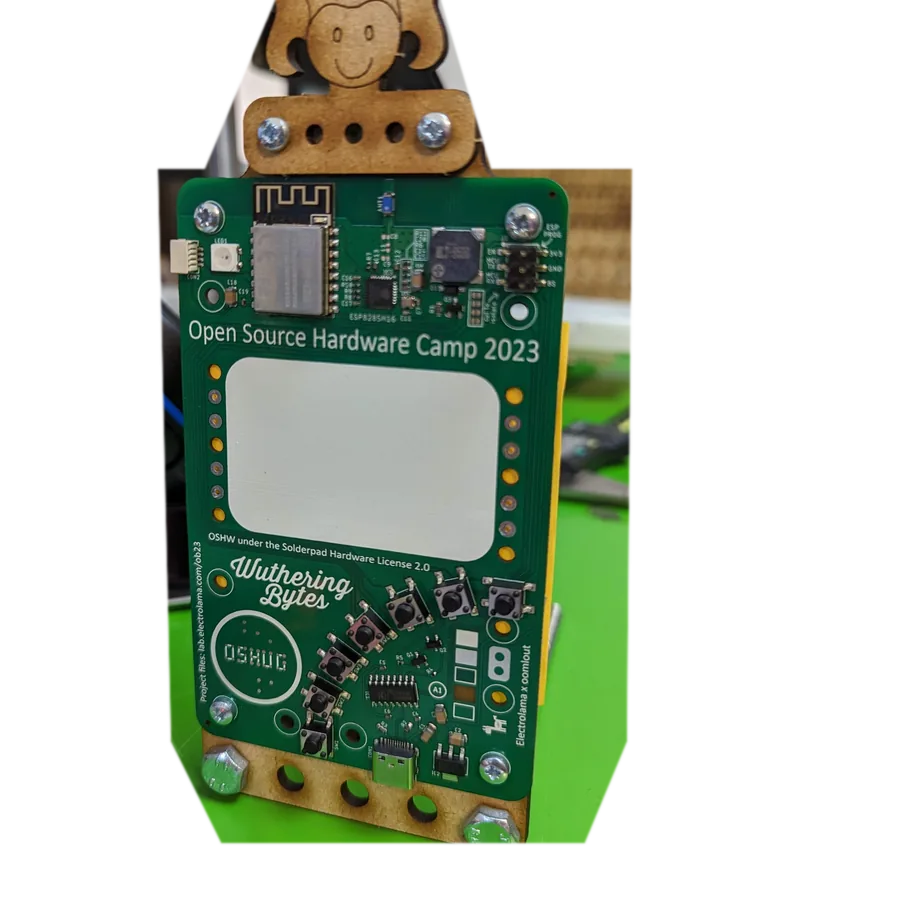
WiFi room-sensor name badge
A WiFi badge for Open Source Hardware Camp 2023, designed as a name badge, solder-paste workshop board, USB-UART adapter, qwiic/STEMMA QT sensor host, and post-event Tasmota room sensor.
People
The Electrolama writeup credits Paul Downey's artwork and decoration/name-plate collaboration.
SourceThe Electrolama lab writeup and repository preserve the badge design and source trail.
SourceThe OSHCamp event page names the badge workshop as hosted by Omer Kilic.
SourceThe Electrolama writeup credits oomlout collaboration around laser-cut badge add-ons.
SourceOSHCamp 2023 adds a UK open-hardware camp badge record where the badge is deliberately practical: participants could build it during the workshop, extend it with add-ons, and keep using it after camp as a sensor platform.
OSHCamp 2023's badge is a WiFi radio board with ESP8285H16 QFN or ESP-12 module population options, USB-C power/programming, CH343 USB-UART, pushbuttons, a qwiic/STEMMA QT compatible I2C port, topper/prototyping contacts, and sensor-device use after the event, as documented in the Electrolama writeup.
The default lifecycle is Tasmota: after the event, attendees can attach a qwiic/STEMMA QT sensor and turn the badge into a room sensor. The repository also preserves design files and example code paths for further hacking.
Electrolama framed the badge as celebrating OSHCamp's return as part of Wuthering Bytes 2023. The board mixed name-badge identity, workshop assembly, Paul Downey artwork, oomlout laser-cut add-ons, a 3D name-plate generator, and a topper board for prototyping.
Lifecycle
The qwiic/STEMMA QT compatible port gives the badge a plug-in sensor ecosystem for post-event use and experiments.
SourceThe badge/topper arrangement exposed prototyping and expansion space, making the badge a workshop board rather than a closed souvenir.
SourceThe badge decoration workflow included a 3D name-plate generator so attendees could personalize the badge object without changing the electronics.
SourceThe writeup credits oomlout and Paul Downey collaboration around laser-cut badge decorations that extended the base PCB into a more complete name-badge object.
SourceElectrolama describes flashing Tasmota by default so the badge could continue as a room sensor after camp when paired with an external sensor.
SourceOperational history
The catalogue avoids overstating app-store-like functionality for a badge whose public record is centered on Tasmota and open hardware files.
The record names both options so readers do not infer every badge had the same radio-module build.
The public badge page, image archive, and API point at a licensed original-photo derivative with source and attribution preserved.
The badge experience depended on workshop readiness instead of only passive distribution; that is useful context for anyone comparing camp-badge accessibility.