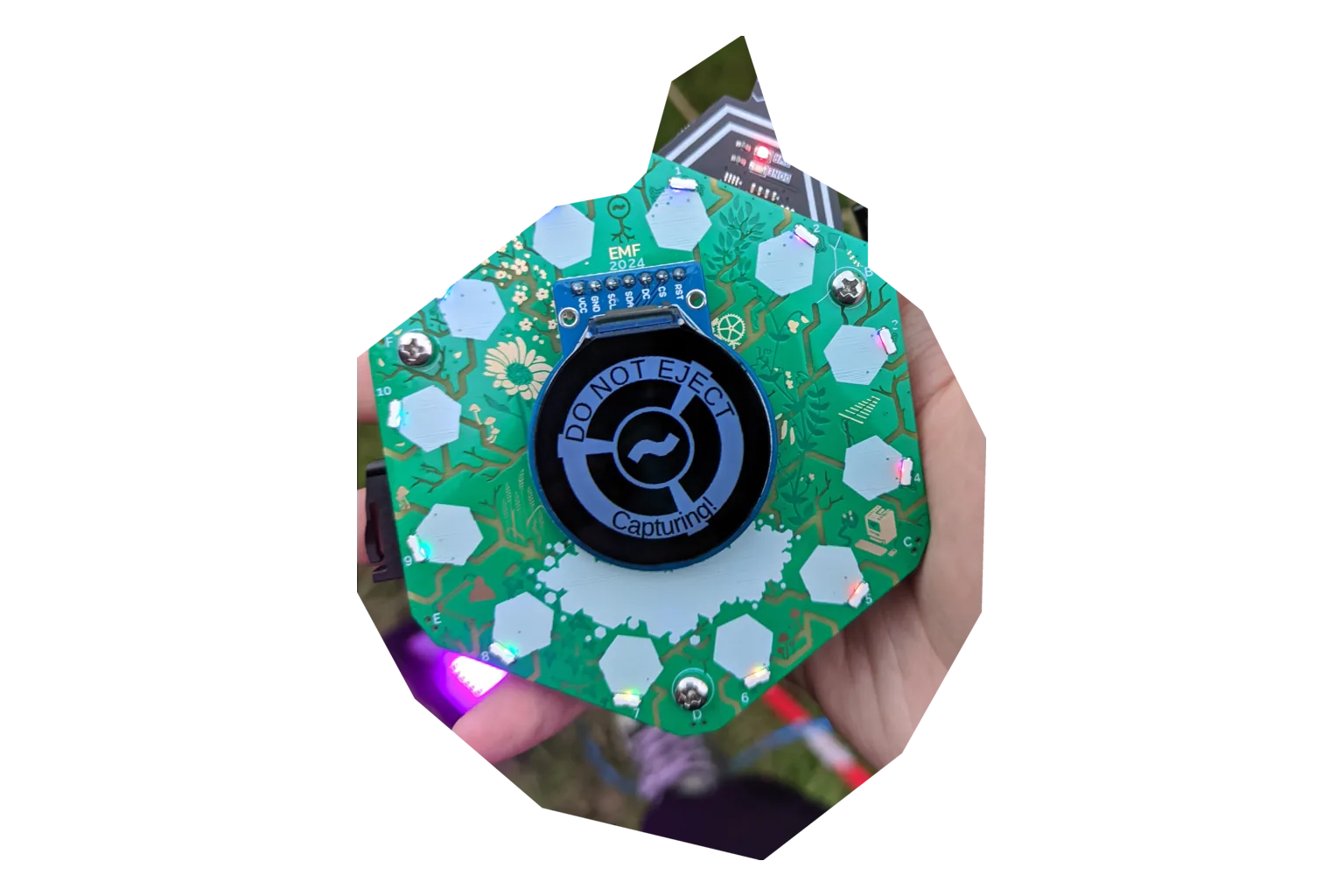
Tildagon
A reusable hexagonal badge platform with six expansion slots, MicroPython apps, and community hexpansions.
Electromagnetic Field
The first Tildagon year, intended as a reusable badge platform with hexpansions.
Eastnor Castle Deer Park · United Kingdom · 2024
A reusable hexagonal badge platform with six expansion slots, MicroPython apps, and community hexpansions.
Lifecycle
Yale32's Social Battery renders configurable social energy as a fuel gauge and adds BLE remote support, another example of post-event badge apps using the platform's radio and display surface.
The Machine Shop's GPS Hexpansion and its published files document a location-sensing hardware path for Tildagon owners.
John Thurmond's LED Filament hexpansion appears in the official showcase as a rainbow LED-filament add-on, extending Tildagon's visual display culture beyond the onboard LEDs.
Matt Emerick-Law's EEH Logo app controls NeoPixels on the East Essex Hackspace LED Logo Hexpansion and advertises that the hexpansion is expected to be available at EMF 2026.
Matt Emerick-Law's Pacman LED app controls LEDs on the Pacman hexpansion created by The Untitled Goose, capturing another app-store entry tied to a named physical add-on.
dratini0's legacy adapter connects Tildagon to SAO, TiDAL, and QW/ST-style expansion traditions, showing that add-ons also serve compatibility and reuse.
The live app directory makes Tildagon a post-event software platform, with badge, background, game, media, music, pattern, hexpansion utility, schedule, WiFi, and sensor apps published by community authors.
Lix's Microphone hexpansion prototype stores visualisation code on EEPROM and samples audio on the badge, a concrete example of self-describing add-on behavior.
The named TGSTL sound-to-light module records the performative side of Tildagon expansion culture: audio-reactive light hardware built for the badge edge.
JonTheNiceGuy's EMFight lets EMF Camp badge holders challenge each other, keeping inter-attendee play in the app-store layer rather than only in built-in firmware.
naomi's Breadboard Tester is scoped to breadboard hexpansions and toggles eGPIO and GPIO pins, making hardware bring-up and pin probing part of the app-store lifecycle.
Skyler Mansfield's Goosespansion is a named PCB hexpansion with published files, showing how the Tildagon gallery tracks both creator attribution and reusable fabrication data.
Tiff's Ducks hexpansion records the purely expressive side of the ecosystem: camp-lore ornamentation using the same connector format as active electronics.
lornajane's Petals use multiple decorative hexpansions around a badge, illustrating how the connector can turn the badge silhouette into a larger wearable object.
JonTheNiceGuy's WiFi Scanner app scans nearby access points and includes a connection doctor that decodes STAT_* failures, a practical post-event network-debugging upgrade.
webboggles' Tildagon WiFi Radar turns a single badge into a directional WiFi radar: rotate the badge to sweep and nearby APs appear as blips on a polar display.
dratini0's HUB75 hexpansion ties the badge platform to large LED-matrix display experiments through published hardware files.
kliment's Flipspansion is an adapter for mounting a hexpansion upside down, with caveats around USB-port-adjacent slots preserved in its project notes.
Tom Dalby's HAB Flash app used Tildagon as a HABVille navigation and tracking tool, sending location to a physical receipt printer during EMF 2024.
The WebUSB flasher gives owners an official browser-based recovery and update path, with caveats around USB serial access and supported browsers.
Matthew Wilkes's MD Updater updates firmware on the Megadrive interface hexpansion, evidence that Tildagon add-ons can have their own firmware-maintenance lifecycle.
pikesley's EMF 2026 Countdown keeps Tildagon active between camp editions, using the badge as a countdown surface for the next EMF cycle.
walkerdanny's Caffeine Jitters is a companion app for the Club Mate haptics hexpansion, where badge buttons adjust jitter frequency.
Six edge connectors allow community hardware modules such as prototyping boards, decorative boards, sensors, GPS, communications, plotter experiments, and other hexpansions.
EEPROM-equipped hexpansions can carry metadata plus a LittleFS filesystem containing an app.py, allowing hardware add-ons to ship their own badge-side behavior.
Team Robotmad's BadgeBot is published as a Tildagon App Directory app for the Hex Drive hexpansion, extending the same hardware ecosystem already visible through HexManager.
Team Robotmad's HexManager app is a 2026 app-store release for managing hexpansion EEPROMs, making Tildagon's hardware add-on lifecycle visible as badge-side software.
John Rogers and Ben Eriksson's Fluroclock app controls an EMF installation from the badge, showing Tildagon as a controller for camp-side media hardware.
mich181189's ArtNet Receiver turns Tildagon into a networked lighting-control receiver, with the app-directory description explicitly warning that the first release is janky and hard-coded.
Official docs preserve post-event recovery behavior: firmware v1.6.0+ can force hexpansion detection with button chords, and failed updates may require better WiFi or flashing.
Nathan Dumont's Omni wheel appears in the official showcase with published files, another example of Tildagon add-ons using mechanical play rather than only electronics.
Nathan Dumont's Flopagon uses a floppy-disk form factor, documenting that Tildagon add-ons range beyond simple sensors into playful media and mechanical experiments.
webboggles' TILDENSTEIN 3D is a 2026 Tildagon App Directory release: a Wolfenstein-style raycasting FPS with ESP-NOW multiplayer set around the EMF Camp grounds.
The post-event WiFi guide documents how owners can attach the badge to a home or workshop network after the camp infrastructure is gone.
Iain Yarnall's 7-Segment display model is a printable visual add-on in the official showcase, showing the hardware record also needs printables and non-PCB artifact links.
Floppy's Interlocking Brick Hexpansions provide stud-compatible plates in multiple sizes, including versions that account for USB-C clearance.
Jake Walker's Protoboard Hexpansion gives badge owners a small general-purpose prototyping surface in the official connector shape.
The official Tildagon hexpansion guide preserves jasonalexander-ja's DECTspansion as a community-made radio expansion example for the reusable EMF 2024 badge platform.
kliment's OG Hexpansion is the official gallery's reference-style PCB example exposing badge-edge pins and linking back to the EMF 2024 hardware repository.
The official docs now preserve concrete repair paths for damaged screens, FPC cables, LEDs, and battery connectors, treating Tildagon as maintainable camp hardware rather than a disposable novelty.
JonTheNiceGuy's Now & Next app shows current and upcoming EMFCamp stage items, carrying the badge from novelty hardware into a live event companion.
webboggles' Seismograph app turns the onboard IMU into a live waveform and Richter-readout instrument with auto-scaling and axis cycling.
MicroPython apps and OS work continue after the event through the documented app publishing and simulator workflow.
Tony Goacher's TGSTL app turns a SparkFun sound detector into a Tildagon sound-to-light path, tying the app store to a physical sensor hexpansion.
pikesley's Hat Village app is listed as the official app of Hat Village at EMF 2026, showing that Tildagon app distribution is already carrying future village-specific software.
Operational history
Hardware add-ons and examples may depend on firmware version, so the badge needs lifecycle tracking rather than one-time hardware notes.
The compendium keeps the app and author record while flagging that source-code provenance is weaker than other Tildagon app entries.
badge.gallery needs to treat Tildagon as a lifecycle record with recurring app, firmware, and hexpansion updates instead of a static EMF 2024 page.
The maintenance record matters because reusable camp badges only stay useful if spare-part and repair workflows survive after the event.