CCCamp 1999 Pass
Early Chaos Communication Camp identity artifact
A conservative identity-pass record for the first Chaos Communication Camp, before public sources document an official electronic camp badge.
Country dossier
Worldwide badge coverage for Germany, grouped into seeded badges, event editions, add-ons, operational issues, resources, and evidence sources.
Seeded artifacts
Early Chaos Communication Camp identity artifact
A conservative identity-pass record for the first Chaos Communication Camp, before public sources document an official electronic camp badge.
Pre-Sputnik Chaos Communication Camp identity artifact
A source-conservative record for CCCamp 2003 as a pre-electronic-badge identity/pass artifact in the camp lineage.
CCCamp 2007 active RFID badge
A small active 2.4 GHz RFID badge/tag used with OpenBeacon base stations for real-time camp tracking and post-camp hardware experiments.
ATmega88 USB-bootloader rabbit badge
A source-backed record for the eHaserl, the Easterhegg 2010 surprise badge from the Munich Chaos Computer Club, with official assembly notes, flashing instructions, errata, and a badge talk.
CCCamp 2011 electronic badge
A shiny electronic nametag and full-featured microcontroller development board that established the long-lived CCC Camp badge tradition rad1o later built on.
Nixie-tube hacker conference badge
A source-backed early TROOPERS electronic badge built around a glowing nixie-tube digit, a programming station for badge scores, a Cat-5 LANyard switch, and hidden capacitive-touch and pad-field hack surfaces.
ARM, 2.4 GHz, LCD, USB, and button badge
A source-backed Hackover 2013 badge record: the event blog described an assembled and flashed badge PCB for every attendee, with ARM processor, 2.4 GHz radio, 6.5 Kpx LCD, USB, and buttons.
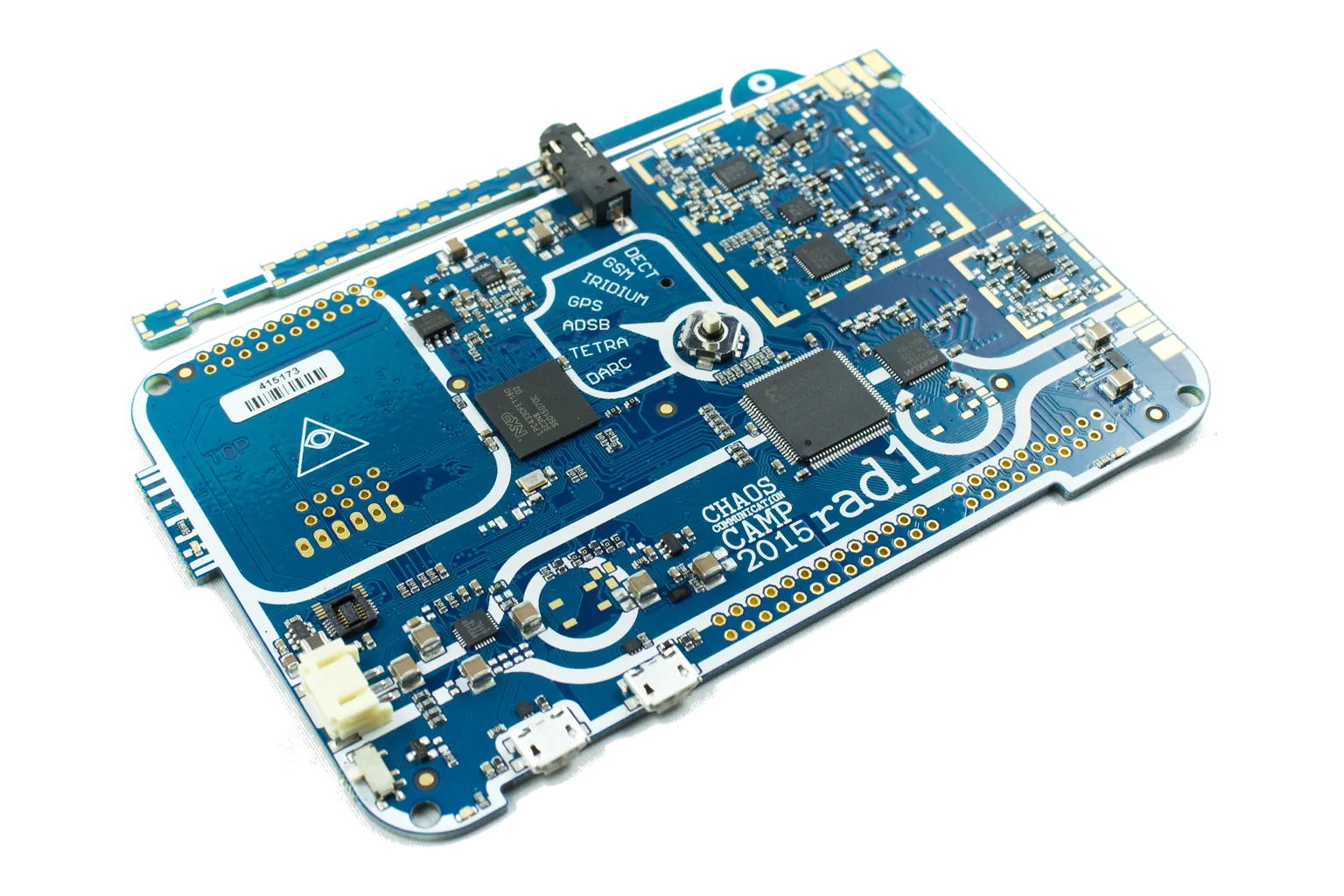
CCCamp 2015 SDR badge
A HackRF-inspired software-defined radio badge that let campers receive, transmit, inspect spectrum, flash evolving firmware, solder RF add-ons, and keep hacking long after camp.
ESP8266 GulaschPushNotifier badge
An Entropia-produced Gulaschprogrammiernacht 17 badge built around ESP8266, a 128x128 LCD, 18650 power, sensors, WS2813 LEDs, IR, a ROM store, and Hack-the-Badge camp challenges.
Unofficial SR-latch PCB badge for Labitat
An unofficial Labitat indie badge for 35C3 using the congress artwork theme, a simple flip-flop memory circuit, reverse-mount LEDs, a two-AA battery holder, and an optional power-only Shitty Add-On footprint.
CCCamp 2019 wearable sensor badge
A wrist-worn CCC Camp badge focused on sensing, health-style signals, BLE, and a Python-friendly app ecosystem.
ESP32 e-paper keyboard badge
A WiFi-connected MicroPython badge for TROOPERS19 with ESP32-WROVER, 2.9 inch e-paper display, full QWERTY keyboard, joystick, USB-C charging/flashing, LEDs, accelerometer, and Shitty Addon support.
Bring-your-own-controller WS2812B LED badge
An unofficial 36C3 badge kit made as a bring-your-own-controller blinky platform with a PCB, eight WS2812B addressable LEDs, eight 100 nF capacitors, lanyard, prototyping area, and controller examples using an Adafruit Feather M4 Express with CircuitPython.
On-site printed and laminated attendee badge
A source-backed non-electronic GPN20 attendee-badge record anchored by the Entropia wiki workflow for printing and laminating badges at the infodesk.
ESP32-C3 electronic badge for Hacking in Parallel
The Hacking in Parallel Berlin attendee badge was an ESP32-C3 electronic badge with RGB LEDs, USB-C Serial/JTAG, battery charging, NFC/I2C storage, SAO/I2C expansion, buttons, and RIOT OS board support.
Badge.Team-powered conference badge record
A conservative TROOPERS22 badge record anchored by Badge.Team's public PID/code entry for Troopers 2022 badges and the official TROOPERS22 event context.
Assembly-created digital achievement badges
The 37C3 Hub archived a digital badge system where assemblies could create badges that visitors might find, redeem, and display during the Hamburg Congress.
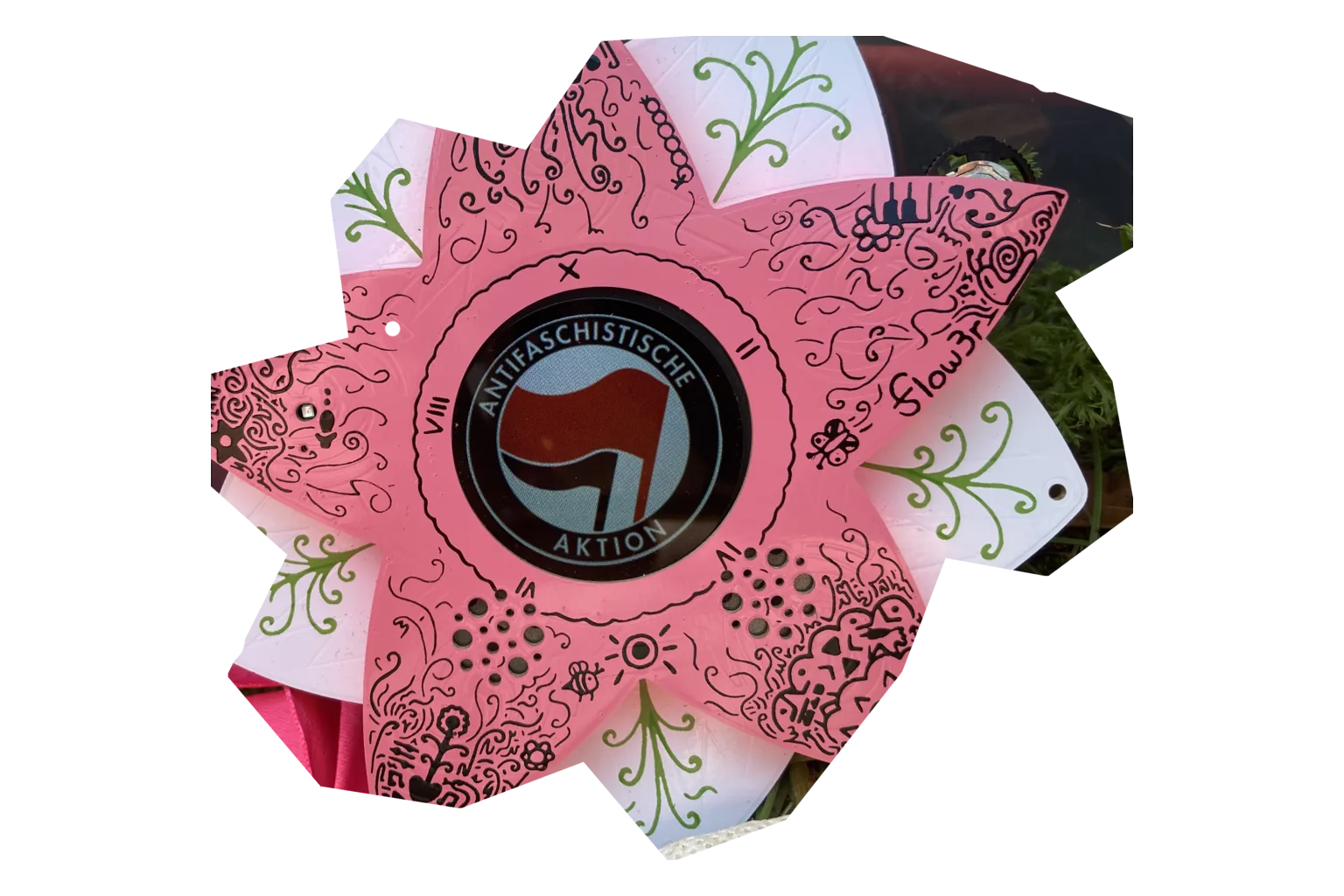
CCCamp 2023 music and light badge
A petal-shaped electronic instrument where touch and gestures become sound and light.
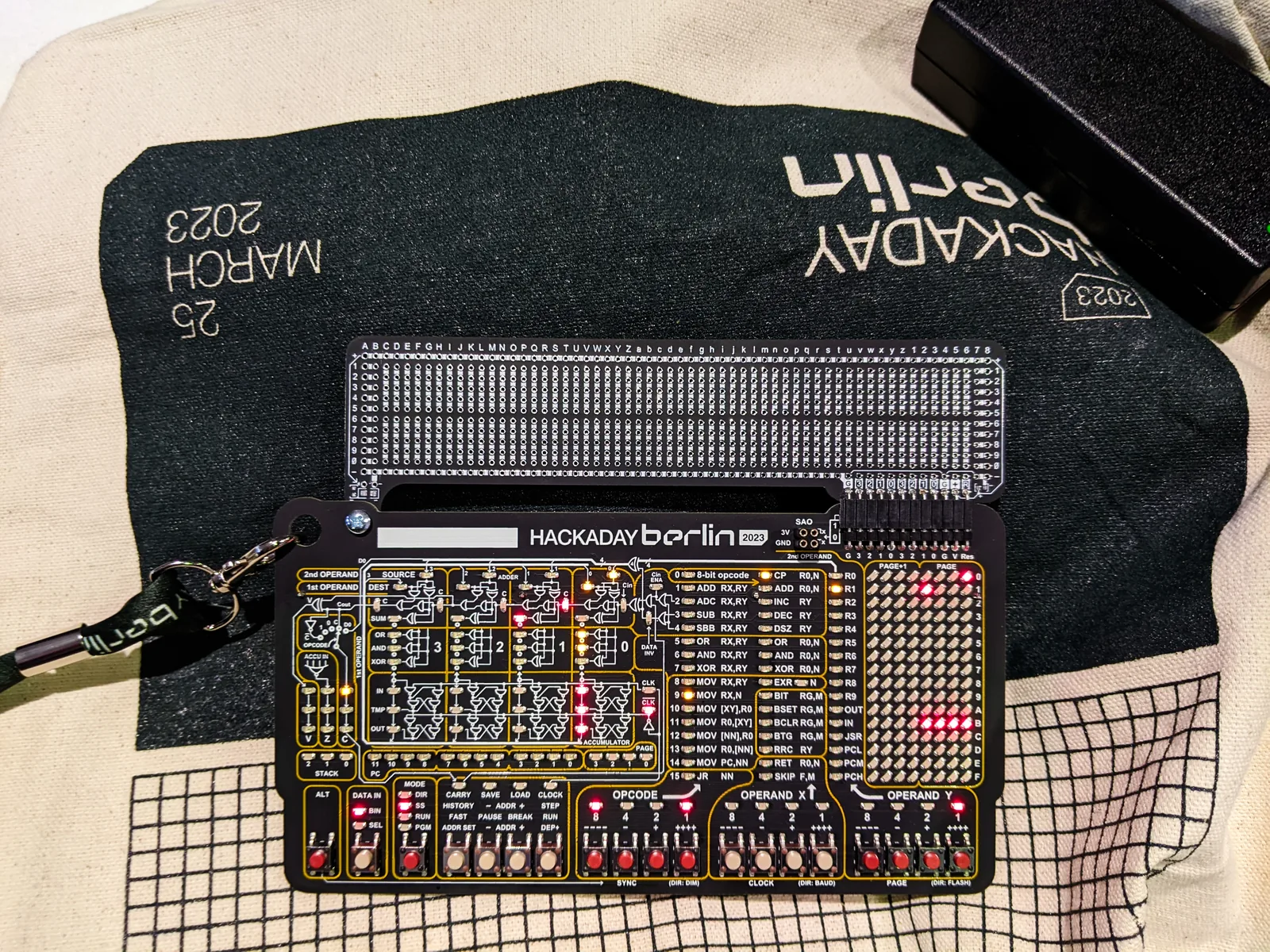
Berlin-reskinned down-to-the-metal computer trainer
Hackaday Berlin 2023 gave European attendees a Berlin-reskinned Voja Antonic Voja4 badge: a compatible revision of the 2022 Supercon down-to-the-metal computer trainer and retrocomputer, with public event sources tying it to the March 25-26 MotionLab.Berlin gathering and Saturday badge-hacking ceremony.
Badge.Team retro-adventure conference badge
A Badge.Team-powered TROOPERS23 electronic badge with a public retrospective PDF, open hardware repository, firmware repository, and companion SAO hardware repository.
Expanded assembly-created Hub badge system
The 38C3 Hub archived an expanded digital badge system where assemblies created discoverable event badges for visitors, grouped into categories such as General, Exploration, and Help.
Rabbit Chaos Adventure badge
A source-backed Easterhegg 2024 badge record for the Rabbit Chaos Adventure: the event wiki points to challenges on campus, laptop, and badge, while the public repository preserves RCA badge files, schematics, Gerbers, parts exports, media, and printable add-ons.
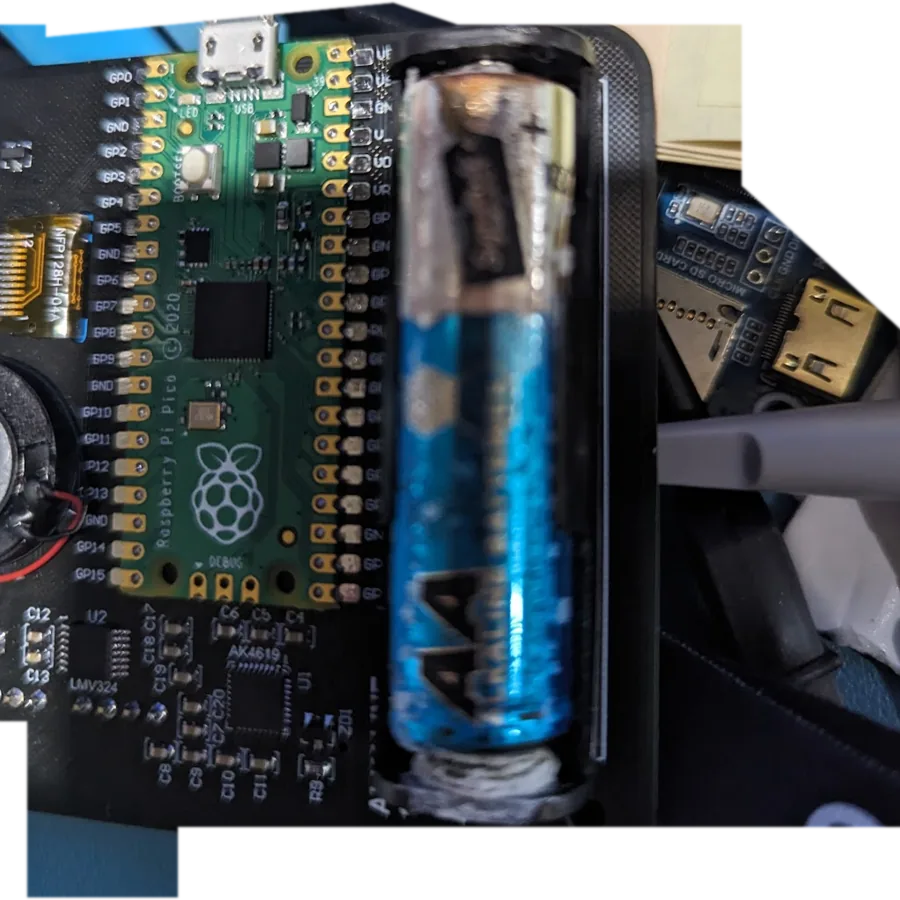
Berlin reuse of the RP2040 analog vectorscope badge
Hackaday Europe 2024 in Berlin reused the 2023 Hackaday Supercon Vectorscope badge: an RP2040/MicroPython analog playground with a round IPS display, ADC/DAC signal path, front controls, joystick, prototyping space, and badge-hack ceremony.
Open-hardware ESP32-S3 / TROPIC01 assembly badge and devboard
The Critical Decentralization Cluster's CDC Badge was presented as an electronic conference badge and development board at the completed 39th Chaos Communication Congress. The source-backed open-hardware platform combines an ESP32-S3, TROPIC01 secure element, front-lit e-paper display, twelve-button keypad, LiPo power path, and expansion ports, while public sources do not establish a conference-wide or admission-badge allocation.
Modular cyberpunk watch-style badge
An electronic badge created for 39C3 as a modular, solderable watch-style device. The project was designed to be reconfigurable with interchangeable daughter boards (called shards) for different use cases.
Assembly-created Hub achievement badges
The 39C3 info pages documented a Hub badge system where participants could collect assembly-created digital badges via redeem tokens, profile assignment, QR codes, and challenge or visit workflows.
Printed attendee badge, lanyard, and safeR badge workflow
A source-backed non-electronic GPN23 badge record for the printed attendee badges and lanyard workflow documented by Entropia's FAQ and badge how-to.
Berlin reuse of the Supercon 8 SAO badge with revamped firmware
Hackaday Europe 2025 reused the Supercon 8 Simple Add-On badge concept in Berlin: an SAO-focused badge with I2C/GPIO exposure, MicroPython lineage, revamped Europe firmware, Supercon contest-winner add-ons, and badge-hacking ceremony context.
ESP32-C5 V2X badge with 802.11p sniffer and OCPP EVSE mode
A ScapyCon 2026 conference badge documented through public firmware and flash-kit archives: the badge is built around an ESP32-C5-WROOM-1-N4 module, is themed around V2X and IEEE 802.11p in the 5.9 GHz ITS band, and runs a badge UI, 802.11p sniffer, conference schedule, USB host link, and a Pocket EVSE OCPP charge-point simulator mode.
Events
The first Chaos Communication Camp belongs in the lineage as an early outdoor camp identity/pass era before public electronic badge records.
The second Chaos Communication Camp sits between the early pass era and the later Sputnik/OpenBeacon infrastructure badge.
The camp where Sputnik/OpenBeacon active RFID tags turned attendance itself into a 2.4 GHz tracking and experimentation surface.
The Munich Easterhegg edition whose eHaserl surprise badge was documented through assembly instructions, flashing notes, alternative software, and a public badge talk.
The camp where r0ket introduced many attendees to the idea of a deeply hackable electronic camp badge.
A German IT-security conference whose attendee badge used a nixie tube, score programmer, Cat-5 LANyard switch, capacitive touch secret, and hackable pad fields.
The second Hackover edition, whose ticket included an assembled and flashed badge PCB with ARM processor, 2.4 GHz radio, LCD, USB, and buttons.
The camp where rad1o turned the official badge into a serious SDR platform.
Entropia's 2017 Karlsruhe hackathon and conference, where the GPN17 Badge doubled as a GulaschPushNotifier, ROM-store device, and Hack-the-Badge target.
The 2018 Chaos Communication Congress in Leipzig, where Thomas Flummer produced an unofficial Labitat indie badge around the 35C3 Refreshing Memories visual theme.
The 2019 Chaos Communication Congress in Leipzig, where Thomas Flummer produced an unofficial bring-your-own-controller LED badge kit for hallway badgelife hacking.
The edition whose card10 badge explored wearable sensing and app distribution.
A German IT-security conference with a public ESP32 e-paper keyboard badge hardware writeup, KiCad files, and Shitty Addon ecosystem.
Entropia's 2022 Karlsruhe edition whose public wiki documents on-site printed and laminated attendee badges plus badge-issue queue feedback.
The December 27-30, 2022 decentralized Berlin year-end hacker event whose attendees received an electronic HiP badge and whose schedule later included a badge-hacking workshop.
A German TROOPERS conference edition whose public Badge.Team PID record names Troopers 2022 badges as using the Badge.Team platform.
The December 27-30, 2023 Hamburg Chaos Communication Congress whose official Hub archived an assembly-created digital badge system, distinct from a physical or electronic attendee badge.
The flow3r badge shifted the camp badge toward music, touch, light, and collaborative art.
The March 25-26, 2023 Berlin Hackaday conference whose official preview offered attendees a Berlin-reskinned Voja4 down-to-the-metal computer trainer badge and a Saturday-night badge-hacking ceremony.
A German TROOPERS conference edition with a Badge.Team-powered electronic badge documented through the official badge retrospective, public hardware repository, firmware repository, and SAO hardware repository.
The December 27-30, 2024 Hamburg Chaos Communication Congress whose official Hub archived an expanded assembly-created digital badge system, distinct from a physical or electronic attendee badge.
The 21st Easterhegg in Regensburg, where the Rabbit Chaos Adventure tied campus, laptop, and badge challenges to a public badge repository and hardware-hacking area.
The Berlin Hackaday Europe edition whose public schedule included a badge-hacking ceremony and whose field reports document reuse of the 2023 Vectorscope badge.
The December 27-30, 2025 Hamburg Chaos Communication Congress whose official info pages documented a Hub badge system for assembly-created digital souvenirs, challenge rewards, and help/exploration badges, alongside independently scoped Cyberwatch and Critical Decentralization Cluster electronic assembly badges.
Entropia's 2025 GPN edition with source-backed non-electronic attendee badges, lanyard reuse guidance, badge design/production notes, and safeR/orga badge context.
The March 15-16, 2025 Berlin Hackaday Europe edition at MotionLab, with public sources documenting a Supercon 8 SAO badge reuse, revamped Europe firmware, bundled SAOs, and a Saturday-night badge-hacking ceremony.
The September 15-16, 2026 ScapyCon edition at TechBase Regensburg, anchored by the official event page. The elapsed date plus participant talk, workshop, and badge firmware archives corroborate the held conference, while the official page still carries pre-event ticketing wording, so the edition is not marked completed on official wrap-up evidence and badge issuance details stay open. A September 27 recheck found the page unchanged, still pre-event with the gallery showing 2025 photos, and the September 28 through 30 rechecks found it unchanged again.
Lifecycle
The event wiki describes Rabbit Chaos Adventure challenges on campus, laptop, and the badge, making the badge part of the game surface.
The antenna guide documented temporary human/copper-wire reception tricks and the proper SMA modification, including rotating or bridging the 0-ohm resistor in the RF path.
The wiki preserves alternative software links for Tetris Sound Track, TV-Bunny, and Ethersex, showing the badge as a small AVR software target beyond the default firmware.
New apps are published by adding a TOML pointer under the flow3r-apps index and opening a merge request; after merge the app appears in the public directory.
The app index treats a commit that increments metadata.version in flow3r.toml as a new release, making post-camp app maintenance part of the badge lifecycle.
The 36C3 badge intentionally shipped without a controller so attendees could attach Arduinos, FPGAs, Feather boards, or other battery-powered controller choices.
Hackaday documents a score programmer, a 0-to-9 digit collection challenge, a secret capacitive touch sensor, and pad fields intended for attendee hacking.
Project documentation and README material link a LoRa expansion shard to an adapted Meshtastic path, indicating an explicit long-range radio capability target.
The documented board exposes I2C through SAO headers and includes an ST25DV04K NFC/I2C EEPROM for badge experiments.
The optional SAO connector follows the rough orientation of the standard for upright add-ons but leaves I2C pins unconnected, making it a power-only aesthetic expansion point.
The public repository documents a Raspberry Pi GPIO header, a SAO port, and a Grove-compatible connector as three expansion paths. It does not establish that any particular add-on was distributed or supported at 39C3.
The official 39C3 CDC Badge presentation and RIAT hardware repository identify an ESP32-S3 development platform paired with a TROPIC01 secure element. The catalogue does not treat that hardware description as a claim about every physical event unit's exact revision or configuration.
The 39C3 Cyberwatch project is documented as a solderable watch-style base badge that is designed to accept interchangeable shard boards through a modular hardware concept.
The project documentation describes an SD-card form-factor interface used to carry modular add-on boards in place of fixed accessory ports.
Project sources indicate a base firmware expectation around congress time and a prebuilt firmware trail for shard use, but they do not confirm a complete public production release artifact set for all build variants.
Hackaday's speaker announcement says the four winning Supercon SAO contest entries were being put into the Hackaday Europe 2025 schwag bag.
The ticket preview lists the Supercon touch wheel, LED spiral, and CH32V003 prototyping boards as included with the Europe badge/add-on bag.
Sputnik/OpenBeacon tags were read by 30+ OpenBeacon base stations installed around the event venue.
The feedback page records attendee frustration that badge issuing queues were extremely long, turning a simple identity object into a visible camp-operations issue.
The case page linked DXF outlines, simple laser-cut enclosures, SMA-compatible variants, 3D-printable cases, and a limited 32C3 screw-and-spacer kit.
The SDR guide documented GNU Radio, gnuradio-companion, osmocom_fft, Gqrx, SDR#, udev rules, kernel-module workarounds, and cross-platform setup for using rad1o as an SDR peripheral.
The badge could be connected to a laptop by USB-C for development, with RIOT OS documenting Serial/JTAG flashing and manual bootloader recovery steps.
The 37C3 Hub page states that assemblies could create badges that visitors might find during the event.
The 39C3 documentation lists General, Explore, and Help categories for badges created by assemblies through the Hub backoffice.
The 38C3 Hub page states that assemblies could create new badges in the backoffice and that the redeem function is disabled after archival.
The 38C3 Hub page groups badges into categories such as General, Exploration, and Help while listing assembly and community badge names.
The 39C3 page documents Hub profile display, pending badge acceptance, default visibility, per-badge visibility choices, and badge management controls.
The 39C3 page says assemblies could provide redeem tokens with URLs and QR codes so participants could collect badges through the Hub.
The archived 37C3 page preserves the Redeem badge workflow but says the function is no longer available after archival.
The badge turns the 35C3 Refreshing Memories theme into a simple flip-flop memory circuit with two orange LEDs and button-controlled state.
The official Hackaday schedule placed the Badge Hacking Ceremony on Saturday night from 22:00 to 24:00.
Hackaday announced a Saturday-night badge-hacking ceremony for attendees to show what they made with the Berlin Voja4 badge.
The official event schedule included a Saturday-night badge-hacking ceremony, and the heise report describes participants presenting judged badge hacks.
The GPN17 challenge page collected badge-hacking tasks, scoring, and prize context for attendees during the event.
Hackaday's Vectorscope article and repository frame the badge around MicroPython, oscilloscope-like display behavior, waveform generation, ADC/DAC signal paths, and four analog inputs.
The binary repository preserved flashable camp firmware, HackRF images, games, animations, fonts, images, l0dables, and a REV 05 release aligned with HackRF v2022.09.1.
The project page includes a CircuitPython snippet using neopixel.mpy and board.A2 on an Adafruit Feather M4 Express to run a rainbow animation.
The bootloader exposed HACKRF and HKRF-OLD modes, with different USB product IDs for newer and older HackRF software compatibility.
RIOT OS documents the HiP badge as an ESP32-C3 board with a dedicated `hip-badge` flashing target.
Official docs preserve multiple update paths: webflash, USB mass-storage flashing, and a built-in WiFi updater introduced in firmware v1.3.0.
Hackaday's January 2025 preview says the Europe badge would use revamped firmware compared with the Supercon setup.
Hackaday states that the badge could flash the CH32V003-style add-ons through the SAO port.
The ATmega88 was already flashed with a USB bootloader so attendees could program it over a normal USB port with avr-gcc, avrdude, and the public SVN checkout.
Rabbit Radio reports that challenge progress unlocked more parts for the PCB, turning puzzle progress into a physical badge build-up mechanic.
Jeff and Jann Foehringer designed the Fuccs add-on, with the PCB layout published in its own repository.
Participant reporting says CTF success yielded cool add-ons for the Easterhegg badge and that the badge could later be soldered in the hackerspace.
The separate tr23-sao-hw repository documents a companion SAO board for the TROOPERS23 badge.
The r0ket wiki tracked hardware hacks, shields, and add-on ideas, making expansion hardware part of the badge culture from the start.
The TROOPERS19 badge exposed a 3.3 V I2C Shitty Addon interface so the badge could wear its own small add-on boards.
helge's HiFi-Bodge project extends the badge as an audio-capable hardware add-on.
The badge exposes two JST-SH 4-pin footprints following the I2C Qwiic / STEMMA QT pinout, giving app authors a documented path to breakout-board hardware.
The architecture notes list four output bits, four input bits, an external connector, serial mention, and an SAO port as the public expansion surface.
28C3 included USB missile launchers for a competition to combine launcher hardware with r0ket; the first 100 published hacks could keep the launcher.
Team r0ket brought RGB flame m0dules to 28C3 as a purchasable hardware extension for the badge.
Hackaday reports a 10 EUR workshop kit for soldering electrode pads to a sacrificial USB-C cable, including a demo where pads on the temples sensed left/right eye movement.
Public writeups and later community experiments connected rad1o to HackRF/PortaPack-style standalone SDR usage beyond the official camp firmware and documented SMA mod path.
The talk describes a memory-stick-sized ARM7 meshing node design, USB power/reprogramming, RP-SMA antenna, and GCC ARM toolchain support for custom firmware.
The volunteer page documents taking a badge sheet from the printer, laminating it, cutting it, making a hole, and attaching it to a lanyard before issuing it to an attendee.
The badge used a Cat-5 cable through the board as a LANyard switch, making the physical lanyard part of the badge interaction.
The official badge page links 3D-printable mechanical accessories and CAD resources for carrying, controlling, and decorating the badge.
The back-cover README documents printable cover and switch-cap files, optional additional LEDs, switched-power pickup pins, LED mounting, masking, and snap-on assembly.
The wiki pointed Android users to a patched RF Analyzer APK/source path because upstream RF Analyzer did not yet work with rad1o.
The repository exposes separate schematic PDFs and Gerber ZIPs for the badge, head, hood, arm, and back boards, making the RCA artifact a multi-board kit rather than a single PCB record.
Badge Net builds on Badge Link to provide Ethernet and IPv6 connectivity between badges through the 3.5 mm jacks, exposed to MicroPython as a normal network interface.
RIAT publishes KiCad hardware, printable cases, documentation, fabrication-generation material, and v1.0/v1.1 releases under CERN-OHL-P-2.0. This preserves a reproducibility trail without proving final event production parity or a recipient inventory.
The closing talk lists the wider RCA kit around the badge, including lanyard, business card, two sticker variants, postcard, and booklet.
The public Badge.Team firmware repository gives the badge a recoverable software trail instead of leaving the dossier at a hardware-only record.
PID.codes names Troopers 2022 badges in the Badge.Team platform identifier record, tying the badge to the wider Badge.Team ecosystem even though hardware and firmware details remain unrecovered.
The 28C3 update promised an improved mesh network, l0dables for interactive installations, and support for the next flame generation.
krim404's public GPL-3.0 CDC Badge OS describes an ESP-IDF/PlatformIO application stack with hardware-key, identity, plugin, and BLE capabilities, but labels itself pre-1.0 beta and warns of data loss on flashing. It is not a verified 39C3 deployment image.
At 37C3, Hardware Hacking Area mentors provided HiP badges to teams for embedded-programming practice and allowed the devices to be taken home after the showcase.
The 2021 evolution talk documents continuing firmware, Hatchery, BLE, companion-app, sensor, and reuse work after Camp 2019.
The badge how-to records a hidden pattern concept in the printed design and preserves print-production details for A7 landscape badges.
The 2013 development post lists 2.4 GHz radio as one of the headline badge features, placing Hackover in the same radio-badge experimentation era as other early European badges.
The badge how-to and orga notes preserve safeR, orga, participant-name-sign, and area-owner context for different visible badge roles.
The AMG8834 breakout turns the badge expansion interface into a small thermal-camera experiment.
card10's wearable hardware was extended through Hatchery-hosted applications and firmware workflows.
flow3r's app directory and MicroPython docs support post-event applications, instruments, utilities, and experiments.
The badge page documents a ROM store and an official GulaschPushNotifier ROM, making app-like software swapping part of the GPN17 experience.
bl00mbox lets multiple flow3r applications make sound together, with foreground/background audio behavior documented for app authors.
The Hackover archive preserved firmware and schematic git clone commands after the event, including a note that KiCad-free users could find schematic PDFs under plots/schematics.
The FAQ asks visitors to bring a reusable lanyard or donate lanyards so the event can reduce waste while still issuing wearable badges.
The official event page describes a front-lit e-paper display and twelve-button keypad; the public hardware repository associates the keypad with a TCA9535 I²C expander.
The v0j4 project describes the badge as a PIC24 implementation of a 4-bit virtual machine with small instructions, visible registers and stack state, GPIO, and program slots.
The kit included a PCB, eight WS2812B addressable LEDs, eight 100 nF capacitors, a lanyard, and bottom-center VCC/data/GND LED-string pads.
Ten green and ten blue LEDs illuminate the front-side circuit artwork through the PCB, while the assembly guide documents reversed LED mounting and soldering risks.
RIOT OS board documentation lists 16 WS2812B LEDs, while the 37C3 workshop source describes the badge as having many RGB LED lights.
The official wiki walks attendees through solder-bridge removal, LCD connector placement, ATmega88 socketing, IR parts, USB contact soldering, jumpers, and final display insertion.
Attendee writeups place badge soldering and SMD practice inside the event hardware-hacking area, with help and conversation around PCBs and badges.
The Berlin field report describes busy soldering benches, a workshop adding a synthesizer and photodiode experiments, 3D-printed cases, and participant hardware add-ons.
Operational history
The badge is a useful early case study for badge infrastructure as both playful telemetry and a privacy-sensitive camp artifact.
The dossier preserves the kind of practical hardware caveat that matters to badge hackers: assembly order and first-power-on state could damage the device.
The badge-linked challenge was praised by some participants but also created discoverability and inclusion friction for others.
RF expansion was intentionally hackable but not risk-free; the compendium records it as a hardware-modification caveat rather than a plug-and-play feature.
Laptop power-management defaults could make a working badge look broken until autosuspend was disabled for the rad1o USB IDs.
Using rad1o as an SDR depended on choosing the correct firmware mode and sometimes adding udev rules or updated SDR packages.
Even non-electronic badges can affect camp operations when printing, laminating, and handout throughput becomes a bottleneck.
This captures a real camp-experience issue: a major badge can be technically strong while still arriving late enough to affect who can hack on it during the event.
The badge was a real SDR, but practical RF work still required antenna knowledge and sometimes soldered hardware changes.
The catalogue preserves this provenance explicitly rather than presenting the firmware as a purely hand-written engineering artifact.
This keeps the catalogue honest about flow3r's app lifecycle and gives app authors the real publication path.
The badge workflow is historical; live redemption behavior should not be inferred from the archived page.
The badge workflow is historical; live redemption behavior should not be inferred from the archived page.
This is useful lore for European badge culture: the organizers optimized for immediate on-site play and beginners, not only for people already comfortable with microcontroller programming.
The record preserves the concrete 39C3 assembly artifact while not conflating a cluster badge with CCC's main credential or assuming every attendee received one.
The record may describe the public software capability surface but does not endorse the firmware, vouch for its cryptography, privacy, data durability, or safety, or imply it was the software deployed at 39C3.
The record preserves the system-level artifact without inventing individual badge names, counts, icons, or assembly-specific rewards.
A recurring European badge-culture debate: prestige and hack value versus cost, accessibility, and usefulness for the average attendee.
Camp operation included a practical repair and flash-station workflow, not just software experimentation.
The record documents the shared PCB and LED kit without implying a single official firmware or complete electronics stack.
The catalogue models this as an official digital/community badge system and avoids hardware claims.
The catalogue models this as an official digital/community badge system and avoids hardware claims.
The catalogue models this as an official digital/community badge workflow and avoids hardware claims.
Software claims stay limited to the announced revamped firmware, MicroPython lineage, SAO-port flashing statement, and upstream public repository workflow.
Software and hardware claims stay limited to Hackaday's compatibility statement, the v0j4 architecture notes, and the original Supercon badge context.
rad1o belongs in the continuing-platform part of badge.gallery: its record should track firmware and HackRF compatibility well after the camp weekend.
Later firmware transparency is useful evidence, but the catalogue does not backdate it into a confirmed Congress software image or user-support commitment.
The page is a useful example of good badge documentation: it records what can be hacked and where users should be careful.
These caveats make the record useful beyond specs: future badge teams can learn from the production failure modes.
The page is included as a pass/identity artifact and as an archive-recovery target; electronic-badge claims should wait for primary evidence.
The page keeps the transition year visible while avoiding a false continuity of electronic badges.
The edition is not marked completed on official wrap-up evidence, and the badge record documents the public hardware and firmware trail without asserting organizer issuance or universal attendee allocation.
The catalogue records the Berlin artifact as an event-specific revision while avoiding unsupported claims about exact PCB changes until a Berlin-specific hardware archive is recovered.
Detail pages should record source dates and expect firmware, app, networking, and expansion guidance to change after the camp.
GPN17 was hackable, but successful custom ROM work still required understanding the embedded limits instead of treating the badge like a general-purpose computer.
The badge stays image-free rather than copying Hackaday article media, repository photos, screenshots, social media, or generated approximations.
The record stays source-backed and image-free rather than copying wiki media, attendee photos, screenshots, placeholder art, or generated approximations.
The entry remains image-free rather than reusing unrelated badge photos, generated imagery, or archive-adjacent visuals.
The Germany record remains source-backed and image-free rather than copying source-page media, documentation screenshots, event photos, social media, placeholders, or generated approximations.
The record stays source-backed and image-free rather than copying the archived wiki image, Hackaday images, screenshots, or generated approximations.
The Germany record remains source-backed and image-free rather than copying source-page media, documentation screenshots, event photos, social media, placeholders, or generated approximations.
Original Hackaday Europe or Vectorscope badge photos should be added only after license and attribution are cleared.
The entry remains source-backed and image-free rather than copying repository JPEGs or event media.
The entry remains image-free rather than copying unknown-rights project media, generated previews, or social/press photos.
The record remains image-free rather than copying wiki images, badge-design screenshots, attendee photos, placeholder art, or generated approximations.
The record stays image-free rather than copying archived UI screenshots, logos, or unknown-rights badge icons.
The Germany record remains source-backed and image-free rather than copying source-page media, documentation screenshots, event photos, social media, placeholders, or generated approximations.
The Germany record remains source-backed and image-free rather than copying source-page media, documentation screenshots, event photos, social media, placeholders, or generated approximations.
The record remains source-backed and image-free rather than copying Entropia wiki photos, screenshots, repository web assets, Hackaday.io media, or generated approximations.
The Germany record remains source-backed and image-free rather than copying source-page media, documentation screenshots, event photos, social media, placeholders, or generated approximations.
The Germany record remains source-backed and image-free rather than copying source-page media, documentation screenshots, event photos, social media, placeholders, or generated approximations.
The entry remains image-free rather than reusing unrelated badge photos, generated imagery, or archive-adjacent visuals.
The catalogue publishes the record without a badge image until an original licensed photo can replace it.
The catalogue publishes the record without a badge image until an original licensed photo can replace it.
The record stays image-free rather than copying archived UI screenshots, logos, or unknown-rights badge icons.
The entry remains source-backed and image-free rather than copying all-rights-reserved project photography.
The catalogue publishes the record without a badge image until an original licensed photo can replace it.
The record remains source-backed and image-free rather than copying a wiki, event, or documentation image without complete rights provenance.
The entry remains source-backed and image-free rather than copying project-page imagery without a clear catalogue reuse basis.
The record stays image-free rather than copying Hub UI screenshots, logos, badge icons, event graphics, or generated approximations.
The dossier keeps GPN20 in the European badge archive while avoiding unsupported electronics, firmware, app-store, or hardware claims.
The dossier keeps GPN23 discoverable while preventing false firmware, microcontroller, app-store, or hardware claims.
The page separates card10's wearable form factor from ordinary smartwatch expectations and keeps the focus on sensors, BLE, and hackability.
The RCA build-up mechanic was part of the fun, but also created expectations around badge parts and prize/reward availability.
The image is still usable because the license, attribution, Flickr source, and review status are explicit; the typo is not treated as technical evidence beyond the intended machine-code description.
Open hardware remains a preservation and reproduction trail without becoming a claim that every 39C3 badge exactly matches a current repository release or bill of materials.
The dossier records what is sourced—badge architecture and shard concept—without over-claiming circulation or official distribution scope.
The record treats 37C3 as lifecycle and reuse evidence while keeping the badge assigned to Hacking in Parallel Berlin 2022.
The catalogue surfaces the published operational caution without presenting the badge as electrically validated, safe to charge, or safe to flash under every firmware/configuration combination.
The record preserves production reality and warns future builders that surviving boards may differ from repository files.
Badge pickup and identity workflow should be read alongside the event's registration and capacity-control model.
Repository photos and renders are retained as evidence only unless a separate explicit image license or permission basis is recovered.
This keeps the record useful without turning repository existence into unverified hardware-spec prose.
The record should remain tied to Hackaday Europe 2025 while preserving the upstream 2024 Supercon hardware/software lineage.
badge.gallery should preserve both the European field context and the upstream Vectorscope hardware/firmware lineage without implying a separate 2024 board design.
The hardware description keeps the TVOC claim tied to source context and records that not every physical badge necessarily carried the same populated sensor set.
The catalogue records the shipped board as a real attendee badge while preserving the known build limitations.
The software record stays tied to the published architecture and shard references instead of inventing an endpoint, app-store, or locked release stream model.
The page is sourceable, but the image remains empty until a licensed original badge photo is cleared.
The current record keeps sourceable details while marking original-photo, full-BOM, and source-history recovery as future work.
The dossier is now specific about the public artifact package while still avoiding unsupported firmware and chip-level claims beyond what the repository and reports expose.
The first-pass record avoids unsourced chip-level, firmware-feature, and designer-credit claims until the repositories or original media are recovered.
The dossier preserves the badge without inventing chip-level or high-voltage design details that are not present in the public sources.
The dossier is intentionally conservative: it preserves the record without inventing component-level specs or badge-team credits.
The badge is a good example of how open-toolchain choices can improve reuse while still affecting event production schedules.
The catalogue treats the badge as Congress hallway badgelife, not as an official CCC admission badge.
The catalogue keeps it separate from official CCC event identity and models it as independent Congress badgelife.
This records the logistical side of early badge workshops: kits, batteries, and replacement parts shaped the attendee experience.

.jpg)
