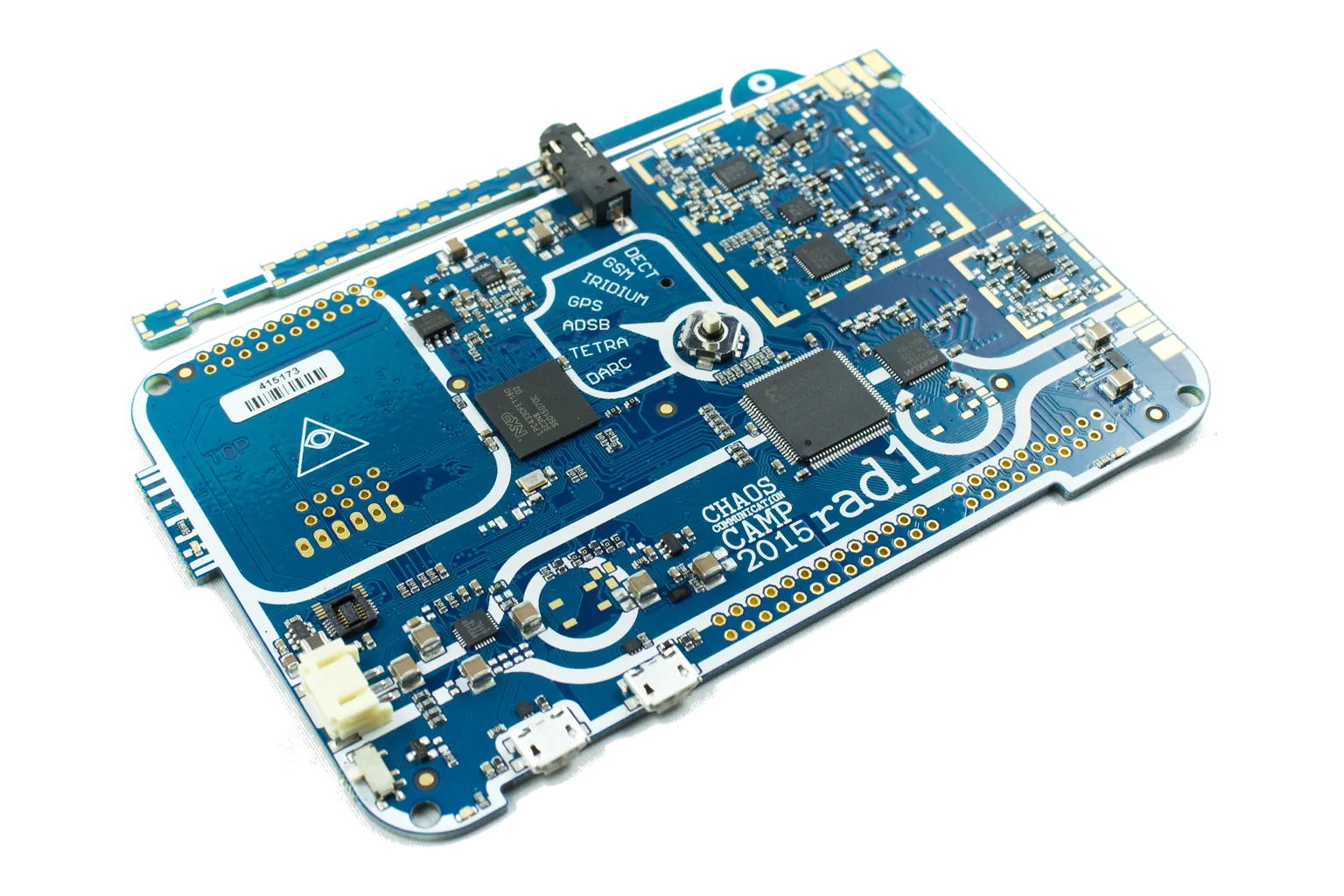
rad1o
A HackRF-inspired software-defined radio badge that let campers receive, transmit, inspect spectrum, flash evolving firmware, solder RF add-ons, and keep hacking long after camp.
Chaos Communication Camp
The camp where rad1o turned the official badge into a serious SDR platform.
Ziegeleipark Mildenberg · Germany · 2015
A HackRF-inspired software-defined radio badge that let campers receive, transmit, inspect spectrum, flash evolving firmware, solder RF add-ons, and keep hacking long after camp.
Lifecycle
The antenna guide documented temporary human/copper-wire reception tricks and the proper SMA modification, including rotating or bridging the 0-ohm resistor in the RF path.
The case page linked DXF outlines, simple laser-cut enclosures, SMA-compatible variants, 3D-printable cases, and a limited 32C3 screw-and-spacer kit.
The SDR guide documented GNU Radio, gnuradio-companion, osmocom_fft, Gqrx, SDR#, udev rules, kernel-module workarounds, and cross-platform setup for using rad1o as an SDR peripheral.
The binary repository preserved flashable camp firmware, HackRF images, games, animations, fonts, images, l0dables, and a REV 05 release aligned with HackRF v2022.09.1.
The bootloader exposed HACKRF and HKRF-OLD modes, with different USB product IDs for newer and older HackRF software compatibility.
Public writeups and later community experiments connected rad1o to HackRF/PortaPack-style standalone SDR usage beyond the official camp firmware and documented SMA mod path.
The wiki pointed Android users to a patched RF Analyzer APK/source path because upstream RF Analyzer did not yet work with rad1o.
Operational history
RF expansion was intentionally hackable but not risk-free; the compendium records it as a hardware-modification caveat rather than a plug-and-play feature.
Laptop power-management defaults could make a working badge look broken until autosuspend was disabled for the rad1o USB IDs.
Using rad1o as an SDR depended on choosing the correct firmware mode and sometimes adding udev rules or updated SDR packages.
The badge was a real SDR, but practical RF work still required antenna knowledge and sometimes soldered hardware changes.
A recurring European badge-culture debate: prestige and hack value versus cost, accessibility, and usefulness for the average attendee.
Camp operation included a practical repair and flash-station workflow, not just software experimentation.
rad1o belongs in the continuing-platform part of badge.gallery: its record should track firmware and HackRF compatibility well after the camp weekend.