declared source-file copyright holder and leLAB supporter
The repository's REUSE metadata assigns 2025 Hackropole copyright text to the hardware JPEG, KiCad files, and related documented assets, while leLAB names Hackropole among its material-support partners. This does not establish a sole hardware, firmware, workshop, or event-author role.
Source
official event and workshop programme publisher
leHACK publishes the workshop schedule and leLAB context for Badge Hackropole. This identifies event-programme publication, not a claim of technical authorship, fabrication, or individual workshop delivery.
Source
official workshop host and event-listing publisher
ANSSI's official page says its experts ran the two-part leHACK workshop and publishes the Badge Hackropole schedule/description. This is not an individual badge-design or image-reuse attribution.
Source
public badge source and documentation publisher
The public FCSC-FR repository publishes the Hackropole badge source files and links the hardware, assembly, firmware, and licensing documentation. This identifies a source-publisher role, not individual design authorship.
Source
Why It Mattered
It adds a current French open-hardware badge record with a rare end-to-end public trail: official event and public-agency scheduling, KiCad production sources, a component-level assembly guide, WLED configuration, and explicit CC BY 4.0 source-image provenance. The dossier keeps that workshop-created device distinct from leHACK's separate general conference badge pickup workflow.
Hardware
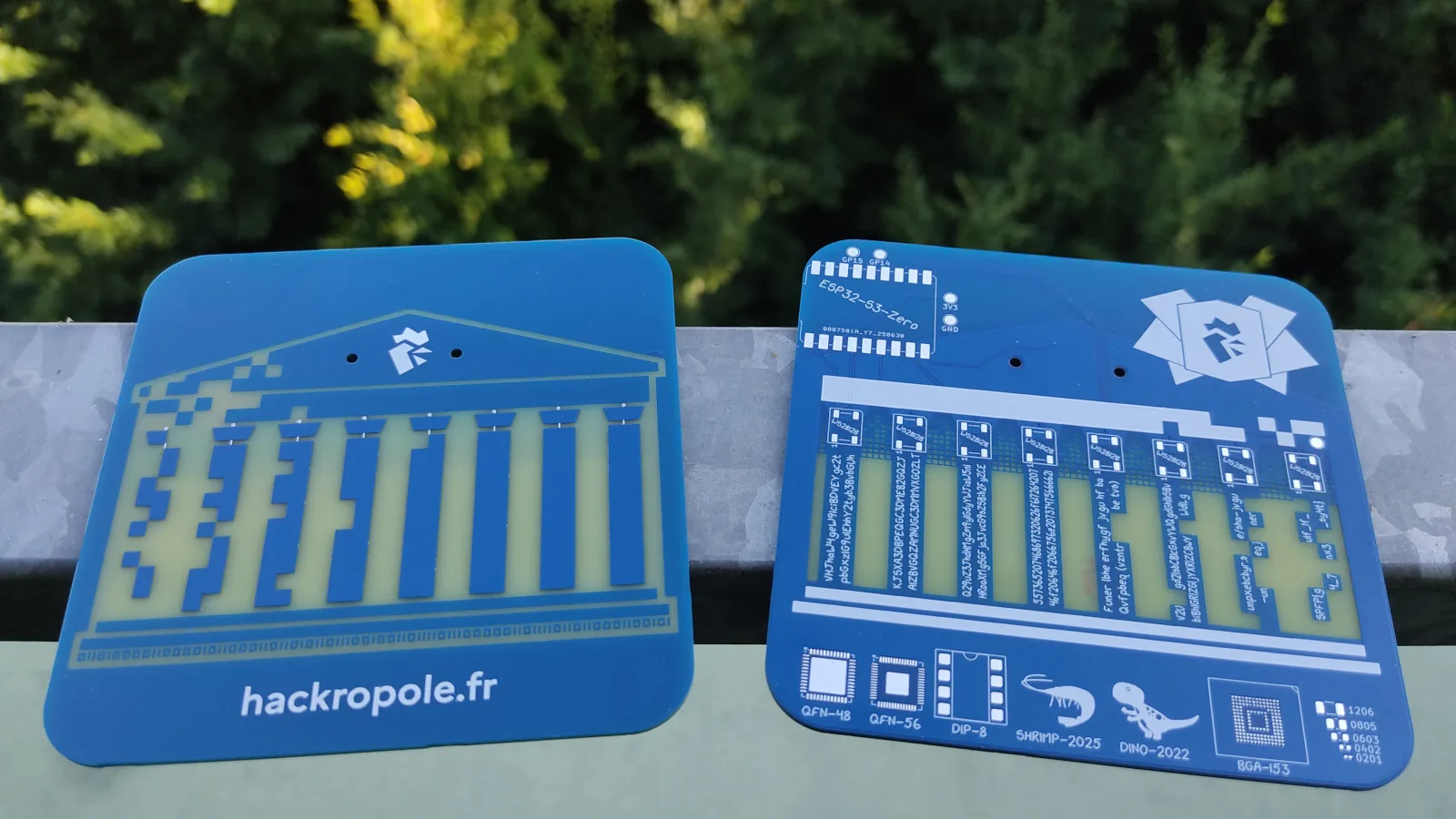
The public FCSC-FR repository supplies KiCad 9 PCB sources and recommends a two-layer, 1.6 mm blue FR-4 board. Its assembly baseline is one Waveshare ESP32-S3-Zero, also called ESP32-S3 Mini, without pin headers plus eight 5050-SMD WS2812B LEDs. The firmware guide maps the eight external LEDs to GPIO 2, the ESP32-S3 board's built-in LED to GPIO 21, eight capacitive pillar controls to GPIO 1, 3, 4, 5, 7, 8, 9, and 10, and the rooster-crest touch control to GPIO 6; GP14 and GP15 remain exposed pads for user modification. Public instructions describe a buildable design, not one verified uniform event-issued configuration, enclosure, lanyard, power-bank, sensor, or finished-unit population.
Software & Apps
The repository provides WLED bootloader, partition, and firmware binaries plus an override configuration that its guide matches to WLED v0.15.5. It documents ESP32-S3 bootloader flashing with esptool, a WLED Wi-Fi access-point onboarding flow, a web configuration interface, default yellow lighting, a crest touch control that toggles light, and a first-pillar control that cycles effects. Builders can also rebuild the firmware from the public WLED source and Hackropole override. No source establishes an event-only application, CTF, backend, attendee account model, final flashed-state ledger, or post-event support/update service.
Lore
Badge Hackropole was scheduled inside leHACK 2026's new leLAB Hardware Village, whose workshop model used on-site first-come registration and a maximum of ten people per workshop session. ANSSI's official listing describes ten 55-minute Badge Hackropole sessions across June 26 and 27. leHACK's practical information separately says attendees collected a general conference badge at reception with a QR code; the sources never equate that credential with the Hackropole hardware workshop project.
firmware workflow
public source guide
The source guide aligns the distributed firmware with WLED v0.15.5, documents ESP32-S3 bootloader flashing with esptool, a WLED Wi-Fi access-point onboarding flow, a web interface, and touch controls for lighting and effects.
Compatibility: Hackropole source-tree workflow; it is not evidence of an event-specific application, CTF, backend, account, final firmware state, or support/update service for every workshop artifact.
Source
hands-on workshop access
official programme
leLAB identifies Badge Hackropole soldering as an introductory activity with no technical prerequisite; workshop sign-up was on site, first come first served, and groups were limited to ten people maximum.
Compatibility: leLAB workshop context only; it does not establish that every leHACK attendee or registrant participated or received a badge.
Source
hardware interaction and modification surface
public firmware documentation
The WLED guide maps eight capacitive pillar controls and a rooster-crest touch control, and exposes GP14/GP15 pads for user modifications such as 3.3 V I2C sensors or an I2S microphone.
Compatibility: Public Hackropole configuration only; no source establishes a particular attendee modification, sensor, microphone, enclosure, pin safety review, or support commitment.
Source
official build guide
public source documentation
The assembly guide recommends one Waveshare ESP32-S3-Zero without pin headers and eight WS2812B LEDs in 5050-SMD packages as the baseline working board.
Compatibility: Hackropole public design baseline; optional lanyard, USB power bank, stand, and sensor additions are not universal event-issued parts or compatibility guarantees.
Source
official workshop schedule
scheduled 2026 programme; individual attendance unverified
ANSSI's official leHACK listing schedules ten 55-minute Badge Hackropole workshop sessions: five on June 26 and five on June 27.
Compatibility: leHACK 2026 Badge Hackropole workshop activity only; the published schedule does not prove which sessions ran, attendance, completed builds, kit allocation, or final handoff.
Source