Nuit du Hack 2011 Badge
French electronic conference badge
A source-backed French electronic attendee badge from Nuit du Hack 2011, preserved through an attendee report, badge photos, and linked reverse-engineering/programming tutorials.
Country dossier
Worldwide badge coverage for France, grouped into seeded badges, event editions, add-ons, operational issues, resources, and evidence sources.
Seeded artifacts
French electronic conference badge
A source-backed French electronic attendee badge from Nuit du Hack 2011, preserved through an attendee report, badge photos, and linked reverse-engineering/programming tutorials.
Assemble-and-hack Black Badge challenge
A limited collector badge and hardware-hacking challenge from Nuit du Hack 2014, with public challenge rules, writeups, and a Virtualabs repository.
Electrolab Arduino Micro-compatible kit
A limited NDH2K15 electronic collector badge kit sold through the official Nuit du Hack store, described as Arduino Micro-compatible, USB-compatible, easy to program or hack, and developed by Electrolab.
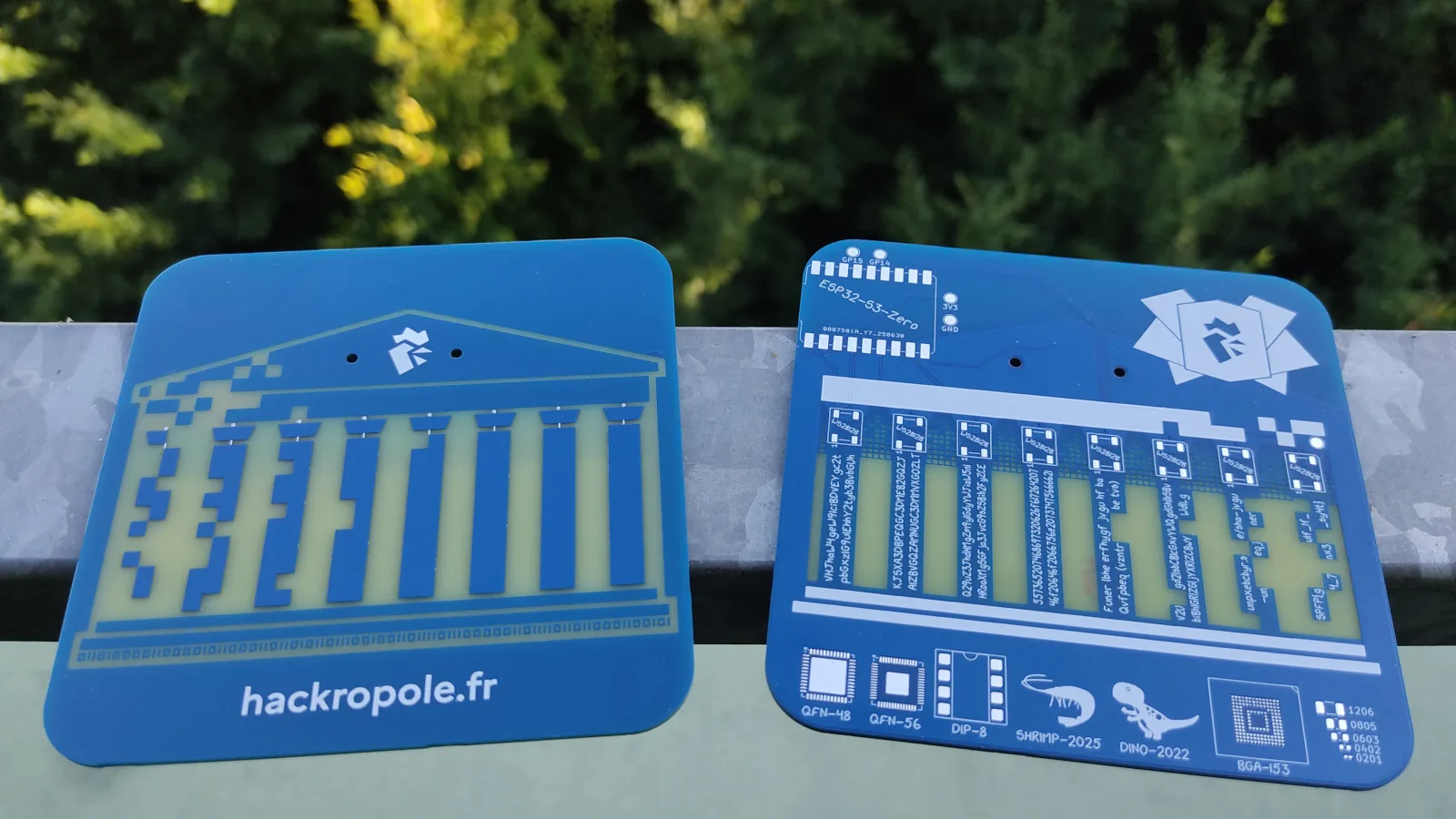
Open ESP32-S3 capacitive light-up workshop badge
leHACK's official 2026 workshop schedule and the French National Cybersecurity Agency's leHACK listing present Badge Hackropole as a novice-accessible workshop in which participants assemble a capacitive light-up badge, solder a microcontroller and eight SMD LEDs, and program preconfigured WLED firmware. FCSC-FR's public hackropole-badge repository supplies the PCB source, assembly instructions, firmware binaries/configuration, and per-file licensing. The programme lists ten 55-minute workshop sessions across June 26-27, but the source trail does not prove final attendance, completed builds, or a conference-wide handout.
French ESP32-C6 B.A.D.G.E. with OLED, SAO, and BLE color propagation
The official THcon 2026 B.A.D.G.E. page documents an ESP32-C6 electronic badge with the Badge3000 WiFi access point, an I2C OLED at address 0x3C, and BLE padlock and one-time-password challenges for the May 5-6 tenth edition in Toulouse. A May 13 first-hand attendee teardown identifies the distributed board as an ESP32-C6-WROOM-1 build with an SSD1306 OLED, WS2812 RGB LED, ATC24C04 EEPROM, SAO connector, single-cell battery/TP4056 charging path, and USB-C CH340C serial bridge; it also documents the delivered firmware's BLE color-command propagation behavior.
Events
A French HackerzVoice security-conference edition with a public attendee report describing a 100% electronic badge and linked reverse-engineering tutorials by its designer.
The Fnord Edition of Nuit du Hack, whose collector badge was an assemble-and-hack hardware challenge for a Black Badge life pass.
The 2015 Nuit du Hack edition whose official store sold an Electrolab-developed Arduino Micro-compatible electronic badge kit limited to 200 units.
The June 26-28, 2026 leHACK edition in Paris, represented by the scheduled Badge Hackropole assembly workshop in the new leLAB Hardware Village. Official leHACK and ANSSI publications document ten 55-minute sessions on June 26-27 to assemble and program a capacitive ESP32-S3/WS2812B light-up badge, while FCSC-FR's public repository carries the hardware, assembly, and WLED documentation. The record treats the device as a workshop artifact rather than a general conference credential, and does not assume individual attendance, finished assembly, or handoff.
The May 5-6, 2026 tenth Toulouse Hacking Convention whose official B.A.D.G.E. page documents an ESP32-C6 electronic badge with a WiFi access point, I2C OLED, and BLE padlock and one-time-password challenges.
Lifecycle
The official badge page documents a BLE padlock interaction as one of two badge challenges.
The official badge page documents a one-time-password flow as the second badge challenge.
The official badge page documents a WiFi access point branded Badge3000 as part of the ESP32-C6 badge interaction surface.
The attendee's analysis reports that the delivered firmware observes compatible BLE advertisements, changes the RGB LED from received color values, and relays them with loop avoidance. This documents an interaction behavior without publishing packet construction, operating instructions, production-firmware identity, range, compliance, or final event deployment claims.
The Virtualabs repository preserves Python console tooling and serial interaction material for working with the badge challenge.
The official store lists USB/HID keyboard and mouse emulation as a supported hack path for the Arduino Micro-compatible kit.
The source guide aligns the distributed firmware with WLED v0.15.5, documents ESP32-S3 bootloader flashing with esptool, a WLED Wi-Fi access-point onboarding flow, a web interface, and touch controls for lighting and effects.
leLAB identifies Badge Hackropole soldering as an introductory activity with no technical prerequisite; workshop sign-up was on site, first come first served, and groups were limited to ten people maximum.
The official challenge asked participants to assemble the collector badge, analyze its embedded secure system, and solve first for a Nuit du Hack Black Badge life pass.
An attendee teardown identifies the distributed board's ESP32-C6-WROOM-1, SSD1306 OLED, WS2812 RGB LED, ATC24C04 EEPROM, SAO connector, single-cell battery/TP4056 path, and USB-C CH340C serial bridge. It does not establish a final production revision, pinout, electrical characterization, or official design archive.
The kit advertised a prototyping area and explicitly invited attendees to hack the hardware in wearable and other forms.
The WLED guide maps eight capacitive pillar controls and a rooster-crest touch control, and exposes GP14/GP15 pads for user modifications such as 3.3 V I2C sensors or an I2S microphone.
The attendee report links a designer-authored reverse-engineering guide and a second programming guide that used avrdude, avr-gcc, and C examples.
The assembly guide recommends one Waveshare ESP32-S3-Zero without pin headers and eight WS2812B LEDs in 5050-SMD packages as the baseline working board.
ANSSI's official leHACK listing schedules ten 55-minute Badge Hackropole workshop sessions: five on June 26 and five on June 27.
The 2016 report describes a Pimp My Badge workshop using the previous year's electronic badge and updating the standard library with additional examples.
The 2015 electronics workshop built a battery-powered Arduino pendant with an 8x8 LED matrix and noted that it could be combined with the 2015 electronic badge.
Operational history
The record remains a workshop-made electronic artifact rather than an unsupported claim about leHACK admission, identity, access control, or universal badge allocation.
Readers can reproduce the documented public design without mistaking one source configuration for a verified event-wide production, security, or support state.
The catalogue can distinguish observed artifact details from the unrecovered official archive while avoiding unsupported production, electrical-safety, design-file, firmware, or reuse claims.
This was not necessarily a universal attendee badge; the page models it as a collector/challenge object rather than a default registration badge.
The page should not imply that every attendee automatically received this badge; it was a limited store item.
The catalogue records the public hands-on workflow while avoiding a claim that all configurations are safe, supplied, tested, supported, or appropriate for every builder.
The source-backed facts remain available while the catalogue withholds imagery until original photos are cleared.
The French record remains source-backed and image-free rather than copying official site imagery, the teardown photo, screenshots, social media, placeholders, or generated approximations.
Publish no image until licensing and attribution for an original badge photo are cleared.
Publish no image until licensing and attribution for an original badge photo are cleared.
The 2015 badge should be treated as a reusable workshop platform across the following edition, while the catalogue should not invent a distinct NDH 2016 badge without stronger sources.
The compendium can preserve a concrete workshop artifact and buildable design without treating a schedule or a public repository as proof that every listed slot ran or that any specific person received and completed a badge.
The dossier remains useful for French badge history while avoiding unsupported chip and firmware claims.