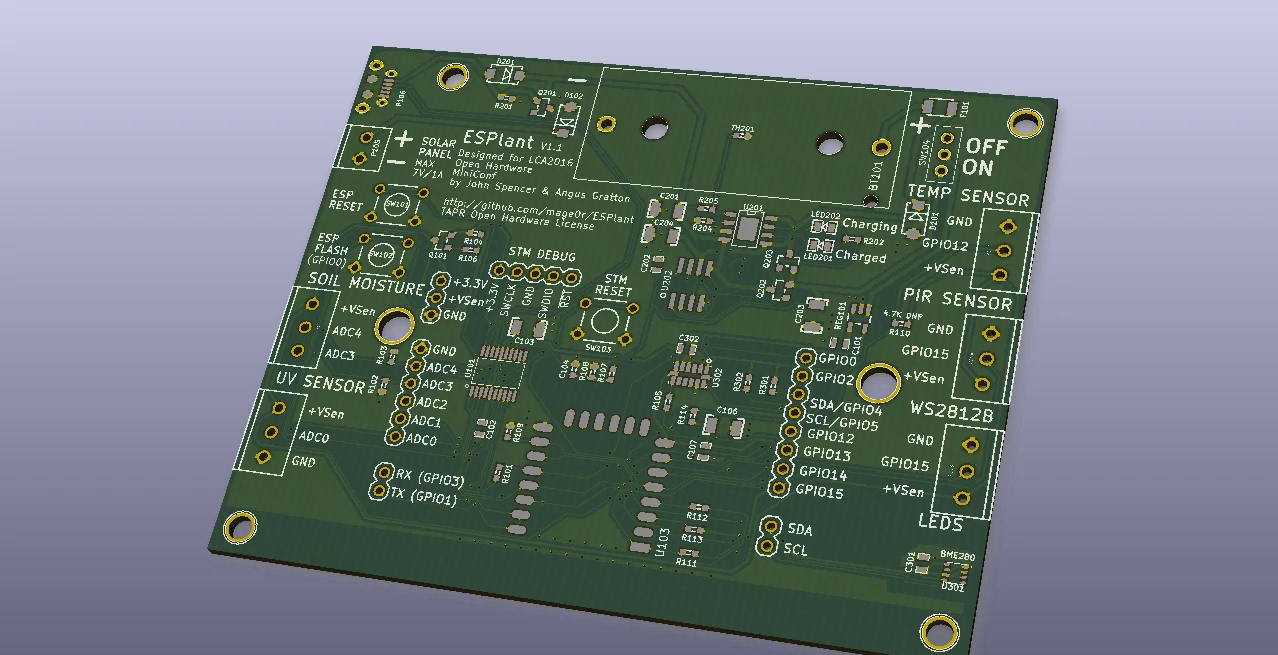
LCA2016 ESPlant
linux.conf.au 2016's Open Hardware / Arduino Miniconf produced ESPlant, an ESP8266 WiFi environmental-sensor board with solar-friendly power, onboard sensors, optional external sensors, Arduino firmware, and public hardware files.
linux.conf.au Open Hardware Miniconf
The February 1-5, 2016 Geelong linux.conf.au edition whose Open Hardware / Arduino Miniconf centered on the ESPlant ESP8266 environmental-sensor board, public hardware repository, assembly context, and attendee MQTT reuse.
Geelong, Victoria · Australia · 2016
linux.conf.au 2016's Open Hardware / Arduino Miniconf produced ESPlant, an ESP8266 WiFi environmental-sensor board with solar-friendly power, onboard sensors, optional external sensors, Arduino firmware, and public hardware files.
Lifecycle
The repository documents ESPlant as an ESP8266 WiFi kit for transmitting environmental data, with Arduino IDE, Espressif SDK, and esp-open-rtos programming paths.
Repository sketches include production-test, serial-sensor, and MQTT sensor firmware; Marc Merlin's writeup adds a participant LED-strip blinky reuse trail.
ESPlant included a 16340 lithium-cell holder, solar-input-friendly charger interface, and automatic switching between solar input, battery, and USB power.
The board exposed BME280 and ADXL345 I2C sensors, screw-terminal ADC inputs for soil moisture, DS18B20, PIR, WS2812B LED strip support, and a switchable VSens rail.
An onboard STM32F042 acted as USB/serial interface and I2C ADC bridge, with ESP_Kwai library support and STM firmware material in the repository.
Operational history
The public badge page, image archive, and API now point at a real upstream ESPlant render with source URL, license, attribution, and processing notes preserved.
The entry is modeled as a conference hardware kit in the linux.conf.au badgelife lineage rather than an attendee identity badge.
The dossier records verified features and source locations while avoiding unsupported production-run or image-provenance claims.
