BSides Brisbane
Publisher identity for the 2026 event, sponsor/prospectus/ticketing trail, and the public bsidesbrisbane/badge-2026 Clock Module repository used for the post-event badge refresh.
SourceBSides Brisbane 2026 · Australia · 2026
Post-event 555/74LS clock-generator badge with MIT source release
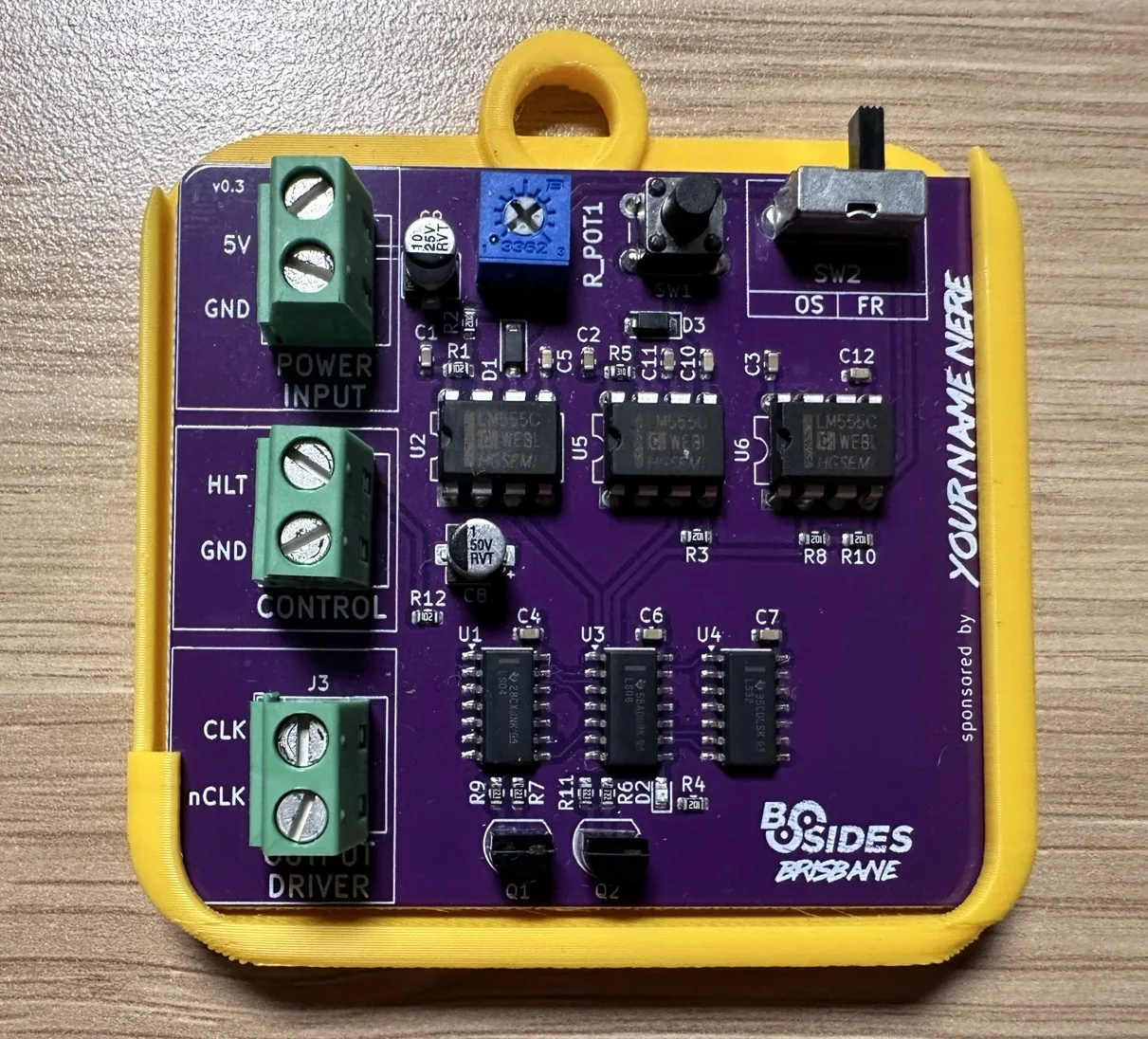
BSides Brisbane 2026's official prospectus offered electronic badge design/build for 500 delegates, Humanitix marked the July 4 event passed while listing conference-badge and VIP special-badge pickup, and public event updates named BLARGE as the electronic-badge supporter. Six days after the event, the `bsidesbrisbane/badge-2026` repository publicly documented the actual 2026 Clock Module: a photographed purple BSides Brisbane board in a 3D-printed case, a simple manually controllable clock generator made from 555 timers and 74LS-series logic, with committed Gerbers, BOM/CPL production data, an STL case file, and an MIT license.
People
Publisher identity for the 2026 event, sponsor/prospectus/ticketing trail, and the public bsidesbrisbane/badge-2026 Clock Module repository used for the post-event badge refresh.
SourceIt turns a Queensland event-level electronic-badge record into a traceable physical hardware record without claiming a microcontroller, radio, firmware, badge CTF, or universal recipient configuration. The post-event repository is particularly useful because it preserves a real board photograph and manufacturable hardware data under a reusable licence while keeping public-release timing and deployment scope explicit.
The official README describes three 555 timers: an astable free-running clock with a 1 MΩ adjustment potentiometer, a monostable debounced single-step button, and a debounced mode-select path. 74LS04, 74LS08, and 74LS32 logic selects free-running or one-shot operation and applies an external HLT input; a discrete 2N7000 MOSFET stage drives normal CLK and inverted nCLK outputs, with an LED pulse indicator. The repository also provides Gerbers, BOM/CPL production files, and a 3D-printable case. It specifies a regulated +5 V input but does not establish a production count, a recipient-by-recipient configuration, or an event-unit assembly history.
This is a discrete-logic clock module, not a microcontroller platform: the public release contains no firmware, app, binary, or badge-specific CTF program. It was published after the event and has no tag or release. The conference itself advertised CTF and IoT/hardware-hacking activity, but those event programmes are not assigned to the clock-module badge without direct badge-level evidence.
The 2026 Time Travel edition took place at QUT Gardens Point Campus on July 4. Humanitix and BSides Brisbane's event-day updates establish badge pickup, but the `bsidesbrisbane/badge-2026` repository was publicly created on July 10. Its source and photo therefore document the event-specific clock-module design after the fact rather than proving public access, a particular deployment revision, or identical distribution to every attendee.
Source-backed hardware metadata
Structured technical signals seeded from public badge documentation, repositories, schematics, firmware notes, or event evidence. These fields are designed for filtering, API use, repair planning, preservation, and future Companion Gear matching.
BSides Brisbane's public post-event Clock Module README identifies an event-specific electronic badge built from 555 timers and 74LS-series logic.
Signal sourceLifecycle
BSides Brisbane's event-day public update said check-in was open and told attendees to grab their badge and shirt before the opening. It establishes pickup flow, not a per-unit Clock Module handoff ledger.
SourceThe documented 555/74LS design can free-run at an adjustable rate, single-step with a debounced button, or halt via an external HLT input; an SPDT switch selects the free-running or one-shot path.
SourceThe documented discrete 2N7000 output stage provides normal CLK and inverted nCLK outputs for slow digital-logic or teaching experiments, with an LED pulse indication.
SourceThe 2026 prospectus offers an Electronic Badge item covering electronic badge design and build for 500 delegates, and BSides Brisbane's public update thanks BLARGE for the electronic badge. The prospectus is not a final recipient or assembly ledger.
SourceHumanitix ticketing lists standard conference badge inclusion and a limited VIP Edition with a special VIP badge, and the page now marks the event passed. The sources do not map the VIP tier to a different Clock Module configuration.
SourceThe bsidesbrisbane/badge-2026 repository documents the badge as a manually controllable 555/74LS clock module and publishes Gerbers, BOM/CPL data, a case STL, and an actual board photo after the event.
SourceOperational history
The badge page now has a factual, rights-cleared documentary source photo without using a generated visual, sponsor-page graphic, social-media copy, or approximate reconstruction.
The catalogue can document the verified discrete clock module while avoiding claims about universal deployment, event-day source availability, firmware, radio, or an exact recipient ledger.
The record combines corroborating event and hardware evidence without converting sponsor wording, later source publication, or one photo into a universal fulfillment or configuration claim.
