Kiwicon 7 Badge
Official pickup-era identity badge
Kiwicon 7's official site documented badge assembly during conference week and tied the event credential to Friday early pickup before the November 9-10, 2013 Wellington conference.
Country dossier
Worldwide badge coverage for New Zealand, grouped into seeded badges, event editions, add-ons, operational issues, resources, and evidence sources.
Seeded artifacts
Official pickup-era identity badge
Kiwicon 7's official site documented badge assembly during conference week and tied the event credential to Friday early pickup before the November 9-10, 2013 Wellington conference.
Cyberwar is Hell visible venue credential
Kiwicon 9's official site told attendees to wear their badge visibly while in the venue and documented early pickup before the December 10-11, 2015 Wellington conference.
Michael Fowler Centre visible identity credential
Kiwicon X's official site required attendees to wear a Kiwicon X badge and lanyard visibly in the venue and tied that credential to the Michael Fowler Centre pickup workflow.
Christchurch identity tag with source-backed badge-challenge context
CHCon 2018's official site documents identification tags/badges as part of the event materials and says CTF, badge, and locksport challenges would run throughout the main event.
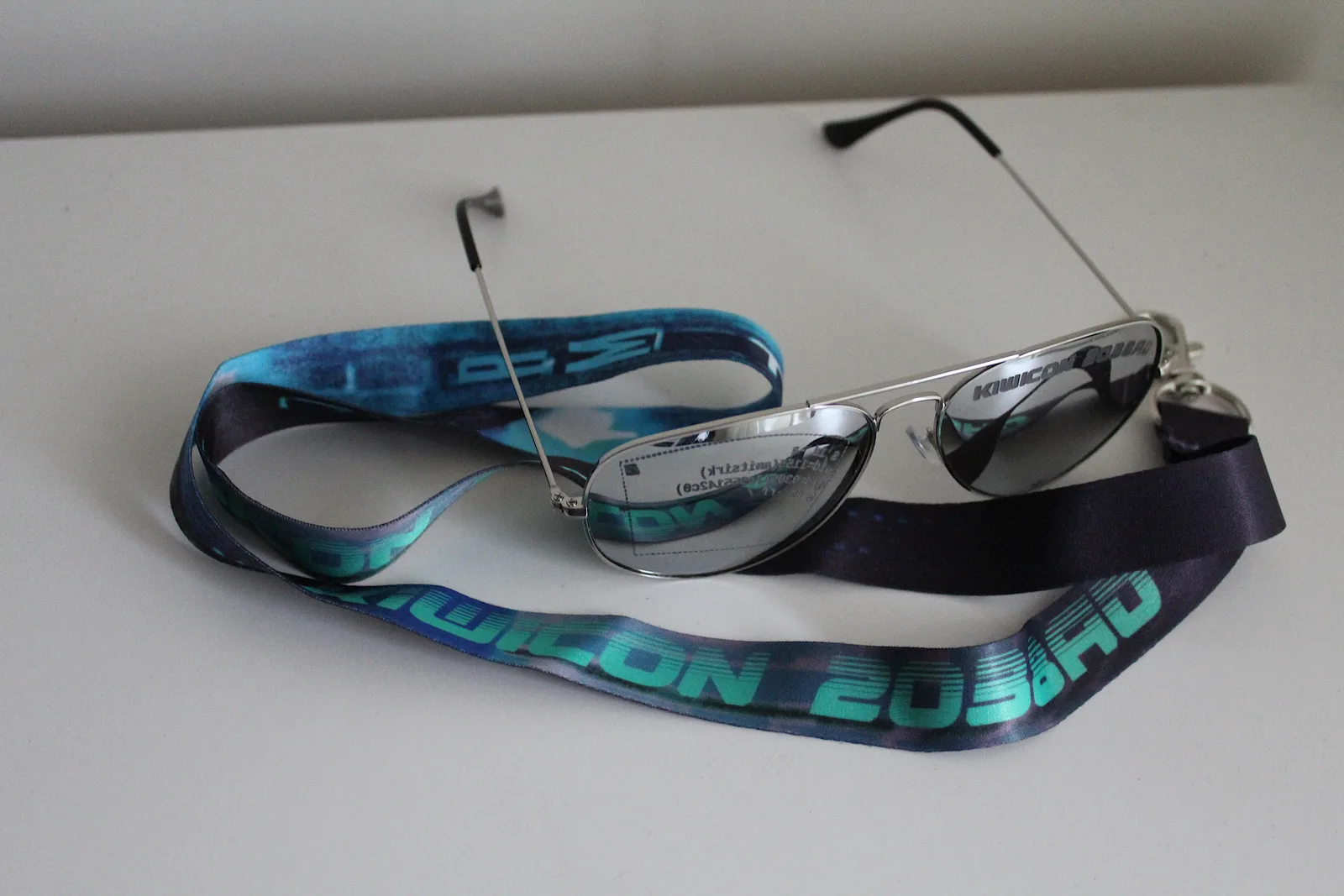
Official identity badge and afterparty credential
Kiwicon 2038's official site required attendees to wear a Kiwicon2038 badge and lanyard visibly during the conference and to bring the badge to the afterparty.
One-day soldering and Arduino conference-badge workshop artifact
Kiwicon 2038's official Intro to Badge Hacking training page documents a one-day workshop where attendees built and hacked their own conference badge from supplied electrical components and tools.
Official lanyard and glow-in-the-dark star identity badge
Purplecon's official 2018 diary says attendees received a lanyard with the official purplecon badge, a glow-in-the-dark star, when entering the Kiwicon-adjacent Wellington event.
Arts Centre identity-badge materials with electronic challenge context
CHCon 2019's official sponsorship page documents identification tags/badges and printed materials, while the official about page documents a two-day CTF with cyber, physical, and electronic challenges.
Raspberry Pi and TensorFlow self-driving car kit for the Open Hardware Miniconf
linux.conf.au 2019's Open Hardware Miniconf included a Donkey Car self-driving car kit designed by the Open Hardware Miniconf team, assembled by participants, and used for TensorFlow-based driving experiments.
Raspberry Pi Zero sensor-bonnet hardware kit for Apprentice Linux Engineer labs
linux.conf.au 2019 hosted the Apprentice Linux Engineer tutorial track in Christchurch, where lab participation required a purchased Floral Bonnet board for Raspberry Pi Zero hands-on embedded-Linux exercises.
First sticker-backed Kākācon puzzle trail
The organizer walkthrough for Kākācon 2021 documents the first Kākācon badge challenge, with the entry point printed on the backing paper of a Pepper Raccoon-designed sticker.
Second sticker-backed Kākācon puzzle trail
The organizer walkthrough for Kākācon 2022 documents the second Kākācon badge challenge, again using the back of the event sticker as the puzzle entry point.
ESP32-C3 pukeko badge with OLED, RGB LEDs, Rust VM, and Minecraft server
CHCon 2025's attendee badge was a custom circuit-board badge with an ESP32-C3, SSD1306 128x64 OLED, 24 WS2812 RGB LEDs, USB Serial JTAG shell access, bare-metal Rust firmware, a stack-based pattern VM, and a Minecraft 1.21.4 challenge server.
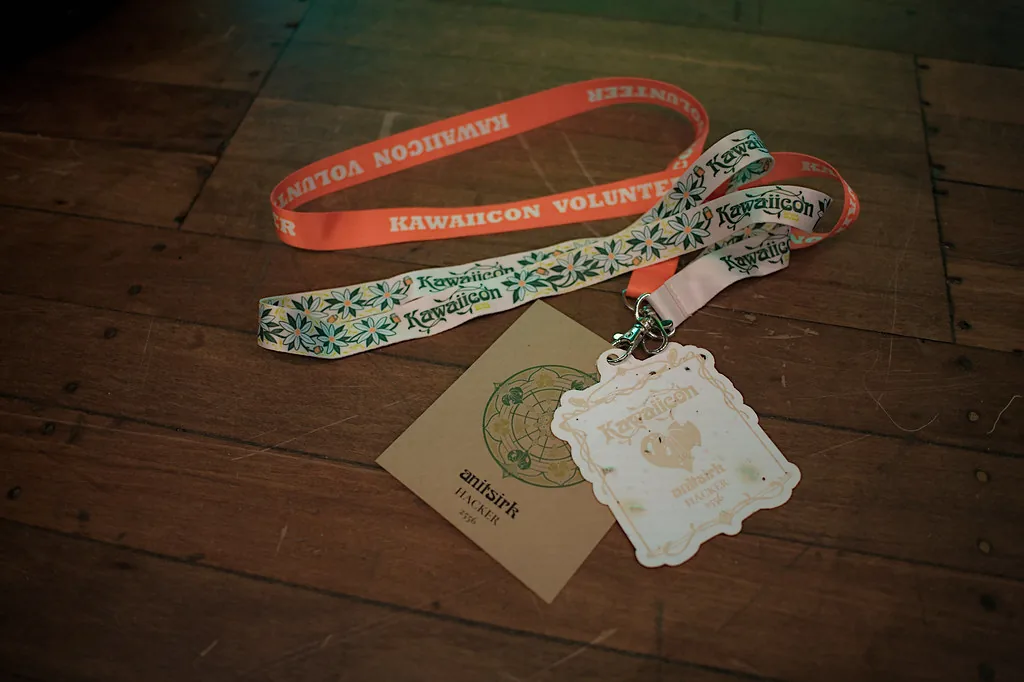
Laser-etched recycled paper badge with wildflower seed mixture
Kawaiicon 2025's official badge page documents the Kawaiicon 3 badge as a laser-etched and cut recycled-paper identity artifact made with a wildflower seed mixture and handmade by the Papermill in Whangarei.
Events
The November 9-10, 2013 Wellington Kiwicon edition whose official site documents Kiwicon 7 badge assembly, early pickup, ticket and merch workflow, and New Zealand hacker-conference context.
The December 10-11, 2015 Wellington Kiwicon edition whose official site documents a venue-visible badge requirement, early pickup, 1,400 expected attendees, and New Zealand hacker-conference context.
The November 17-18, 2016 Wellington Kiwicon edition whose official site documents early ticket pickup and a Kiwicon X badge-and-lanyard visibility requirement at the Michael Fowler Centre.
The October 25-27, 2018 Christchurch Hacker Conference edition whose official page documents CTF, badge, and locksport challenges plus sponsor-funded identification tags/badges and printed materials.
The Wellington Kiwicon 2038AD edition held November 16-17, 2018 at the Michael Fowler Centre, whose official site required attendees to wear a Kiwicon2038 badge and lanyard visibly and bring the badge to the afterparty.
The November 15, 2018 Wellington defensive-security conference whose official diary documents a lanyard and glow-in-the-dark star badge issued to attendees.
The October 9-11, 2019 Christchurch Hacker Conference edition whose official about and sponsorship pages document cyber, physical, and electronic CTF challenges plus identification tags/badges and printed materials.
The January 21-25, 2019 Christchurch linux.conf.au edition whose Apprentice Linux Engineer track required a purchased Floral Bonnet board for Raspberry Pi Zero hands-on labs, sensors, LEDs, buttons, and driver-writing seminars.
The January 21-25, 2019 Christchurch linux.conf.au edition whose Open Hardware Miniconf included a source-backed Donkey Car self-driving car kit lineage built around Raspberry Pi camera control and TensorFlow training.
The 2021 Kākācon edition whose organizer walkthrough documents the first Kākācon badge challenge, using a printed sticker backing-paper puzzle as the entry point.
The 2022 Kākācon edition whose organizer walkthrough documents the second Kākācon badge challenge, again using the printed sticker backing paper as the challenge entry point.
The Christchurch Hacker Conference edition held October 29-31, 2025, whose attendee badge paired an ESP32-C3, 24 WS2812 RGB LEDs, SSD1306 OLED, USB Serial JTAG shell, bare-metal Rust firmware, and progressive badge challenges.
The November 6-8, 2025 Wellington Kawaiicon edition whose official badge page documents a Kawaiicon 3 badge laser etched and cut from recycled wildflower seed paper.
Lifecycle
The badge implemented a Minecraft Java Edition 1.21.4 server on the ESP32-C3, with in-world levers mapped back to the 24 physical RGB LEDs.
A later challenge stage used badge networking and elevated shell access to start the Minecraft server and solve the in-world lever puzzle.
The challenge path unlocked rainbow LEDs, login/password interaction, named LED patterns, and custom pattern definition.
Badge users could program custom LED animations with a stack-based bytecode interpreter, persistent flash slots, arithmetic, bitwise operations, and LED opcodes.
The badge included two addressable RGB LED strips with 12 LEDs each, used for animated eyes and unlocked challenge feedback.
The official CHCon 2018 event page says CTF, badge, and locksport challenges would run throughout the main event.
The official CHCon 2019 about page says the CTF included cyber, physical, and electronic challenges across both main-event days.
E-ALE documented a NZD 20 on-site kit price at LCA after ARM sponsorship reduced the original hardware cost.
The designer writeup documents no_std Rust firmware on ESP32-C3 using Embassy async tasks, esp-hal, esp-radio, embassy-net, embedded-graphics, ssd1306, smart-leds, and esp-storage.
Participants learned IC programming and used the Arduino IDE, then shared code and developed new badge features with others at the conference.
The CHCon 2025 badge used an ESP32-C3 with mounted OLED screen on a custom pukeko-themed circuit board.
The board exposed CP2102 serial-over-USB, SPI SSD1306 OLED, I2C pressure/temperature and light sensors, a GPIO push button, and a PWM tricolor LED for driver-writing exercises.
Purplecon's official diary says attendees received a lanyard with the official purplecon badge, a glow-in-the-dark star.
The official badge page says the Kawaiicon 3 badge was laser etched and cut from recycled paper with a wildflower seed mixture.
The official Kiwicon 7 news feed directed in-town attendees to Friday early pickup for tickets and merch after documenting badge assembly during conference week.
The Kiwicon X ticket-pickup notice said attendees had to wear their Kiwicon X badge and lanyard visibly at all times in the venue.
The official Kiwicon 9 page instructed attendees to wear their badge visibly while inside the venue.
The miniconf workflow gathered training video from the car and analyzed it offline with TensorFlow before attendees tried self-driving runs.
The badge page lists the included wildflower seed mixture and asks attendees who are not based in New Zealand to return the badge in merch-desk recycling boxes.
The 2022 walkthrough says the second Kākācon badge challenge again started from text printed on the back of the sticker.
The 2021 walkthrough says the badge challenge started from text printed on the back of the Kākācon sticker.
Marc Merlin's first-hand report documents a Donkey Car kit with an onboard camera connected to a Raspberry Pi and a custom last-minute Raspberry Pi HAT.
The official training page says all components and tools required to create a standard conference badge were supplied during the one-day workshop.
The E-ALE LCA2019 pages document Raspberry Pi Zero WH lab use and a Floral Bonnet purchase requirement for hands-on seminar work.
The LCA2019 E-ALE schedule used the board across a three-day sequence covering walkthrough, GPIO/libgpiod, SPI/spidev, I2C/i2cdev, IoT/cloud, and security topics.
The 2022 challenge used URL reconstruction, repeated bird-image clues, and substitution solving after the sticker entry point.
The 2021 challenge used web pages, source comments, dawn-chorus audio, image EXIF data, and substitution solving after the sticker entry point.
The official linux.conf.au 2019 miniconfs page anchors the Donkey Car work inside the Monday Open Hardware Miniconf and its beginner-to-advanced hardware/software framing.
Participants assembled the cars, manually drove them around the track to collect training data, and then attempted autonomous driving after model training.
Operational history
The catalogue preserves the badge's material lifecycle and avoids treating a plantable local artifact as universally exportable swag.
The catalogue summarizes the puzzle structure while avoiding claims that the live challenge infrastructure remains complete.
The catalogue summarizes the puzzle structure while avoiding claims that the live challenge infrastructure remains complete.
The entry keeps claims to the official component list and training context while avoiding unsupported board-revision, driver-source, or manufacturing-quantity details.
The catalogue keeps the record to badge assembly and pickup evidence until direct badge documentation appears.
The catalogue keeps component-level fields empty until direct badge documentation is recovered.
The catalogue keeps the record to badge/lanyard identity and pickup evidence until direct badge documentation appears.
The record avoids inventing component-level details until a workshop handout, schematic, or first-hand writeup is recovered.
The catalogue keeps the record to lanyard and star-badge evidence until direct artifact documentation appears.
The catalogue keeps the record to identity-badge and challenge evidence until a direct technical source appears.
The catalogue keeps the record to visible badge and pickup evidence until direct badge documentation appears.
The entry is modeled as a Kiwicon identity artifact so New Zealand coverage expands without inventing PCB, firmware, display, radio, NFC, or CTF behavior.
The entry separates identity-badge materials from CTF electronics so the record does not invent a PCB credential.
The entry is intentionally modeled as a conference identity artifact so Kiwicon coverage expands without unsupported hardware or firmware claims.
The record keeps the Kawaiicon badge as a material identity artifact rather than upgrading it into a PCB badge without evidence.
The entry is modeled as a glow-in-the-dark identity artifact and avoids unsupported PCB, firmware, display, radio, NFC, or CTF claims.
The entry is intentionally modeled as a conference identity artifact so New Zealand coverage expands without inventing hardware, firmware, RF, CTF, or PCB claims.
The record is modeled as an identity and challenge artifact so the CHCon lineage expands without unsupported microcontroller, firmware, display, radio, NFC, or CTF-on-badge claims.
The entry is modeled as a Kiwicon identity artifact so New Zealand coverage expands without inventing PCB, firmware, display, radio, NFC, or CTF behavior.
The entry now has a real rights-cleared lanyard/name-badge photo while preserving the rule against generated, placeholder, social-media, conference-gallery, or uncleared event imagery.
The entry is modeled as an LCA hardware-kit artifact in the badge lineage while avoiding claims about attendee identity-badge issuance.
The record remains source-backed and image-free rather than copying blog or art-page images without complete provenance.
The record remains source-backed and image-free rather than copying seminar-page photos or publishing generated imagery.
The record remains source-backed and image-free rather than copying event imagery, social photos, or generated badge art.
The record stays image-free rather than copying site imagery, sponsor assets, social-media photos, or generated badge art.
The entry intentionally keeps an empty hero image rather than copying article photos or publishing generated imagery.
The record remains source-backed and image-free rather than copying event imagery, Flickr photos, social photos, or generated badge art.
The record remains source-backed and image-free rather than copying blog or art-page images without complete provenance.
The training-badge record remains source-backed and image-free rather than copying event imagery or using generated art.
The record remains source-backed and image-free rather than copying attendee photos, thumbnails, screenshots, or generated imagery.
The record remains source-backed and image-free rather than copying event photos or publishing generated badge art.
The record remains source-backed and image-free rather than copying event imagery, sponsor logos, social photos, or generated badge art.
The record remains source-backed and image-free rather than copying event imagery, Flickr photos, social photos, or generated badge art.
The dossier can now describe the implemented firmware architecture from a primary source while still avoiding unsupported repository, schematic, image, or reuse-rights claims.
The record keeps hardware and software claims to official event context and first-hand evidence until deeper project archives are recovered.
The entry preserves the printed challenge artifact without inventing PCB hardware, firmware, RF, display, or battery behavior.
The entry preserves the printed challenge artifact without inventing PCB hardware, firmware, RF, display, or battery behavior.
The entry is modeled as a hardware training kit in the linux.conf.au/Oceania lineage rather than an official admission badge.
The compendium keeps the artifact in the Kiwicon lineage while distinguishing a classroom build from a con-wide badge issue.