IHC 2018 1337 3310 WiFi
Nokia-3310-inspired ESP32 badge
An Italian Hacker Camp badge built around recycled Nokia 3310 shells, ESP32 WiFi hardware, an LCD, keypad, accelerometer, compass, buzzer, NeoPixels, and MicroPython.
Country dossier
Worldwide badge coverage for Italy, grouped into seeded badges, event editions, add-ons, operational issues, resources, and evidence sources.
Seeded artifacts
Nokia-3310-inspired ESP32 badge
An Italian Hacker Camp badge built around recycled Nokia 3310 shells, ESP32 WiFi hardware, an LCD, keypad, accelerometer, compass, buzzer, NeoPixels, and MicroPython.
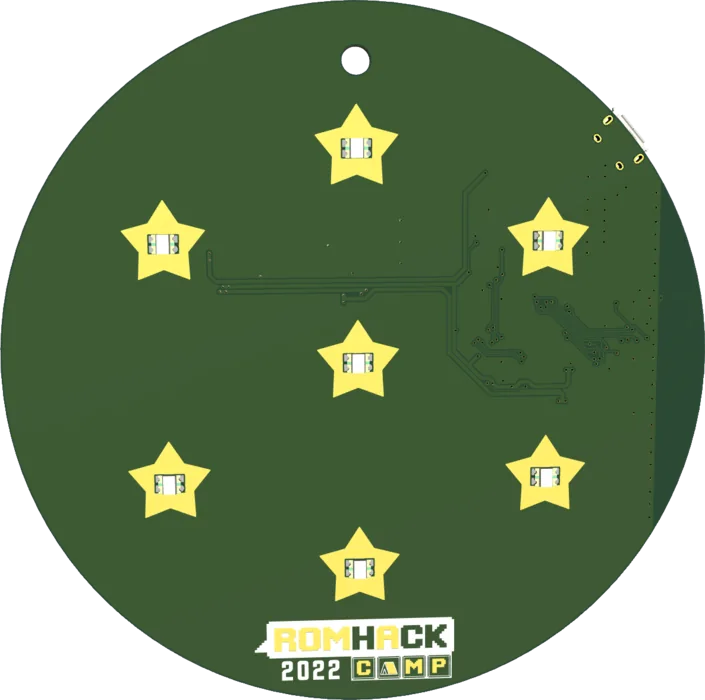
ESP32-C3 dragon-sphere camp badge
A Cyber Saiyan-designed ESP32-C3 badge for RomHack Camp 2022, with seven RGB LEDs, BLE badge discovery, schedule screens, WiFi/AP functions, snake, a 2.4 inch TFT, two rear buttons, and AA battery power.
RP2040 MicroPython badge with NFC and sensors
An Italian MuHack badge built around an RP2040, MicroPython, addressable LEDs, NFC, sensors, optional ESP32 connectivity, and a public MuHackademy workshop/talk trail.
Transparent PET flex-PCB cube conference badge
A completed Italian End Summer Camp {21} electronic badge whose organizer-owned badge-2025 repository explicitly calls it a flex-PCB badge distributed at ESC{21}. The public archive includes KiCad hardware, Gerbers, a BOM, placement data, folding material, a case directory, and firmware material; an author retrospective and first-person maker project document a transparent PET board folded into a cube. Public sources do not establish a recipient total, final unit-by-unit configuration, safety certification, a unified final firmware release, or reusable image provenance.
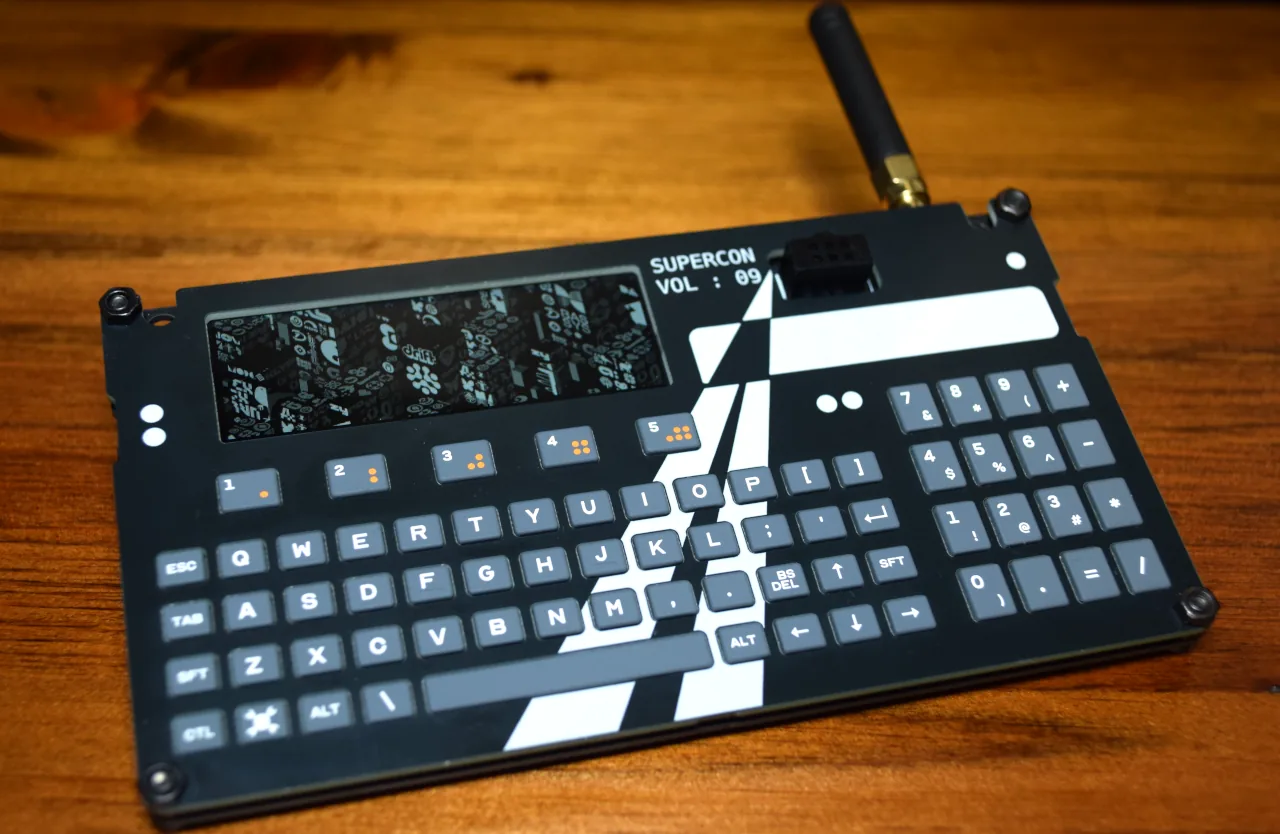
Lecco reuse of the Supercon 2025 LoRa mesh badge
Hackaday Europe 2026 brought the 2025 Hackaday Supercon Communicator Badge to Lecco: a retro-styled keyboard badge with LoRa mesh experimentation, MicroPython/LVGL app support, and post-event Meshtastic reflash framing.
SemiTO-V Developer Zone RP2350/GW1N-9 electronic badge project
SemiTO-V's RISC-V FPGA Badge was a limited Developer Zone electronic PCB badge project for RISC-V Summit Europe 2026 in Bologna. Primary team sources name an RP2350 MCU, a GOWIN GW1N-9 FPGA, custom firmware, and a default RV32I core; they say NextPCB produced the boards and planned to bring 25 to the developer workshop. A logistics update then delayed intended June 8 distribution. The source record supports real physical boards and a 2026 event association, not a final unit count, completed recipient delivery, or the precise current post-event design revision.
ESP32-S3 Walkman-inspired handheld badge with Tactility, Retro-Go, and NFC TagQuest
The hardware badge of the October 2-4, 2026 RomHack Camp at Flaminio Village, whose event site and participant FAQ advertise a unique hardware badge and collectible challenge. On September 29-30, 2026, two days before the camp, Cyber Saiyan's official GitHub organization published the rhc2026-badge repository and the badge.romhack.io setup site: an ESP32-S3 handheld inspired by the Sony Walkman WM-22, with a 2.4-inch 320x240 ILI9341 screen, stereo audio and speaker, 22 RGB LEDs, a Ci522 13.56 MHz NFC reader, microSD, a LiPo battery, and USB-C, running a Tactility-based firmware with camp agenda, map, music player, a TagQuest NFC trivia hunt, and Retro-Go emulators. Firmware 0.4 was tagged on October 2, the camp's opening day. The camp has since ended (romhack.io: RomHack Camp 2026 is over; closing slides: 550 attendees), and the organizer README now opens with a Setup your badge link, but no source states how many badges were sold or handed out.
Events
The Italian Hacker Camp year with a Nokia-3310-inspired ESP32 badge built into a repurposed phone shell.
The first RomHack hacker camp in Rome, where Cyber Saiyan produced the RHC22 electronic badge.
The MuHackademy 2k23 public programme included a MuHack Badge talk and workshop record for an RP2040 MicroPython badge.
The September 2-7, 2025 Italian nonprofit hacking, free-software, and DIY camp in San Donà di Piave. Its organizer-owned badge-2025 repository explicitly identifies the flex-PCB BadgESC{21} as distributed at the camp and preserves hardware, firmware, case, and folding material under scoped licensing; event-wide recipient count, final production state, and reusable-image evidence remain unreported.
The May 16-17, 2026 Hackaday Europe edition in Lecco, Italy, whose official sources said Hackaday was bringing the 2025 Supercon Communicator Badge to Europe for LoRa mesh, MicroPython app, and badge-hacking experiments.
The completed June 8-12, 2026 RISC-V Summit Europe in Bologna, with core summit sessions June 9-11 and Developer Workshops on June 8. SemiTO-V documented a limited Developer Zone RISC-V FPGA badge project prepared for the event, while delivery/receipt and exact final production-revision evidence remain incomplete.
The completed October 2-4, 2026 RomHack Camp edition at Flaminio Village, the second RomHack hacker camp, advertised with a unique hardware badge, collectible challenge, participant FAQ, and on-site CTF context. A September 28 recheck found the site carrying a CAMP IS SOLD OUT banner while the participant FAQ's Cyber Saiyan stand listing adds The Camp electronic badge as a card-only on-site purchase item; a September 29-30 organizer release on GitHub and badge.romhack.io then published the ESP32-S3 Walkman-inspired badge's schematic, Gerbers, BOM, Tactility and Retro-Go firmware, and a browser flasher ahead of the camp. Firmware releases 0.2 to 0.4 followed on October 1-2; on October 4, the scheduled last day, the event site still read pre-event. By October 15 romhack.io states that RomHack Camp 2026 is over and thanks attendees, speakers, and volunteers, and Cyber Saiyan's official rhc2026-resources repository publishes the talk material and closing slides, which report 550 attendees, so the edition is marked completed. Badge handoff counts remain unpublished.
Lifecycle
The separate RomHack Camp CTF page provides the event-side context for tracking whether badge hardware becomes part of on-site challenge play.
Tactility apps for the camp agenda and map plus an MP3/AAC music player reading up to four folder levels from microSD.
A Tactility app that scans NFC tags with the Ci522 reader and fetches a timed Cyber Trivia question from a server for each tag, with network and invalid-tag error handling; the setup site also links a Cyber Trivia challenge.
Hackaday said the Europe run would continue the Supercon custom LoRa mesh experiment in Italy on different frequencies and possibly push transmission parameters.
RomHack Camp 2026 was advertised pre-event with a unique hardware badge and collectible challenge. The released firmware's TagQuest app is the likely badge-side mechanic, but the organizers have not tied the two together in public text.
The firmware exposed schedule viewing plus AP and schedule-sync modes so attendees could update and interact with camp data from the badge.
The public technical accounts identify an ESP32-C3, 42 WS2812B LEDs, an I2S microphone, and an accelerometer described as work in progress. They do not establish final component substitutions, feature enablement, calibration, electrical limits, all-unit parity, or a production BOM beyond the public archive's scope.
SemiTO-V identifies an RP2350 microcontroller and GOWIN GW1N-9 FPGA for the badge. The record does not infer unlisted peripherals, power behavior, safety limits, complete bill of materials, or exact population of every physical unit.
The official schedule data lists a Saturday 22:00 Badge Hacking Ceremony before the Hackaday Europe party.
The organizer directory preserves WLED-related material and the first-person maker project describes WLED/SoundReactive context. This records a public software lineage without repeating configuration details, claiming final deployed settings, or presenting a support, privacy, or operating guarantee.
A separately built Retro-Go launcher with NES, SNES, Game Boy and Color, Game & Watch, Master System, Game Gear, ColecoVision, PC Engine, and Lynx cores plus PrBoom for Doom, loading ROMs and WADs from microSD.
The README points to pico2-editor and riscv-badge-displaylib. This record preserves their public-reference role without asserting version parity, a released binary, a deployed event image, programming steps, support ownership, or a recovery procedure.
Hackaday described the user side as MicroPython-programmed with a plug-in architecture for adding apps.
The fifth firmware screen provided a playable snake game, giving the badge an explicit entertainment surface beyond schedule and discovery functions.
The official page documents a BOSS socket so the badge can be extended with add-on boards.
The repository README identifies KiCad 10 and the archive exposes native PCB and schematic files. The open source tree is valuable documentation, but it is not a substitute for a reconciled physical production revision, assembly record, electrical-safety assessment, or delivery ledger.
The team says the custom firmware includes a default RV32I core. This is recorded as high-level source context only, without operational FPGA configuration, programming, debugging, execution, or security claims.
The hardware list includes an NFC tag, making identity and near-field interaction part of the badge surface.
SemiTO-V stated it would bring 25 badges to the Developer Zone workshop and later reported a logistics problem that prevented intended June 8 distribution. The sources establish a limited 25-unit Developer Zone badge run in planning and a real physical-board project, not a completed allocation ledger, attendee-wide issue, or confirmed recipient count.
Hackaday's customization article frames the badge as built to be modified with replaceable front-panel mechanical files.
The badge's mechanical identity comes from turning old Nokia 3310 phone shells into camp badge enclosures while keeping the keypad and handheld form factor.
The organizer hardware tree exposes KiCad project files, rendered schematics, Gerbers, BOM, and placement data. The repository's licence statement is preserved as a schematics/hardware source condition only; it does not independently license every repository file, firmware component, photo, render, or external image.
The organizer archive and designer retrospective document a transparent PET flexible board intended to fold into a cube, with case and folding material published alongside the design. This is a source-backed physical form, not a claim that every unit was identically folded, undamaged, assembled, or safe to modify.
The Europe CFP says attendees could reflash the badge after Hackaday Europe and use it as a Meshtastic device.
Cyber Saiyan reused the RHC22 badge as a MOCA 2024 workshop and contest target, publishing a dedicated firmware branch and inviting owners to bring the badge, a PC, and USB cable.
Version 1.6 fixes listed in the August source commit demonstrate that the public design continued after the June summit. The current post-event V1.6 KiCad revision is therefore not presented as a photograph, render, or authoritative specification of every physical summit badge.
Five-step setup guide and esptool-js Web Serial flasher for Chromium browsers serving firmware 0.1.1, plus demo Tactility apps (calculator, media keys, snake, brainfuck, vi, diceware).
The badge advertised itself over BLE with a 1-7 ID and included radar and badge-list screens for discovering nearby badges in camp.
The upstream repository preserves user-app examples and firmware docs for writing MicroPython applications on the Communicator Badge platform.
The ESP32 badge is documented as MicroPython-capable, making the recycled phone shell a programmable badge platform rather than a static prop.
The badge page lists support for an ESP32 board to add wireless capability beyond the RP2040 base badge.
Operational history
Custom firmware should read the expander one register at a time. The observation comes from one community author and is not confirmed by the organizers.
The record should not imply identical RF operating conditions, channel plans, or range behavior between Pasadena and Lecco.
The catalogue calls this a completed event artifact without turning a distribution statement into an attendee-wide entitlement, precise production number, recipient ledger, or uniform delivery claim.
The official page recommended a micro USB data cable plus replacement AA batteries or a power bank, so a prepared kit mattered for camp hacking.
The catalogue preserves the source-backed design trail without calling it a fabrication recipe, tested device specification, safety assessment, or compatibility guarantee.
The record should be revisited if the repository or project page publishes final attendee firmware, recovery, or app documentation.
The record describes public firmware context at a high level without presenting any current source checkout as deployed, supported, verified, or suitable for operation.
Software claims stay tied to the public Europe articles and upstream Communicator Badge firmware repository rather than a separate Europe firmware tag.
The record preserves the documented artifact without implying that it is certified, risk-free, suitable for unsupervised modification, or a substitute for qualified technical review.
Hardware files are linked rather than mirrored, and no badge render or photo is reused.
The catalogue may describe the source-backed hardware archive but publishes no image and does not treat a hardware licence as blanket permission to reuse media or unrelated project files.
The image proves the physical badge platform, not a separate Lecco documentary field photo; any event-floor photo should be added only with its own source URL, license, attribution, and processing notes.
The public badge page, image archive, and API point at a licensed upstream raster asset with source and attribution preserved.
The dossier credits named contributors and the stated production partner without inferring sole authorship, manufacture responsibility, fulfilment ownership, product-support duty, or image authority.
The catalogue links the source-license and sponsorship context while keeping organizer ownership, attendee credential status, trademark/endorsement scope, physical-delivery responsibility, and image rights separate.
The catalogue does not turn a limited planned workshop allocation into proof that all 25 boards, all workshop participants, or all summit attendees received a badge.
The Italy record remains source-backed and image-free rather than copying source-page media, documentation screenshots, event photos, social media, placeholders, or generated approximations.
Hardware facts remain source-backed while the catalogue withholds the image until licensed original photos are curated.
The record remains source-backed and image-free rather than copying repository renders, team social media, event media, screenshots, logos, or approximate/generated imagery.
The Italy record remains source-backed and image-free rather than copying source-page media, documentation screenshots, event photos, social media, placeholders, or generated approximations.
The Italy record remains source-backed and image-free rather than copying source-page media, documentation screenshots, event photos, social media, placeholders, or generated approximations.
The record describes the released design and firmware for a completed camp without asserting a badge count, inclusion with every ticket, or on-site behaviour.
The record keeps the already-cleared MIT repository badge photo and does not copy post-event article media as an event-floor replacement.
The catalogue retains a narrow documented production caveat without presenting it as a defect rate, recall, safety finding, or universal final-unit characteristic.
The compendium keeps separate United States and Italy event records while preserving the shared hardware and firmware lineage.
The entry is sourceable, but image and deeper software details remain intentionally omitted until licensing and archive recovery improve.
Current open design sources are linked for research but are not represented as the definitive exact event-unit design, final production revision, or a factual image of every distributed unit.
The entry records the source-backed software context without asserting a particular network behavior, service, privacy posture, security property, or current operational endpoint.
