Igor Brkić
The 2024 writeup is published by HYPERGLITCH and written in first person as the badge designer.
SourceDORS/CLUC 2024 · Croatia · 2024
E-paper IR social-quest badge
The first electronic DORS/CLUC conference badge, with a 2.66 inch monochrome e-paper display, badge-to-badge IR discovery, twelve special-badge unlocks, light-sensor web configuration, blue LED patterns, open KiCad and firmware files, and OSHWA certification.
People
The 2024 writeup is published by HYPERGLITCH and written in first person as the badge designer.
SourceThe public design writeup and linked source repository are published under the Hyperglitch identity.
SourceDORS/CLUC 2024 adds Croatia to the European badge map with a source-backed open hardware conference badge whose main mechanic was social: attendees had to meet other badges and special speaker/organizer badges to fill the counter and hidden image.
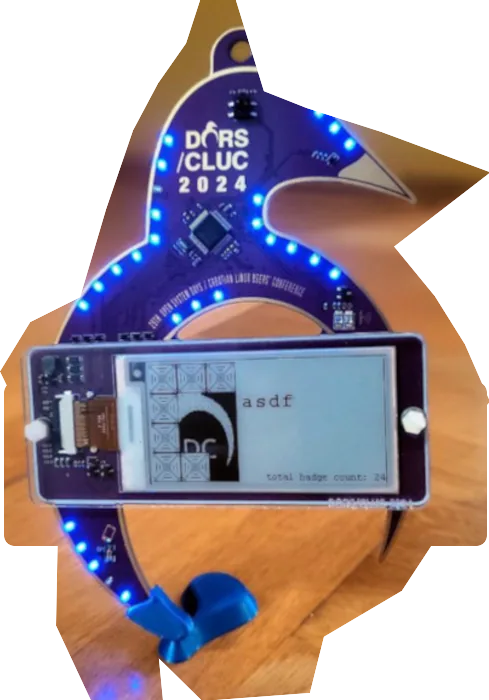
DORS/CLUC 2024's badge uses STM32L431, a raw Waveshare 2.66 inch monochrome e-paper display with driving circuitry on the PCB, two AA batteries, ambient light sensor, IR transmitter and receiver, touch sensor, blue LED matrix, voltage supervisor, and 32.768 kHz RTC crystal, as documented in the design writeup.
Firmware was written in C with STM32CubeIDE, used Waveshare e-paper driver code, and implemented Manchester-encoded IR and light-sensor configuration protocols. A static web UI encoded configuration by flashing full-page colors for the badge's light sensor.
The designer explicitly framed it as the first electronic badge for DORS/CLUC. The hidden-image quest turned the badge into a social prompt, while the writeup also preserves practical firmware pain around phone-display differences and light-sensor decoding.
Lifecycle
Each badge periodically transmitted a unique IR code and listened for other badges; seeing twelve special speaker/organizer badges unlocked parts of a hidden image.
SourceA static web page encoded settings by blinking full-page colors that the badge decoded through its ambient light sensor.
SourceThe 2024 badge released KiCad, firmware, web configuration, production data, and a programming-jig model, with CERN-OHL-P-2.0 hardware and MIT firmware licensing.
SourceOperational history
The public badge page, image archive, and API point at a real badge photo with source URL, license basis, attribution, and documentary processing notes preserved.
The source documents the practical edge case and mitigation: slowing down the transmission speed helped on some devices.