Sephiroth storm
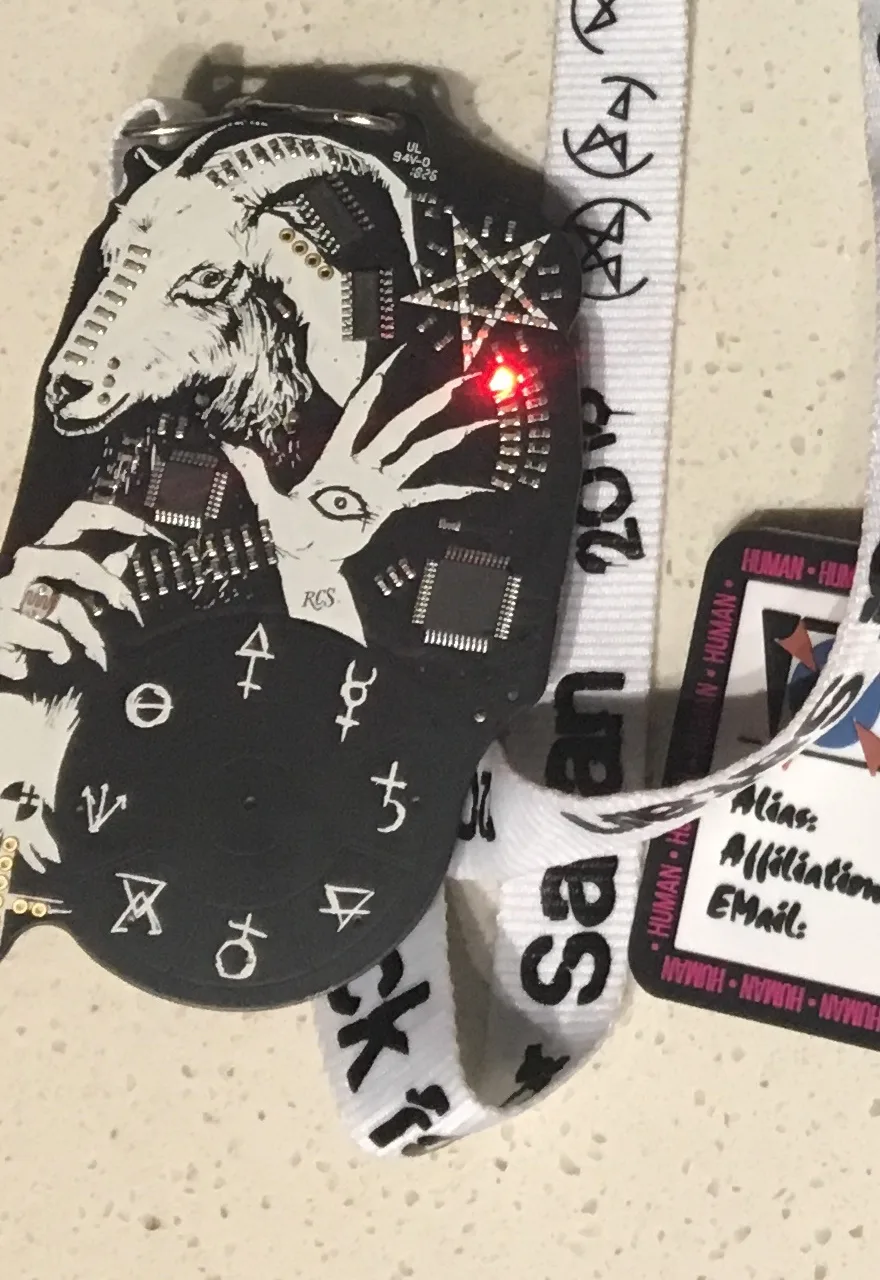
Wikimedia Commons identifies Sephiroth storm as author of the HackerCon Badges.jpg documentary photo used for the AND!XOR DC26 crop and licenses it under CC BY-SA 4.0.
SourceDEF CON 26 · United States · 2018
Unofficial DEF CON 26 ESP32-WROVER Wild West of IoT badge
The AND!XOR DC26 Badge was an unofficial DEF CON 26 badgelife board themed as the Wild West of IoT, built around an ESP32-WROVER module with WiFi/Bluetooth, a color LCD, microSD, IS31FL3736-driven RGB lighting, CP2102N USB serial, LULZCODE scripting, the B.E.N.D.E.R. console challenge, and badge-to-badge networking ambitions.
People
Wikimedia Commons identifies Sephiroth storm as author of the HackerCon Badges.jpg documentary photo used for the AND!XOR DC26 crop and licenses it under CC BY-SA 4.0.
SourceAuthor of the Hackaday hands-on source used for ESP32-WROVER, WiFi/Bluetooth, mesh/botnet, USB serial, GreenPAK, and LED-driver corroboration.
SourceThe retrospective credits Doc from the Packet Hacking Village with the western-themed design help that shaped the DC26 badge art.
SourceProject identity behind the DC26 Wild West of IoT badge, Hackaday.io project page, logs, and public badge-game documentation.
SourceHackaday.io lists Andrew on the AND!XOR DC26 Badge project team.
SourceHackaday.io lists bitstr3m on the AND!XOR DC26 Badge project team.
SourceHackaday.io lists Hyr0n on the project team and attributes the ARG and LULZCODE logs to Hyr0n.
SourceHackaday.io lists Zapp on the project team and attributes the DC26 retrospective to Zapp.
SourceIt continued AND!XOR's DC24/DC25 unofficial badge lineage into the DEF CON 26 year, moving from the DC25 nRF52/BLE platform to ESP32-WROVER so the team could support more RAM, a faster display path, LULZCODE, a richer serial adventure, and a more elaborate public badge-game surface.
The badge uses an ESP32-WROVER module, ISSI IS31FL3736 LED driver, CP2102N USB-to-UART bridge, switch hardware, and hackable dev-board framing in a DEF CON 26 Las Vegas context, per the project page. The retrospective describes a 220x176 color LCD, 40 MHz SPI and SD-card paths, ESP32-WROVER external RAM for LULZCODE and double-buffered display behavior, 31 RGB LEDs plus screen LEDs driven by the IS31FL3736, CP2102N micro-USB serial access, two-AA power, Skyworks AAT1217 boost regulation, and SAO/add-on work.
The B.E.N.D.E.R. text-adventure challenge ran over a USB serial console using ESP-IDF console tooling, with LULZCODE as a LOLCODE-derived microcontroller scripting layer, WiFi/Bluetooth and badge-to-badge network goals, badge actions that affect files, LEDs, screen animations, packets, and hardware interfaces, plus hardware, reversing, cryptography, and wireless challenge areas, per public logs.
The retrospective says the team wanted stronger manufacturing, a more ambitious design, add-ons, learning value, and a badge that made people ask what they were seeing. The resulting Wild West of IoT badge wrapped Bender-themed art and a social hacking challenge around serial-console play, with the team later noting that participants solved large parts of the game collectively but not enough individuals teamed up to finish it during the event.
Lifecycle
The ARG and retrospective logs describe the Badge Enabled Non Directive Enigma Routine as a serial text-adventure challenge spanning hardware hacking, reverse engineering, cryptography, wireless capture, badge actions, and social collaboration.
SourceThe retrospective and Hackaday review describe the switch from WS2812B pixels to an IS31FL3736 common-anode RGB LED driver controlling 31 RGB LEDs plus screen LEDs around the Bender eye artwork.
SourceThe LULZCODE log describes a LOLCODE-derived badge language extended for microcontroller peripherals, with high memory usage that drove the ESP32-WROVER external-RAM choice.
SourceThe retrospective and Hackaday review document the micro-USB CP2102N path used to expose the serial console for the B.E.N.D.E.R. game after the DC25 wireless terminal experience.
SourceThe retrospective documents the 220x176 LCD upgrade, 40 MHz SPI and SD-card behavior, double-buffered display goals, and reduced frame-rate decisions caused by SD-card constraints.
SourceThe project page and retrospective document the move to ESP32-WROVER for WiFi/Bluetooth, external RAM, LULZCODE memory needs, and faster display/SD-card paths after the DC25 BMD-300 badge.
SourceOperational history
The catalogue records the ESP32-WROVER migration as a deliberate capability upgrade while preserving the team's documented engineering tradeoffs.
The software record describes the intended and observed challenge surface without implying a completed public solve path for every attendee.
The entry now has a real rights-cleared documentary-photo derivative with source URL, license, attribution, and processing notes instead of generated, placeholder, article, project-gallery, or social-media imagery.
The record cites project-owner logs and hands-on technical coverage while avoiding stronger open-source hardware/software claims until a repository or archive mirror is recovered.
The compendium preserves the community hardware lineage without confusing it with the official DEF CON 26 text-adventure badge.
