OzmoOzmo
The commit-pinned README names the OzmoOzmo GitHub account as the badge project's author and publishes the project documentation, photo, and post-event source archive.
SourceWomen's International Cybersecurity Challenge 2026 · Ireland · 2026
Maker-documented ESP CTF challenge badge
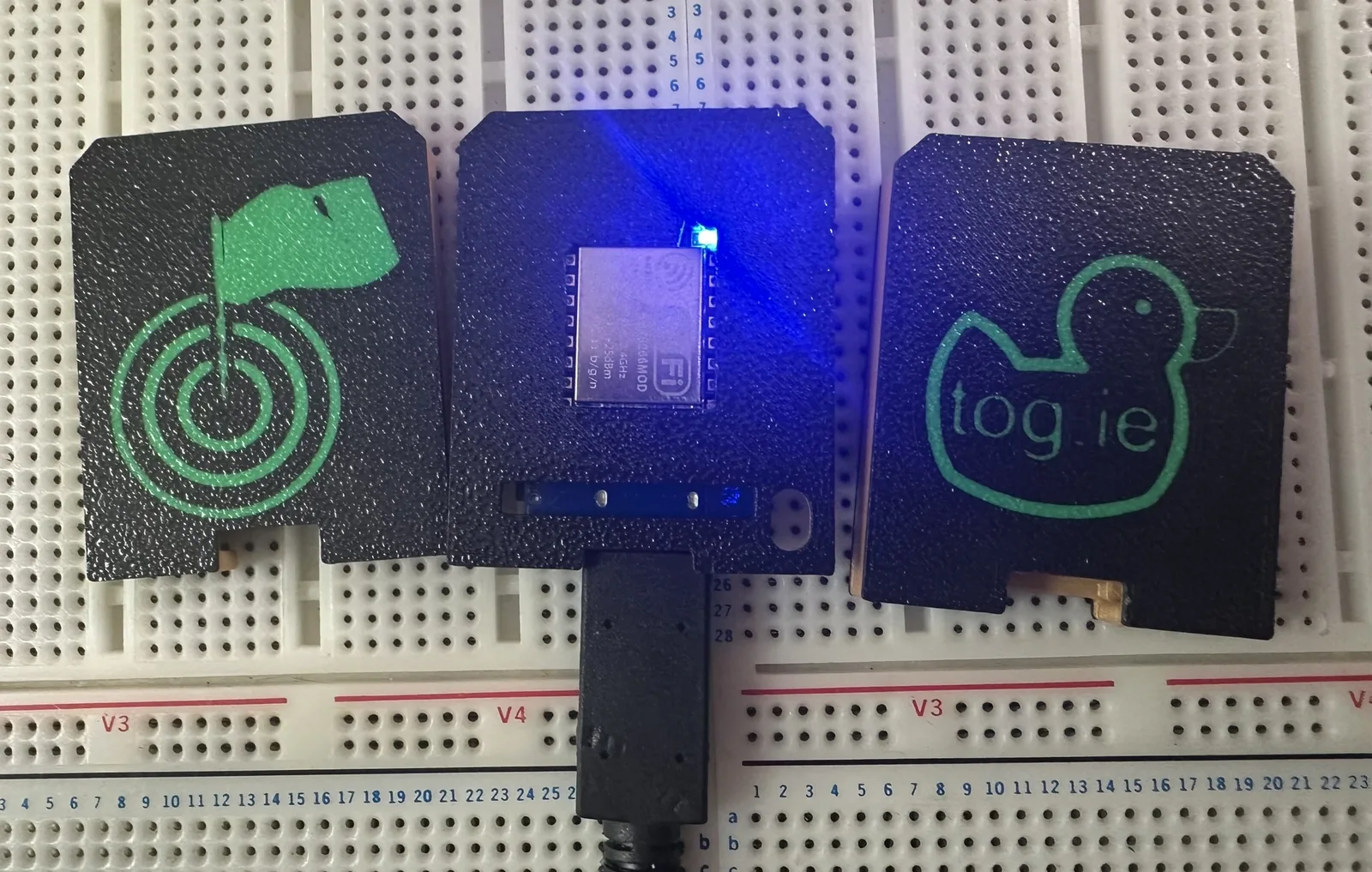
A public maker archive explicitly titled Women's International Cybersecurity Challenge Badge 2026 links itself to WICC and documents a hackable serial-CLI CTF badge with ESP8266 and ESP32 target trees, challenge activities, a two-part protective case, and a repository photo of a physical cased device. WICC's official site and Cyber Ireland's post-event recap confirm the completed July 9-10 Dublin competition, but neither organizer source names this exact project. TOG separately reports building 15 ESP8266 hardware flags for the same CTF without identifying them as this archive, so this is a maker-documented event-linked electronic badge—not an organizer-issued credential, general attendee badge, or claim of equivalence to the flags.
People
The commit-pinned README names the OzmoOzmo GitHub account as the badge project's author and publishes the project documentation, photo, and post-event source archive.
SourceThe official WICC event site and post-event Cyber Ireland recap establish the completed competition context. This is not asserted as a badge-design, manufacture, allocation, or image-reuse credit.
SourceIt adds a carefully bounded Irish competition badge with a public post-event maker archive and a rights-cleared original image, while retaining the critical distinction between a maker-declared WICC association, a completed event, and unproven organizer ownership, allocation, or final unit configuration.
The maker README says its PlatformIO C++ project targets ESP8266 / ESP32 badge hardware, says an ESP32 version is available, and presents a photo of a cased device. It describes the case as protecting the electronics and coming in two halves. The public material does not map a particular ESP8266 or ESP32 configuration, board, PCB, component list, power source, battery, display, sensor, radio configuration, enclosure material, manufacturing process, production count, or final event unit to WICC recipients.
The source archive describes an interactive serial CLI, CTF-style activities, hidden strings, manual-entry flags, games/puzzles, Wi-Fi scan and captive-portal activities, and a badge-to-badge ransom mechanic. It is built with PlatformIO in C++ and says source was intentionally kept offline until after the conference. This catalogue records the high-level public software surface only, not operating instructions, credentials, flags, exploits, challenge solutions, connection details, recovery procedures, or a claim that the public tree exactly matches every event device.
WICC's inaugural Dublin event combined international teams with advanced CTF areas including hardware security. The maker's README gives OzmoOzmo authorship and thanks TOG hackers and makers for beta testing. TOG's own post-event account independently documents a distinct contribution of 15 ESP8266 hardware flags in custom cases for the competition; it does not say those devices were this badge project. The lineage therefore preserves both source trails without merging their provenance.
Source-backed hardware metadata
Structured technical signals seeded from public badge documentation, repositories, schematics, firmware notes, or event evidence. These fields are designed for filtering, API use, repair planning, preservation, and future Companion Gear matching.
The maker README explicitly identifies a WICC 2026 conference badge and describes ESP8266 / ESP32 target hardware and an interactive serial CTF platform; organizer issuance, final configuration, and recipient allocation remain unresolved.
Signal sourceLifecycle
Operational history
The catalogue records the documented electronic CTF platform without inventing a universal configuration, quantity, delivery outcome, or attendee credential role.
The record is an event-linked maker badge and must not be read as a WICC organizer-issued credential, sponsor deliverable, official hardware programme, or attendee-wide handout.
The record preserves related physical-hardware context without merging separate maker provenance, hardware counts, designs, allocations, or authorship into one unsupported badge claim.